Build vs Buy AI: How a Small Business Should Decide
For most small and mid-sized businesses, the answer is to buy first, customize second, and build only when the AI capability is the thing that sets you apart. Buying gets you running faster and with less risk. Building makes sense when no vendor product fits your process or when the capability is a core competitive advantage. Either way, the choice is not only about cost. It is about who holds your data, who is accountable when the system fails, and who keeps it running a year from now.
If you run a business, here is the uncomfortable truth: the AI tool is rarely the weak link. Your data handling, your access controls and your vendor contracts are. We see that pattern in security work every week, and it shapes how we advise on this decision.
Table of Contents
TL;DR
- Buy for generic jobs (email drafting, meeting notes, support chat, document search) where speed and proven capability matter most.
- Boost a purchased tool with your own data when accuracy on your content matters, and expect higher usage costs.
- Build only when the capability gives you a real edge and you can pay for specialist talent, data preparation and ongoing maintenance.
- Whatever you pick, settle data ownership, access and compliance (HIPAA, FTC Safeguards Rule) before launch, not after.
- Score the decision on paper first: bottleneck, data sensitivity, skills, budget, and exit plan.
Table of Contents
- What build vs buy actually means
- What building costs, and what people forget
- Speed, skills and lock-in
- What the success data says
- When each path fits
- A scoring method you can run in an afternoon
- Security, privacy and governance checks
- Why the hybrid path wins for many small businesses
- Our perspective
- How we can help
- FAQ
- Sources
What build vs buy actually means
The terms get used loosely, so here is the working vocabulary. MIT Sloan describes three paths for generative AI: buy, boost and build.
- Buy: you adopt an off-the-shelf solution. The vendor provides, runs and maintains the model. Adoption is quick, pricing is typically based on use, and the tool is often geared to a narrow context.
- Boost: you enhance a vendor’s solution with your own proprietary data. Results become more accurate and relevant, but usage costs rise.
- Build: you take full responsibility for developing, running and maintaining a custom solution. You get complete control and a chance to differentiate, but it is expensive, difficult and demands significant upfront computing investment.
For a ten-person dental office or a 60-person CPA firm, “build” rarely means training a new model from scratch. More often it means wiring an existing model into your own systems with custom logic around it. That middle ground matters, and we come back to it below.
What building costs, and what people forget
The headline numbers depend heavily on what you call “building.”
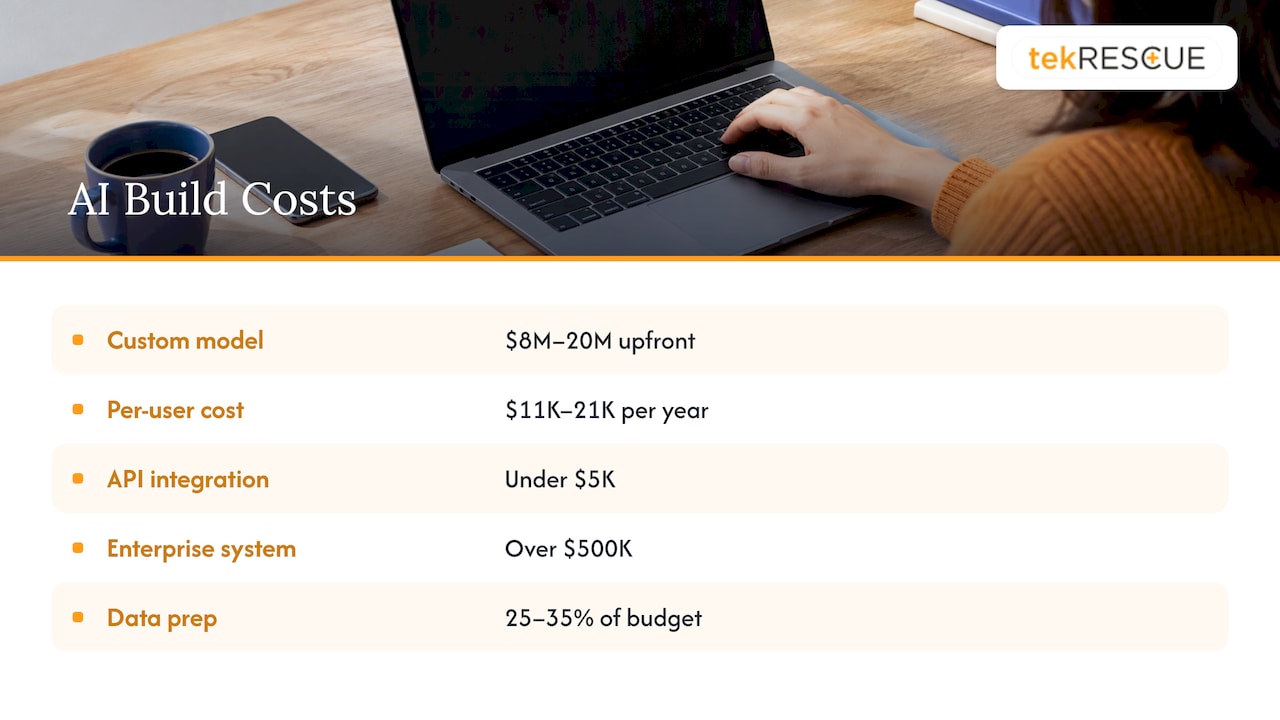
At the extreme end, Gartner estimates that building a custom model from scratch costs $8 million to $20 million up front, with ongoing expenses of $11,000 to $21,000 per user per year. That is an enterprise number. It is not your number, and it is not the choice in front of you.
At the practical end, one 2026 cost guide reports that lightweight API integrations can start below $5,000, while complex enterprise systems often exceed $500,000. That range is wide because the work is wide. A chatbot that answers questions from your service pages is a different animal from a system that reads invoices, matches them to purchase orders and posts them to your accounting platform.
The line items that surprise owners are the ongoing ones. The same guide notes that data preparation consumes 25% to 35% of an AI project budget, and that running costs include monitoring, retraining, infrastructure and human oversight. Cleaning up years of inconsistent customer records is not glamorous, and it is where many projects stall.
Buying has its own recurring costs: subscriptions, per-seat or per-use fees, and the staff time to manage the vendor. Those are easier to forecast, which is a real advantage for a small budget.
Speed, skills and lock-in
HP’s decision framework puts typical time to value at 3 to 9 months for buying versus 12 to 24 months for custom builds. Treat those as enterprise-scale ranges. A small business can move faster on a narrow use case, but the ratio holds: buying is quicker.
The skills differ too. Building calls for specialist talent such as data scientists and ML engineers, plus ongoing resources for maintenance and updates. Buying calls for vendor-management skills: reading contracts, reviewing security terms, tracking renewals and pricing changes.
The tradeoff of buying is limited customization and the risk of vendor lock-in. You manage that risk with contract terms, not by avoiding vendors:
- Ask how you export your data and prompts if you leave.
- Keep a copy of your own knowledge base outside the vendor’s platform.
- Avoid building critical workflows that only one vendor’s proprietary features can run.
What the success data says
Two data points are worth knowing, with the right amount of skepticism.
Reporting on MIT NANDA research suggests that internally built systems succeed about 33% of the time, while vendor-purchased tools succeed roughly 67% of the time. The same coverage notes Gartner’s prediction that over 40% of agentic AI projects will be canceled by the end of 2027 because of escalating costs, unclear business value and inadequate risk controls.
The lesson is not that building is doomed. It is that unfocused projects die. Assaf Melochna of Aquant put it plainly in Communications of the ACM: if you are not focused or aligned with business objectives, you will not solve your problems or get a good return on investment. “We need to do something with AI” is not a project. A named bottleneck with a number attached is.
When each path fits
TechTarget’s CIO decision matrix draws the line clearly: buy for generic use cases where speed and proven capability matter, build when existing solutions cannot meet specific requirements or the capability creates competitive advantage, and combine both with a hybrid. Guidance it cites from EY and McKinsey frames the decision as strategic rather than technical: if a capability is a commodity, buy it; if it is core differentiation, lean toward building the data and intelligence layers.
Here is how that translates for a small business.
| Situation | Likely path | Why |
|---|---|---|
| Meeting summaries, email drafts, internal Q&A | Buy | Commodity task, speed matters |
| Support answers based on your own documents | Boost | Needs your content for accuracy |
| Intake, quoting or billing across two or three systems | Hybrid | Standard AI engine, custom workflow logic |
| A pricing or scoring method that is your competitive edge | Build (or build the custom layer) | The logic is your differentiator |
| Regulated data such as patient records | Buy or hybrid with compliance review first | Contracts and safeguards come before features |
Our 5 SMB workflows you can automate with custom AI models walks through the kinds of repetitive processes where a hybrid approach tends to pay off.
A scoring method you can run in an afternoon
There is no need for a 40-page study. Gather the people who run the process and walk through these steps.
- Name the bottleneck with a number. “Our front desk spends about ten hours a week re-keying intake forms” qualifies. “We should use AI more” does not. If you cannot finish the sentence, you are not choosing between build and buy yet. You need an assessment first.
- Check whether a product already does it. Search for tools aimed at your industry. If a purchased tool covers 80% of the need, start there.
- Rate how sensitive the data is. Client financials, patient information and confidential contracts raise the stakes for every option. Our guide on implementing AI without exposing confidential business data covers the controls to put in place.
- Ask whether the capability is your edge. If customers choose you because of how you do this task, it deserves custom work. If every competitor does it the same way, buy.
- Be honest about skills. Who will own this in month 13? If the answer is “the one person who built it,” you have a continuity risk.
- Price the run, not just the launch. Include data preparation, monitoring, retraining, subscriptions and oversight time.
- Pilot small, with a stop rule. Pick one workflow, one team, a clear success measure and a date to decide whether to expand or end it. Our 90-day AI pilot approach for small business is built around this idea.
Give each factor a score from 1 to 5 for “favors buy” versus “favors build,” weight the ones that matter most to you, and look at the pattern. If the scores are close, take the hybrid.
One more point on the edge question. Deciding whether AI is a core capability or a standard business need is often the hardest step, and for a small company it helps to look at what custom AI tools for workflow automation actually do in practice before committing budget.
Security, privacy and governance checks
This is where our brand voice gets serious, because it is where small businesses get hurt. Buying a tool does not transfer your responsibility for the data you put into it.
NIST guidance notes that governance should address the full product lifecycle, including legal and other issues with third-party software, hardware and data. In practice, before you sign:
- Where does the data live? At an FTC summit on AI, a panelist described the core privacy question as whether the data sits on a computer you own or on someone else’s. Panelists also discussed uncertainty about underlying models and data sub-processors. Ask your vendor who the sub-processors are.
- Is your data used to train the vendor’s models? Get the answer in writing.
- Who can access what? Apply least privilege. An AI assistant connected to your whole file server can read everything its user can read.
- What is the incident plan? If the vendor is breached, what do they tell you, and how fast?
- Can you exit? Confirm how data is returned and deleted.
For a deeper look, see our pieces on AI data privacy for US professionals and what businesses need to know about data privacy and AI.
Healthcare and protected health information
If you handle protected health information, the decision has an extra gate. HHS guidance on cloud computing says a covered entity or business associate must enter a HIPAA-compliant business associate agreement with a cloud service provider that creates, receives, maintains or transmits ePHI. It must also conduct its own risk analysis of the cloud environment and make sure the provider meets applicable Security Rule requirements. HHS also states that the provider is directly liable for applicable HIPAA requirements.
In plain terms: if a vendor will not sign a BAA, that tool does not touch patient data. Our guide on what a business associate agreement must cover under HIPAA lists the terms to look for. Your compliance officer or a HIPAA attorney should confirm the final agreement for your situation.
Why the hybrid path wins for many small businesses
Build versus buy is a false binary for most companies under 200 people. The practical pattern is this: buy the engine, build the plumbing. You license a mature model or platform for the heavy lifting, then add custom pieces that are specific to you: connections to your CRM or practice management system, rules for what the AI may and may not do, approval steps where a human checks output, and logging so you can see what happened.
This keeps your differentiation in the layer you control while letting a vendor carry the model maintenance. It also limits lock-in, because your workflow logic and data prep belong to you.
People are part of the build, too. Tools nobody trusts do not get used, so plan training and communication. Our practical plan for AI change management covers that side, and why AI is essential for business process automation explains where the gains tend to show up.
Our perspective
We get asked this question by owners who feel pressure to “do something with AI” and are afraid of either wasting money or falling behind. Both fears are reasonable. Our answer is almost always the same: start with the business problem, then pick the least risky path that solves it.
For most small and mid-sized businesses, that means buying a proven tool or a hybrid, wrapped in the security and compliance controls that the tool itself will not give you. We work on managed IT, cybersecurity, HIPAA and FTC Safeguards Rule compliance, and AI consulting, so we look at the decision from the infrastructure side. Your AI is only as safe as the network, identities and data stores around it. That is the real weak link, and it is the part we can help you get right.
Custom building has its place. When a workflow is truly yours, a tailored layer on top of a vendor platform can be worth the investment. We would rather help you scope that carefully, with a pilot and a stop rule, than sell you a sprawling project. Move fast, but do not let a machine that works at speeds no human can match touch data you have not classified.
Randy Bryan
How we can help
If you are weighing build, buy or hybrid, our Strategic AI Consulting helps you score the options against your goals, data and budget before you spend. If the data in play is sensitive, a cybersecurity risk assessment shows where your environment stands first, and our managed IT services keep the underlying systems maintained. We work with businesses across Austin, San Marcos, Kyle, New Braunfels and the surrounding Central Texas area.
FAQ
What is build vs buy for AI?
It is the choice between developing and running your own AI solution (build) or adopting a vendor’s ready-made one (buy). A third option, boost, adds your own data to a vendor’s tool. Most small businesses end up with buy or a hybrid.
How much does it cost to build AI?
It depends on scope. One 2026 cost guide puts lightweight API integrations below $5,000 and complex enterprise systems above $500,000. Building a model from scratch, per Gartner’s estimate, runs $8 million to $20 million up front. Budget also for data preparation, monitoring and retraining.
Which AI is better to buy?
The better product is the one that fits a specific, named task, signs the agreements your industry requires, and tells you plainly how it handles your data. Start from the bottleneck, then compare tools on security terms, data use, integrations and exit options.
Can a healthcare practice use a purchased AI tool with patient data?
Only if the provider will sign a HIPAA-compliant business associate agreement and you have done your own risk analysis of how the tool handles ePHI. Without a BAA, keep patient information out of the tool. Your compliance officer or attorney should review the final terms.
Is it ever smart to build AI in-house?
Yes, when existing products cannot meet your requirements or the capability is your competitive edge, and you can fund the skills and upkeep. Many companies build only the custom layer on top of a vendor platform.
Sources
- Buy, boost, or build? Choose your path to generative AI, MIT Sloan
- GenAI: The Buy vs. Build Solution, Communications of the ACM
- How Much Does AI Cost? The Complete Guide For 2026, CloudZero
- Enterprise AI Services: Build vs. Buy Decision Framework, HP
- The Build-vs-Buy Shift, Forkast
- Build vs. buy AI: A CIO’s decision matrix, TechTarget
- NIST remarks on product lifecycle governance
- FTC Tech Summit on Artificial Intelligence quote book
- Guidance on HIPAA and Cloud Computing, HHS
Recommended
Table of Contents