
Data Quality for AI: A Practical Readiness Guide for SMBs
AI is only as reliable as the data you feed it. If your records are duplicated, outdated, scattered across systems or undocumented, an AI tool will produce confident answers built on bad inputs. Data readiness for AI means your data is accurate, complete, consistent, current, documented and protected before any model touches it.
If you run a business, here is the uncomfortable truth: most AI projects do not stall on the model. They stall on the data underneath it. This guide shows what “good enough” looks like, how to check where you stand, and what to fix first.
Table of Contents
TL;DR
- Data quality means data that is fit for a specific use. A file can be fine for invoicing and useless for an AI forecast.
- Poor inputs make AI unreliable. The U.S. GAO has said so plainly in its work on fraud detection and AI.
- Document where your data came from, who changed it and how reliable it is. Skipping this step hurts most later.
- Keep a human checking AI output against ground truth. Fast is not the same as correct.
- Regulated businesses, especially healthcare practices, must treat data quality and data security as one project.
Table of Contents
- What data quality means when AI is involved
- Why bad data breaks AI
- The dimensions to measure
- Provenance: the step most teams skip
- Keep a human in the loop
- Healthcare and regulated data: a higher bar
- A readiness check you can run in a week
- Security is part of data quality
- Our perspective
- How tekRESCUE can help
- Common mistakes to avoid
- FAQ
- Sources
What data quality means when AI is involved
Traditional data quality asks whether a report is right. AI data quality asks a harder question: will a system that learns patterns from this data, and then acts on them, behave correctly?
The National Institute of Standards and Technology puts it simply in a data governance profile concept paper: data quality is critical to making sure organizational data assets are fit for purpose, and poor quality can hurt an organization’s ability to manage cybersecurity, privacy and AI risks. Notice the three risks in that sentence. Quality is not only an analytics problem. It is a security and privacy problem too.
Two ideas matter most:
- Fit for use. Quality is always relative to a task. Customer addresses that are good enough for mailing may be too messy to train a model that predicts churn.
- Scale of consequence. A person skims a bad spreadsheet and senses something is off. A machine does not. It moves at a speed humans cannot match, and it repeats an error thousands of times before anyone looks.
Why bad data breaks AI
The federal government has run into this problem at scale. A GAO report on fraud and improper payments describes data quality and a skilled workforce as essential for unlocking the benefits of AI. It notes that AI tools can sift large volumes of data for anomalous patterns, but they require error-free, unadulterated data, which can be hard to come by. GAO followed up with a January 2026 update that repeats the same message.
Your business is smaller, but the mechanics are identical. Think of three common failures:
- Stale records. A sales-forecast model trained on customer data that was last cleaned two years ago will recommend outreach to people who have moved, closed or churned.
- Inconsistent definitions. If one system counts a “customer” as anyone who ever bought and another counts only active accounts, an AI assistant will give different answers to the same question depending on where it looks.
- Unrepresentative samples. If your data only covers one kind of client, the model learns only that world and fails quietly outside it.
None of these requires a sophisticated attacker or a flawed algorithm. They are ordinary housekeeping problems that AI amplifies.
The dimensions to measure
You cannot improve what you have not defined. Health IT is a field where this has been formalized. The Office of the National Coordinator for Health IT describes data quality as fitness for use in a specific context, measured by dimensions including accuracy, completeness, concordance, consistency, currency and redundancy. Those translate well to any small business.
| Dimension | The question to ask | Typical small-business symptom |
|---|---|---|
| Accuracy | Does the value match reality? | Wrong phone numbers, mistyped prices |
| Completeness | Are required fields filled in? | Leads with no source, patients with no insurance field |
| Consistency | Do systems agree with each other? | Billing and CRM show different customer names |
| Currency | Is it up to date? | Contacts and statuses not touched in years |
| Redundancy | Is the same thing stored twice? | Three records for one client |
| Concordance | Do values agree with a trusted standard? | Free-typed service names instead of a fixed list |
Pick the two or three dimensions that matter most for your first AI use case. Do not try to score everything at once.
Provenance: the step most teams skip
The most overlooked task is recording where data came from. Provenance means knowing the origin of each dataset, how it was collected, who has edited it and how much you trust it.
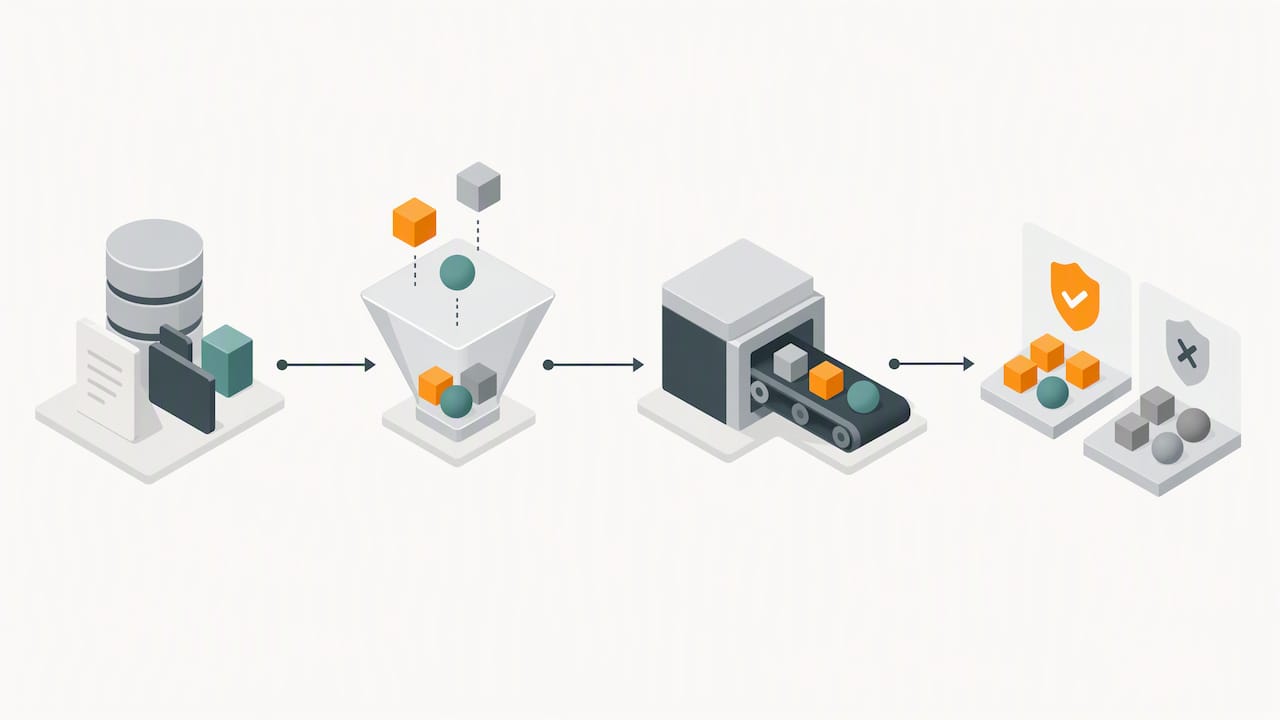
The NIST paper above frames data quality as part of responsible AI, alongside human-centricity and documented rationale for data processing decisions. GAO makes a parallel point in its review of DHS’s use of AI for cybersecurity: the agency’s public inventory of AI use cases included a cybersecurity case that was not AI at all. If an organization cannot even characterize what it is running, it cannot account for what the system was fed.
Without provenance, a model’s outputs become a black box. When it produces a biased or wrong result, you cannot trace why. For a healthcare practice, that is also a compliance exposure, because you need to show what happened to protected information and where it went.
A lightweight provenance record needs only five items per dataset:
- Source system and owner
- Date range covered
- How it was collected or imported
- Known gaps or errors
- Who is allowed to see it and why
A shared spreadsheet is enough to start. A perfect catalog that never gets filled in helps nobody.
Keep a human in the loop
Many owners fall for the “end-to-end AI” trap, the belief that automation will clean up messy data by itself. It will not, and it can make things worse. If an AI tool merges records incorrectly and nobody checks, you have corrupted your own source of truth at a speed you cannot manually undo.
GAO’s report on AI uses and risks for small business contracting records concerns from panelists and officials about the data sources behind AI tools. That is a useful reminder for private firms too: ask what a tool was trained on and what it will do with what you give it.
For small and midsize businesses, the practical approach is usually to use established, commercially available AI tools for cleanup tasks like deduplication and formatting, then put a person in charge of validating the results. Build these habits:
- Sample before you accept. Review a random set of changed records, not just the ones that look obviously right.
- Compare against ground truth. Check a handful of outputs against source documents, invoices or signed forms.
- Keep the original. Never let a cleanup tool overwrite the only copy. Back up first.
- Watch for automation bias. The more polished the output looks, the more people trust it. Name one person responsible for saying “this is wrong.”
This is not a one-time cleaning event. It is a persistent operational job, and it should have an owner and a schedule.
Healthcare and regulated data: a higher bar
If you run a medical, dental or behavioral health practice, data quality and compliance overlap. Two points are worth knowing.
First, standardizing the structure of data is not enough. You also need to standardize its meaning. ONC’s own survey findings illustrate the gap: preliminary results from 2022 laboratory interoperability surveys showed that only 1 in 5 hospital laboratories used LOINC for issuing orders and 2 in 5 used it for reporting results. Where codes differ, data does not line up, and AI built on top of it inherits the mismatch.
Second, the standards baseline is moving. Under the HTI-1 final rule, ONC set USCDI Version 3 as the baseline for certified health IT as of January 1, 2026, and created transparency requirements for AI and predictive algorithms in certified health IT. If your electronic health record vendor is certified, ask how they handle these requirements before you connect any AI tool to it.
For practices, this means siloed records that give an incomplete picture of a patient are a quality problem, a clinical risk and, depending on how they are handled, a HIPAA problem. Our own guidance on AI for healthcare compliance walks through making AI use audit ready.
A readiness check you can run in a week
You do not need a data science team. Work through these steps with whoever knows your systems best.
- Choose one use case. Examples: answering customer questions, summarizing support tickets, forecasting demand, drafting reports. Readiness is judged against a task.
- List the data it needs. Name every system involved: accounting, CRM, email, practice management, shared drives.
- Score each source. Use the dimensions in the table above. Mark each green, yellow or red. Be honest.
- Find the sensitive material. Mark anything containing personal, financial or health information. This decides what may go into an outside AI tool at all. Our piece on implementing AI without exposing confidential business data covers the controls.
- Fix the reds first. Deduplicate, standardize naming, fill critical fields and retire stale records.
- Write the provenance notes. Five lines per dataset, as above.
- Pilot small with review. Run the tool on a limited slice, check results against ground truth, then expand. Our guide to piloting three workflows to prove AI ROI shows how to scope that.
- Set a review rhythm. Monthly or quarterly, re-score the sources. Data decays.
Security is part of data quality
Data you cannot trust is a liability. Data that someone else can alter is worse. If an attacker, or a careless integration, can change records, your model learns from poisoned inputs, and you may not notice for weeks.
That is why the same controls matter for both goals: access limited to who needs it, encryption, tested backups, logging of who changed what, and a response plan when something goes wrong. If you are building out governance, our 90-day AI data governance approach for SMBs maps these controls to NIST and ISO frameworks, and our overview of AI data privacy obligations covers what U.S. professionals should do now.
Our perspective
We see the same pattern with small businesses and practices around Austin and San Marcos. Someone wants an AI assistant by next month. Nobody has asked where the customer list lives, who edits it, or whether the files on the shared drive are the current versions.
Our view is blunt. The weak link is rarely the model. It is your infrastructure and your habits: unmanaged file shares, inconsistent systems, accounts nobody reviews, backups nobody has tested. Those are the things attackers exploit, and they are the same things that make AI results unreliable.
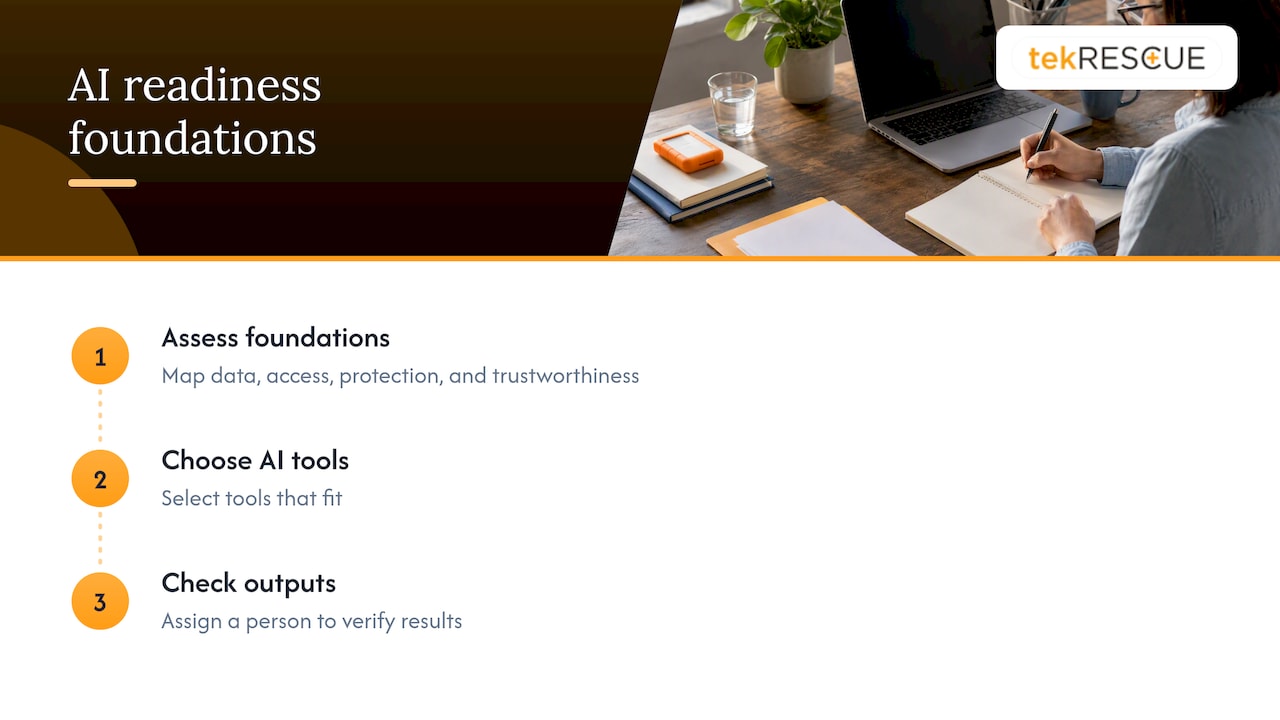
So we start with the foundations. We look at where your data sits, who can reach it, how it is protected and whether it is trustworthy enough for the task. Then we choose AI tools that fit, with a person accountable for checking the output. It is less exciting than a demo. It is also what keeps a pilot from turning into an incident.
If an AI vendor tells you your data does not need preparation, ask them who is responsible when the output is wrong.
— Randy Bryan
How tekRESCUE can help
We help small and midsize businesses, healthcare providers and professional firms get their environment ready for AI. That includes strategic AI consulting to choose a first use case and scope it sensibly, a cybersecurity risk assessment to find where your data is exposed, and managed IT services to keep systems, access and backups under control once the work is done. Healthcare practices can also talk to us about HIPAA compliance through our main site.
Common mistakes to avoid
- Cleaning once and calling it done. Data degrades the moment you stop watching it.
- Pasting sensitive records into a public chatbot to see what happens. Decide what is allowed before anyone experiments.
- Buying a tool before choosing a task. The task defines the quality bar.
- Ignoring meaning. Matching file formats is easy. Agreeing on what “active client” means is the hard part.
- Trusting the tool’s confidence. Polished output is not verified output.
FAQ
What does “AI-ready data” mean?
It means data that is accurate, complete, consistent and current enough for a specific task, documented well enough that you can trace its origin, and protected well enough that only the right people and systems can reach it. Readiness is always measured against a use case, not in the abstract.
Do I have to clean all my data before using AI?
No. Clean the data that feeds your first use case, then expand. Trying to fix everything at once is the quickest way to stall a project. Start with one process, measure the results and let that guide the next round of cleanup.
Can AI tools clean my data for me?
Often, for tasks like deduplication and formatting, but not unsupervised. Use established tools, back up the original data and have a person check a sample of the changes against source documents. Errors fixed at machine speed can also be introduced at machine speed.
Why does provenance matter for HIPAA?
When protected health information is involved, you need to know where it came from, where it went and who touched it. Without that record you cannot explain an AI output or demonstrate control of the data. Talk to a qualified compliance professional about what your practice must document.
Sources
- NIST Data Governance and Management Profile Concept Paper
- GAO: Fraud and Improper Payments, Data Quality and a Skilled Workforce (2025)
- GAO: Fraud and Improper Payments, Realizing AI’s Benefits (2026)
- GAO: Responsible Use of AI for Cybersecurity at DHS
- GAO: AI Uses and Risks for Small Business Contracting
- ONC: Special Emphasis Notice on FHIR and USCDI Data Quality
- ONC: HTI-1 Final Rule
Recommended
Table of Contents