
FTC Safeguards Rule: Requirements and a Compliance Checklist
The FTC Safeguards Rule requires financial institutions under the Federal Trade Commission’s jurisdiction to run a written information security program that protects customer information. If your business handles customer financial data, you need a named Qualified Individual, a written risk assessment, encryption, multi-factor authentication, an incident response plan, and a way to notify the FTC when a breach hits 500 or more consumers. Many owners learn they are covered only after something goes wrong. We would rather you learn it now.
This guide explains what the rule is, who it covers, what it demands, and how to work through it in order. If you want the program built and maintained for you, tekRESCUE’s cybersecurity services include risk assessment and FTC Safeguards Rule work for small and mid-sized businesses.
Table of Contents
TL;DR
- The Safeguards Rule (16 CFR Part 314) comes from the Gramm-Leach-Bliley Act and covers non-bank financial businesses such as mortgage brokers, tax preparers, collection agencies and finance companies.
- You must have a written, risk-based security program with a Qualified Individual, encryption, multi-factor authentication, monitoring, training and vendor oversight.
- A security event involving unencrypted data of 500 or more consumers must be reported to the FTC within 30 days of discovery.
- Businesses holding data on fewer than 5,000 consumers are exempt from some of the heavier written requirements, but not from the program itself.
- Start with a written risk assessment. Every other control follows from it.
Table of Contents
- What the FTC Safeguards Rule is
- Who has to comply
- What the rule requires
- Reporting a breach to the FTC
- A practical compliance checklist
- Why owners struggle to do this alone
- Getting help with the program
- FAQ
- Sources
What the FTC Safeguards Rule is
Congress passed the Gramm-Leach-Bliley Act (GLBA) in 1999 to regulate how financial institutions handle privacy and data security. The law told the FTC and other agencies to set standards for administrative, technical and physical safeguards. The FTC issued the Safeguards Rule in 2002, and it took effect on May 23, 2003.
The rule is not new, but it is much stricter than it was. The FTC issued amended regulations on December 9, 2021, and most of the changes took effect on June 9, 2023. The older version asked for “reasonable” safeguards. The current version lists specific controls.
A breach-reporting amendment followed. The FTC announced in May 2024 that the notification requirement was in effect, covering breaches of at least 500 consumers’ information.
The text of the rule has not been rewritten since. What keeps changing is enforcement attention, state privacy laws and customer contracts that ask whether you comply. Treat the 2023 and 2024 requirements as the standard you will be measured against.
Who has to comply
The rule applies to financial institutions under FTC jurisdiction that are not regulated by another agency under the GLBA. The definition is based on what you do, not what you call yourself. According to the FTC’s business guidance, a financial institution is a business engaged in activities that are financial in nature or incidental to them.
The FTC’s examples include:
- Mortgage lenders and mortgage brokers
- Payday lenders and finance companies
- Account servicers and collection agencies
- Check cashers and wire transferors
- Credit counselors
- Tax preparation firms
- Non-federally insured credit unions
- Investment advisors not registered with the SEC
- “Finders,” which the 2021 amendments added
Law firm analysis also points to businesses significantly engaged in incidental financial activity, such as retailers that extend their own credit and dealers that lease vehicles for longer than 90 days. If you are an accounting practice, we cover the specifics in our guide on whether your CPA firm is compliant.
What about banks and healthcare providers?
Banks and other institutions with their own federal regulator follow that regulator’s version of the GLBA standards, not the FTC’s. Healthcare is a separate track. HHS explains that HIPAA applies to health plans, providers that conduct standard electronic transactions, clearinghouses and their business associates.
If you run a medical practice, your main obligation is the HIPAA Security Rule, and our page on the HIPAA Security Rule covers it. A practice that also does something financial, such as running its own consumer financing, should have that activity reviewed against the Safeguards Rule.
The 5,000-consumer exemption
The FTC has exempted institutions that keep customer information on fewer than 5,000 consumers from certain provisions. Those are the more documentation-heavy pieces: the written risk assessment, continuous monitoring or testing, the written incident response plan and the annual report to leadership. You still need a security program, a Qualified Individual and the core safeguards.
Count carefully. Customers include past clients whose files you still hold, not only current ones. A small firm with a decade of records can pass 5,000 without noticing.
What the rule requires
The program must be written and comprehensive. Under 16 CFR 314.3, it must contain administrative, technical and physical safeguards appropriate to your size and complexity, the nature and scope of your activities, and the sensitivity of the customer information you hold. A five-person tax practice and a regional lender do not need identical programs, but both need one.
The core elements sit in 16 CFR 314.4.
| Requirement | What it means in practice |
|---|---|
| Qualified Individual | One person (an employee or an outside provider) is responsible for running the program |
| Written risk assessment | Documented internal and external risks to customer data, with criteria to rank them |
| Access controls | Only people who need customer data can reach it |
| Data inventory | You know what data you hold, where it lives and what systems touch it |
| Encryption | Customer information is encrypted in transit and at rest, or you use approved compensating controls |
| Multi-factor authentication | Required for anyone accessing information systems |
| Monitoring and testing | Ongoing monitoring, or annual penetration testing plus periodic vulnerability scans |
| Training | Staff are trained on security and the people running the program stay current |
| Service provider oversight | You choose capable vendors, require safeguards by contract and check on them |
| Incident response plan | A written plan for responding to and recovering from security events |
| Board reporting | The Qualified Individual reports in writing at least annually to leadership |
The rule also covers secure disposal of customer information that you no longer need and change management for system updates. The regulation text is the authority on exact timing, so read it before you finalize policies.
The incident response plan
The plan has to be written, and it has to cover seven areas. Law firm analysis of the final rule lists them: the plan’s goals, internal response processes, roles and decision-making authority, internal and external communications, remediation, documentation and reporting, and post-event evaluation.
A plan that lives only in the IT person’s head fails this test. We lay out the first hours of a response in our data breach response checklist, and our incident response service is there for the moment it is needed.
Reporting a breach to the FTC
The rule uses the term “notification event.” It means unauthorized acquisition of unencrypted customer information. When a notification event involves at least 500 consumers, you must notify the FTC as soon as possible and no later than 30 days after discovery, using the FTC’s electronic form.
Three details trip people up:
- Discovery starts early. The event counts as discovered on the first day any employee, officer or agent knows about it, not the day management hears.
- Encryption matters. The trigger is unencrypted data. Properly encrypted data is a strong reason to build encryption in from the start.
- Law enforcement can ask for a delay. It can request up to 30 days, extendable up to 60 more, and you need its written determination on file.
The form asks for high-level information: your company name, the start and end dates of the event, the number of affected consumers, the types of information involved and a brief summary. According to the FTC’s guidance, staff will contact you if they need more.
The FTC is only one audience. Most states have their own breach notification laws, and your contracts may add duties. Your attorney should confirm what applies to you.
A practical compliance checklist
Work in this order. Each step feeds the next.
1. Name your Qualified Individual
Pick the person accountable for the program. For many small firms this is the owner or an office manager who lacks security training, which is exactly where outside help earns its keep. The rule allows a service provider to fill the role, though you remain responsible for compliance.
2. Inventory your data and systems
List every place customer information lives: your accounting platform, email, laptops, phones, cloud storage, paper files, the website contact form and any vendor portal. Map how data moves between them. You cannot protect what you have not found.
3. Complete a written risk assessment
Document reasonably foreseeable internal and external risks to the security, confidentiality and integrity of customer information, along with the criteria you use to rank them. A university guide to the rule recommends the same sequence: designate a lead, run a gap analysis, plan to close the gaps and document the results.
This is the step where mistakes cost the most. A generic template that never touches your actual systems will not hold up. Our risk assessment work is designed to give you a documented picture of your own environment.
4. Close the technical gaps
Turn the assessment into controls:
- Turn on multi-factor authentication for email, remote access, financial software and admin accounts.
- Encrypt laptops, servers, backups and cloud storage, and require encrypted connections for data in transit.
- Put a firewall and network monitoring in place, and keep systems patched.
- Limit access by job role and remove accounts of departed staff the same day.
These map to the services in our managed IT offering, which includes network security and firewalls and data storage and security.
5. Test and monitor
The rule expects continuous monitoring, or else periodic testing: annual penetration testing and vulnerability assessments at regular intervals. Your website is part of the surface. Our piece on website security monitoring explains what to watch and who should act.
6. Train your people
Phishing and credential theft are how most small-firm incidents begin. Train new hires at onboarding and refresh everyone regularly. Our write-up on insider threats covers the human side.
7. Manage your vendors
Your payroll processor, cloud host, IT provider and software vendors can all touch customer data. Choose providers that can protect it, require safeguards in writing and review them periodically.
8. Write the incident response plan and report to leadership
Put the seven plan areas on paper, name who does what, and rehearse it once. Then have the Qualified Individual give owners or the board a written report at least once a year covering the program’s status, risk assessment findings, and any security events.
9. Keep it alive
Compliance is not a one-time project. New software, new staff and new vendors change your risk. Revisit the assessment on a schedule and whenever your operations change. Our guide on what SMBs must audit lists the items to recheck.
Why owners struggle to do this alone
The rule is readable, but running it is another matter. The requirements assume someone who can scope a risk assessment, configure encryption and MFA across several systems, read vulnerability scan results and write a response plan. Most small businesses do not have that person on staff.
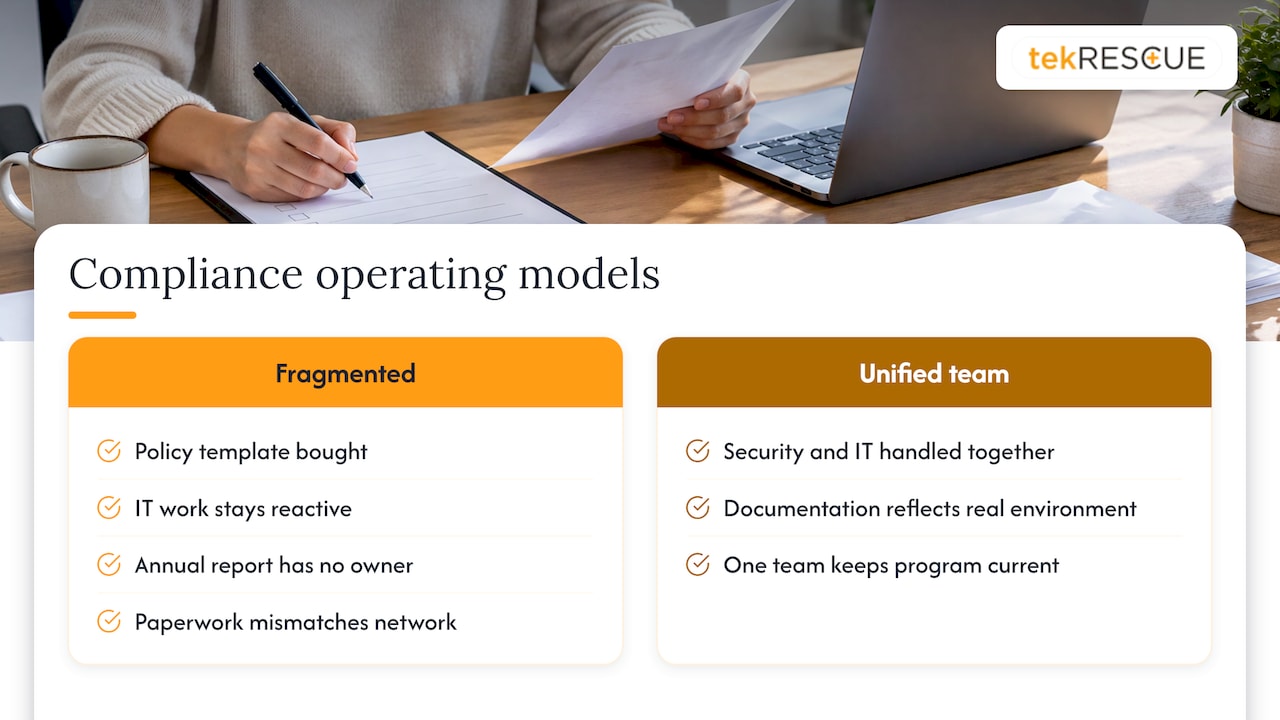
The usual pattern is predictable. The owner buys a policy template, the IT work stays reactive, and nobody owns the annual report. When a regulator, a lender or a client asks for evidence, the paperwork does not match what is actually running on the network.
The fix is to have security, documentation and day-to-day IT handled by the same team, so the written program describes the real environment. That is how we approach it at tekRESCUE.
Our perspective
Every week, business owners tell us they assumed the Safeguards Rule was meant for banks. It is not. If you prepare taxes, broker loans, service accounts or collect debts, the FTC treats you as a financial institution, and the attackers going after your client files do not care how small you are.
We believe the strongest compliance programs are built from the real network outward. That means a risk assessment based on your systems, controls like multi-factor authentication and encryption that are actually switched on, and an incident response plan you can find at 2 a.m. The paperwork should describe the environment, not replace it.
Our team handles cybersecurity, managed IT, incident response and FTC Safeguards Rule work for small and mid-sized businesses in Austin, San Marcos and across Central Texas. Having one team on all of it is how a program stays current after the first audit.
Randy Bryan
Getting help with the program
If you want the Safeguards Rule program built and kept current, start with a conversation about your systems and the customer data you hold. tekRESCUE offers FTC Safeguards Rule compliance alongside cybersecurity services, managed IT and incident response. You can also see our dedicated page at ftc.mytekrescue.com.
FAQ
Is the FTC Safeguards Rule part of the GLBA?
Yes. Congress directed the FTC and other agencies to set safeguard standards under the Gramm-Leach-Bliley Act, and the FTC issued the Safeguards Rule in 2002. It is codified at 16 CFR Part 314.
Does the FTC Safeguards Rule apply to banks?
Generally no. It covers financial institutions under FTC jurisdiction that are not subject to another regulator’s GLBA standards. Banks follow the standards of their own federal regulators, while non-bank businesses like mortgage brokers, tax preparers and finance companies fall under the FTC.
What are the latest updates to the rule?
The major amendments were finalized on December 9, 2021, with most provisions effective June 9, 2023. The breach notification requirement took effect in May 2024. Check the FTC’s Safeguards Rule page for any later changes.
Do small businesses have to comply?
Yes, if they are covered financial institutions. Firms holding customer information on fewer than 5,000 consumers are relieved of some written requirements, such as the formal risk assessment document and annual report. They still need a security program, a Qualified Individual and core safeguards.
When do I have to tell the FTC about a breach?
When unencrypted customer information of at least 500 consumers is acquired without authorization, notify the FTC as soon as possible and no later than 30 days after discovery. The clock starts when any employee, officer or agent first knows about the event.
Sources
- Federal Register: Standards for Safeguarding Customer Information
- eCFR: 16 CFR Part 314
- eCFR: 16 CFR 314.4 Elements
- FTC: Safeguards Rule: What Your Business Needs to Know
- FTC: Safeguards Rule notification requirement now in effect
- HHS: HIPAA and the FTC Act
- U.S. Department of Education: Updates to GLBA Cybersecurity Requirements
- Reinhart: Covered Entities Must Comply with FTC Safeguards Rule
- Sullivan & Cromwell: The FTC’s Updated Safeguards Rule
- University of Wisconsin System: Guide to GLBA Safeguards Rule
Recommended
Table of Contents