
Google Reviews for SEO: What They Do and How to Earn More
Google reviews help your local visibility: the Map Pack, Google Maps and your Business Profile. They are not a lever for ordinary website rankings. If you run a small business, the practical answer is to treat reviews as part of a local SEO system, with a complete profile, a steady flow of genuine reviews and fast, professional replies. That is the work our SEO team does for small businesses in Central Texas, and it is where reviews pay off most.
Table of Contents
TL;DR
- Google says review count and positive ratings can help your local ranking, alongside relevance, distance and prominence.
- Reviews are not a ranking signal for regular web results, so do not expect them to lift your site pages on their own.
- Ask every customer, never pay for reviews, and never filter who you ask. Google bans incentives, and the FTC has its own rule on fake and suppressed reviews.
- Reply to every review, good or bad, in a short, specific, professional way.
- Reviews work best when the Business Profile, website and local citations around them are in good shape.
Table of Contents
- Do Google reviews help SEO?
- How much do reviews matter next to other local factors?
- What a review strategy needs
- Getting reviews that help you rank for the right searches
- Reviews are one piece of local SEO
- A 30-day plan
- Let us run the local SEO around your reviews
- Our perspective
- FAQ
- Sources
Do Google reviews help SEO?
It depends on which kind of search you mean.
Local search. When someone searches “plumber near me” or “dentist in San Marcos,” Google shows a map and a short list of businesses. Google states that review count and ratings are part of prominence, one of the factors in local ranking, and that more reviews and positive ratings can help your business rank. Google also says it does not disclose the full algorithm, and you cannot pay for a better local position.
Regular web results. The blue links to your website are a different system. Search Engine Journal’s report on a 2021 Google Search Central hangout says John Mueller separated the two: review counts were not used to rank normal web results, while local profile factors are separate. So reviews will not push a service page up the organic rankings by themselves.
That split should shape your plan. Reviews are a local visibility tool and a conversion tool. They sit next to your listing in Search and Maps, where they help you stand out against the three or four businesses beside you.
How much do reviews matter next to other local factors?
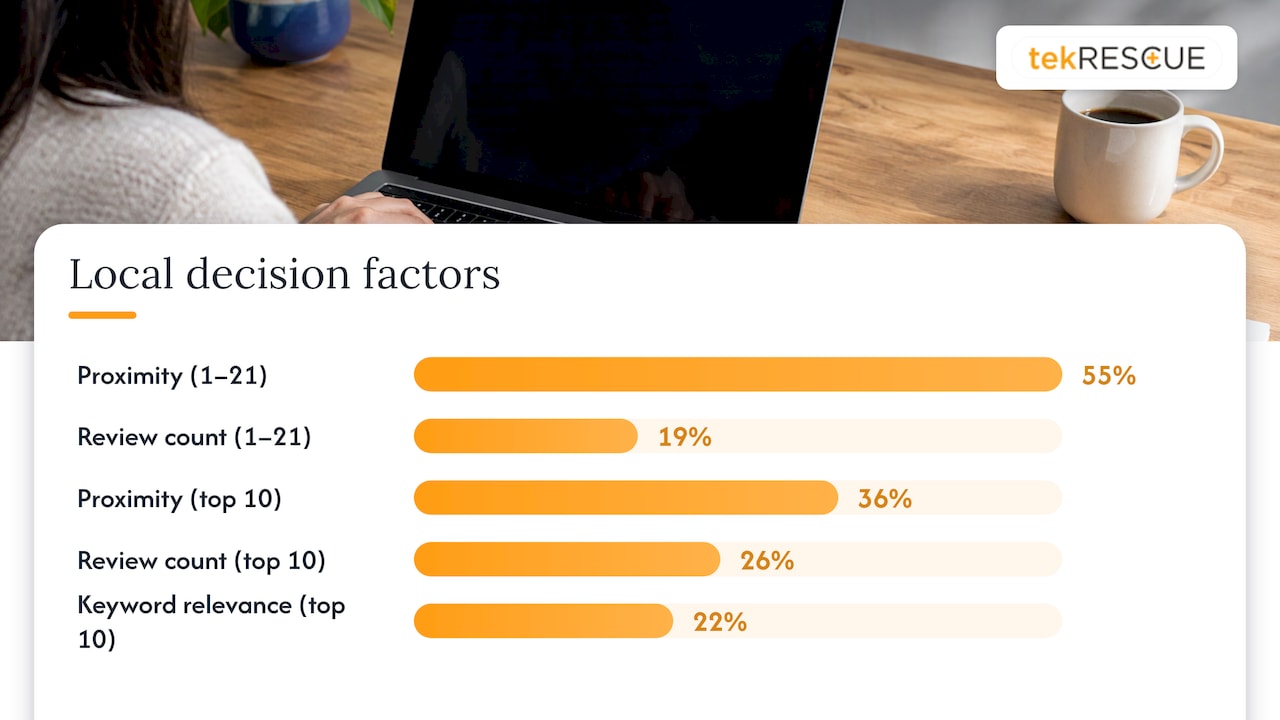
Nobody outside Google knows the exact weights, but one study gives a useful picture. Search Engine Journal covered a 2025 Search Atlas analysis of 3,269 businesses across food, health, law and beauty. Proximity influenced 55% of decisions across positions 1 to 21, and review count 19%. Among the top ten, proximity fell to 36%, review count rose to 26% and review-keyword relevance reached 22%.
Two readings follow for a business owner:
- You cannot move your office, but once you are in the running, reviews gain weight in separating the leaders.
- The words customers use matter. A review that mentions the service and the town describes your business in terms searchers use.
The same coverage cautions that the model shows correlation, not causation, and is a snapshot. Use it as direction, not as a formula.
Star ratings also shape what people do. Google says the displayed score is an average of ratings on a 1 to 5 scale, and a new review can take up to two weeks to update it. Plan for a lag when you run a review push.
What a review strategy needs
A strategy is a routine your staff can run every week without you. It has four parts.
1. A complete profile first
Reviews attach to your Business Profile. If the categories, hours, services and service areas are thin, new reviews land on a weak page. Google ties relevance to complete, detailed business information. Our guide to mapping every Business Profile field to Google’s three ranking pillars walks through the fields, and our local SEO checklist puts the first eight tasks in order. If you serve customers at their location, see our service area business SEO system.
2. A simple way to ask
Google’s advice is to share your Business Profile review link or QR code. Its 2026 playbook suggests placing a QR code where customers already are, such as receipts, menus or storefront windows.
For service businesses, the best moment is right after a job is done well:
- Text or email the link the same day, while the experience is fresh.
- Ask the technician or front desk to mention it at completion.
- Put the QR code on invoices and in the follow-up email.
Ask everyone. Do not hand the link only to customers you expect to be happy.
3. Rules you must stay inside
Google requires reviews to reflect a genuine experience and strictly prohibits incentives such as free or discounted goods or services in exchange for posting, changing or removing reviews. Google may remove reviews it believes are fake or break its policies, and violations can restrict your profile. Losing a profile’s reviews or access costs far more than any shortcut gains.
There is a federal layer too. The FTC’s Consumer Review Rule, 16 CFR Part 465, took effect October 21, 2024. It covers fake reviews, incentives conditioned on a positive or negative sentiment, insider reviews and some forms of review suppression. Legal summaries report civil penalties of up to $53,088 per knowing violation, a figure the FTC adjusts over time. Google’s own rule is stricter for Google reviews, since it bars incentives for any review. If you are unsure whether a particular practice is compliant, ask your attorney.
In practice, that means:
- No gifts, discounts or entries in a drawing for reviews.
- No buying reviews, and no writing them for customers.
- No staff or family reviews presented as customer feedback.
- No screening who gets the link based on how they feel about you.
4. Replies that read like a person
Google advises replies that are professional, polite, short and relevant, and conversational rather than promotional. For negative reviews it advises protecting privacy, avoiding personal attacks, acknowledging mistakes where appropriate, replying promptly and moving complex issues to phone or email.
A workable pattern:
- Positive review: thank them by name, mention the specific job, and keep it to two or three sentences.
- Negative review: acknowledge the problem, never share details of the customer’s account, and offer a direct phone number or email to resolve it.
- Never paste the same reply on every review. Specific replies help the next reader.
The 2026 playbook cites a 2025 SOCi consumer survey: 91% of consumers evaluate local businesses through reviews and 65% are more likely to choose businesses that respond. Those are survey figures about buyer behavior, not ranking weights, but they explain why replies matter even when rankings do not move.
Getting reviews that help you rank for the right searches
You cannot script what a customer writes, and you should not try. You can shape what they remember by asking a better question. Instead of “Can you leave us a review?”, try “Would you tell people what we fixed and how it went?” Customers who describe the work in their own words tend to name the service and the neighborhood, which is the language local searchers use.
A few habits make this easier:
- Use job-specific follow-ups, so a roofing customer is thinking about the roof, not just the crew’s friendliness.
- Keep your service list and categories accurate on the profile so those words match what customers mention.
- Display reviews on your website and mark up your business details. Our local business schema patterns show how to describe your business clearly to search engines.
Reviews are one piece of local SEO
Since reviews support local visibility but not web rankings, the pages and signals around them carry the rest. Strong local pages, consistent business details across directories and links from nearby organizations all feed the same result. We cover these in our local link building guide, our Austin local SEO strategies and our piece on optimizing your Business Profile in search results. If you run a home services company, prioritize these three signals.
Healthcare practices carry an added duty. Replying to a patient’s review can reveal protected health information, even by confirming the person was a patient. Keep replies generic, never confirm treatment details, and take the conversation offline. If you want a second set of eyes on your processes, our HIPAA compliance team can help.
A 30-day plan
| Week | Task | Result |
|---|---|---|
| 1 | Complete every profile field, check categories and service areas | A profile worth reviewing |
| 2 | Create your review link and QR code, add it to invoices and follow-up messages | A one-step way to ask |
| 3 | Train staff on the ask and on reply rules; reply to all existing reviews | Consistent routine |
| 4 | Review what customers wrote, note the services and places named, adjust your ask | Better, more specific reviews |
Remember the two-week lag in score updates when you judge results, and keep the routine running past the first month. Reviews work through steady accumulation.
Let us run the local SEO around your reviews
If you would rather not manage the profile, the website and the review routine alongside your actual work, our search engine optimization service covers the website and local visibility side. Our team also builds and maintains the sites those reviews send customers to through website design and development. Tell us what you sell and where you serve, and we will start there.
Our perspective
Business owners often ask us whether reviews are the secret to ranking. They are not a secret, and they are not a trick. They are the public record of how you treat customers, and Google reads that record when it decides which nearby business to show.
What we push clients toward is discipline. Complete the profile. Ask every customer. Answer every review like a person would. Keep your website fast, secure and clear about what you do, so the visitor who trusts your stars finds a site that earns the call.
The shortcuts are where small businesses get hurt: bought reviews, discounts for five stars, selective asking. Google and the FTC both have rules on this. We build local SEO on genuine reviews because that is the work that lasts.
Randy Bryan
FAQ
Do Google reviews help SEO?
For local search, yes. Google says review count and positive ratings can help your local ranking. For regular website results, a 2021 report on Google’s John Mueller says review counts are not used. Think of reviews as a Map Pack and Business Profile tool.
How do I get more Google reviews?
Share your Business Profile review link or QR code with every customer, ideally right after the job. Put it on receipts, invoices and follow-up emails. Do not offer discounts or gifts, since Google prohibits incentives for reviews.
How should I respond to a negative review?
Reply promptly, politely and briefly. Acknowledge the problem, apologize where appropriate, avoid personal attacks and never share private customer details. Move complicated issues to a phone call or email.
Can I ask only happy customers for reviews?
No. Filtering who receives your review request by expected sentiment is review gating, and the FTC’s Consumer Review Rule addresses review suppression. Ask all customers the same way.
How long until new reviews change my rating?
Google says an updated score can take up to two weeks after a new review is published. Rankings depend on many other factors, so judge progress over months, not days.
Sources
- Tips to improve your local ranking on Google
- Understand review scores for local places and businesses
- Google Search consumer information
- Google: Customer Reviews Not A Signal For Web Search
- Review Signals Gain Influence In Top Google Local Rankings
- Tips to get more reviews
- Google Business Profile Best Practices Playbook 2026
- Overview of Google Business Profile policies
- FTC Consumer Review Rule for Contractors
- Review Gating and the FTC Rule
Recommended
Table of Contents