
Privacy Policy Requirements for U.S. Small Businesses
There is no single federal law that tells every business to post a privacy policy. But if your website collects names, emails, payment details or health information, some combination of federal, state and industry rules almost certainly applies to you, and whatever you publish has to match what your systems actually do. That second part is where small businesses get hurt.
If you run a business, here is the uncomfortable truth: a privacy policy is only as good as the IT behind it. A policy that promises encryption, limited access or no data sharing is a legal promise. If your website forms, plugins, email and servers do something different, the document becomes evidence against you. We build and secure the systems these policies describe, so this guide covers both what to write and what has to be true behind it.
Table of Contents
TL;DR
- No universal federal law requires every business to post a privacy policy, but the FTC Act bars deceptive privacy statements, so anything you publish must be accurate.
- California, other state laws, HIPAA, children’s privacy rules and financial-services rules can each create a posting or notice duty, depending on who your customers are and what data you hold.
- A solid policy names your business, lists the data you collect, says who receives it, explains how people can review or change it, and carries an effective date.
- Healthcare practices have a separate document, the Notice of Privacy Practices, with its own rules and a 2026 update deadline.
- Write the policy after you map your data, then re-check it whenever a form, plugin, vendor or process changes.
Table of Contents
- Do you actually need a privacy policy?
- What a privacy policy has to include
- Privacy policy vs. privacy notice
- Healthcare: the Notice of Privacy Practices
- Financial and customer-data businesses: the FTC Safeguards Rule
- Where and when to present the policy
- What happens if you get it wrong
- How to write and maintain yours: a five-step routine
- Where tekRESCUE fits
- Perspective
- FAQ
- Sources
Do you actually need a privacy policy?
Short answer: if you have a business website that collects any personal information, yes, treat it as required. The longer answer is that the obligation comes from several places, and which ones reach you depends on your customers and your data.
The FTC Act. According to the Minnesota DEED legal guide to privacy and data security, the FTC Act applies to most companies and individuals doing business in the United States and prohibits unfair or deceptive practices involving consumer privacy and data security. The Act does not by itself force you to post a policy. It does mean that if you post one, you are held to it. The same guide frames the core risk as a posted promise that conflicts with how you actually share or secure data.
California. California’s online privacy law, CalOPPA, covers commercial websites and online services that collect personally identifiable information through the internet about California residents. It requires a conspicuously posted policy, per the California Business and Professions Code, section 22575. You do not need an office in California. If Californians use your site, the law reaches you.
Comprehensive state privacy laws. The same legal guide, published by a law firm in its 2026 edition, reports that 20 states had enacted comprehensive data privacy laws as of January 1, 2026, with business thresholds varying from law to law. Oregon is a useful example. The Oregon Department of Justice explains that its law generally applies to a business that controls or processes the data of at least 100,000 consumers in a calendar year, or at least 25,000 consumers while earning over 25% of annual gross revenue from selling personal data. Many very small businesses fall under such thresholds, but you have to check each state’s numbers rather than assume.
Specific kinds of data. The Better Business Bureau’s small-business guidance notes that federal law can require privacy policies when you collect information from children under 13, handle protected health information, or gather information to provide certain financial products or services.
So the practical test is not whether a law names you as a small business. It is whether you collect data from California residents, cross a state threshold, serve children, hold health records or provide financial services. If any of these is a yes, or you are not sure, publish a policy and make it accurate.
What a privacy policy has to include
There is no single federal template. The most detailed U.S. content rule for websites comes from California, and it makes a good baseline for any business because it asks for things every site owner should know anyway. Under section 22575, a covered policy must:
- Identify the categories of personally identifiable information the site collects.
- Identify the categories of third parties with whom that information may be shared.
- Describe the process, if you maintain one, for consumers to review and request changes to their information.
- Describe how you notify users of material changes to the policy.
- State an effective date.
- Disclose how you respond to Do Not Track signals (browser settings that ask sites not to track activity).
- Disclose whether other parties may collect information about a visitor’s online activity across sites or over time.
The California Privacy Protection Agency’s general notices guidance adds the CCPA angle for businesses covered by that law: it describes disclosures covering the categories of personal information, the categories of third parties receiving it, and the specific purposes for selling, sharing or disclosing it.
In plain terms, a policy that works for most small business sites covers these points:
- Who you are. Your legal business name, address and a way to contact you about privacy.
- What you collect. Contact form entries, newsletter signups, checkout data, analytics identifiers, cookies, account logins, uploaded files.
- Why you collect it. Fulfilling orders, answering inquiries, marketing, fraud prevention.
- Who gets it. Payment processors, email platforms, analytics and advertising tools, hosting providers.
- Rights and choices. How people can see, correct or delete their data, or opt out of sales and sharing where a law gives them that right. The 2026 legal guide names access, deletion and opt-outs from data sales as common consumer rights in comprehensive state laws.
- Security. A general statement of how you protect data. Keep it truthful and not more specific than your practices.
- Children. Whether your site is directed to children under 13 and what you do if you learn you have collected their data.
- Changes and date. An effective date and how you will announce updates.
Worked example: a small contractor with a quote form
A remodeling company in Hays County has a contact form, a newsletter signup, Google Analytics and a Facebook pixel. Its data map shows names, phone numbers, emails and home addresses going into a CRM, an email platform and two advertising tools. Its policy should say exactly that: those four categories, those third-party categories, the purposes, a contact address for deletion requests and an effective date. If a visitor from California fills out the form, CalOPPA applies. If the owner writes that the company never shares information with third parties, that sentence is false the moment the pixel fires, and it becomes the kind of mismatch the FTC treats as deception.
Privacy policy vs. privacy notice
People use the terms loosely, and the difference matters when you read a legal requirement. The Indiana Cybersecurity Hub describes a privacy notice as customer-facing and a privacy policy as an internal, employee-facing document. The notice explains what happens to information shared with your organization. On most business websites, the page titled Privacy Policy is functionally the notice. Behind it, you should also have an internal policy that tells your staff how to handle personal data so the public promise is kept.
When a regulation says notice, it means the customer-facing statement. When it says policy, check whether it means your internal rules. Most small businesses need both.
Healthcare: the Notice of Privacy Practices
If you are a medical, dental, behavioral health or other healthcare practice, a standard website privacy page is not enough. HIPAA, the federal health privacy law, applies to health plans, healthcare providers that conduct certain standard electronic transactions, and healthcare clearinghouses. Parts of it also apply to business associates, meaning vendors that handle protected health information for them. HHS defines protected health information as individually identifiable health information held or transmitted by a covered entity or business associate in any form, whether electronic, paper or oral.
Covered entities must give patients a Notice of Privacy Practices that explains how information may be used and disclosed and what rights patients have. The Minnesota DEED legal guide says it is generally provided at the first visit for treatment. Providers with a website also have related posting requirements.
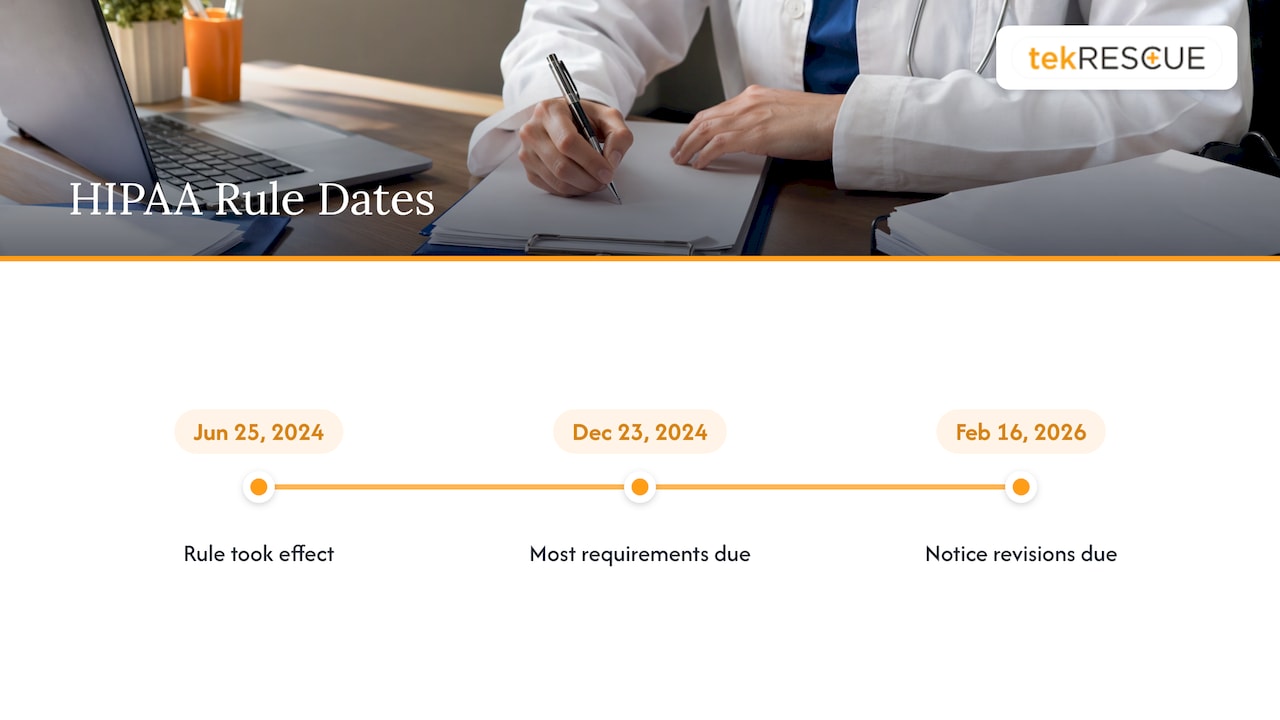
The rules changed recently. The Federal Register records that the 2024 HIPAA final rule took effect June 25, 2024, that most of its requirements were due December 23, 2024, and that revised Notice of Privacy Practices requirements under 45 CFR 164.520 were due February 16, 2026. If your practice has not updated its notice since before that date, put it at the top of your list.
The notice is only one layer. A practice’s website, contact forms, patient email and hosting all touch protected health information. Our guides on a HIPAA compliant website and HIPAA compliant email walk through those pieces, and our HIPAA compliance service covers the safeguards a notice promises.
Financial and customer-data businesses: the FTC Safeguards Rule
Tax preparers, CPA firms, mortgage brokers, auto dealers and other businesses that handle customer financial information face another layer. Privacy notices explain what you do with that data. The FTC Safeguards Rule goes further and requires a written security program to protect it. We cover this in FTC Safeguards Rule: Requirements and a Compliance Checklist and in what SMBs must audit for FTC and data privacy compliance. A privacy notice that promises protection with no program behind it is exactly the gap regulators look for.
Where and when to present the policy
Posting rules are simple, and they are often broken by accident.
- Make it conspicuous. California requires a covered website to post its policy conspicuously. In practice, link it in the footer of every page, on every form and at checkout, and in the signup flow of any app.
- Show it before you collect. OneTrust-style advice aside, the legal point is that a notice should reach people at or before the moment you collect data, not after.
- Use a separate, prominent disclosure for surprising or sensitive data. The FTC’s 2013 consent decree with the app company Path required a clear, prominent disclosure separate from the privacy policy before address-book information was accessed or collected, along with affirmative express consent. The case also carried an $800,000 civil penalty. If your tool collects location, contacts, health details or anything people would not expect, a footer link will not carry you.
- Give healthcare patients the notice in person. For HIPAA covered entities, that means at the first treatment visit, in addition to the website.
What happens if you get it wrong
The penalties are less about a missing page and more about a false one.
Under CalOPPA, an operator violates the posting requirement only if it fails to post its policy within 30 days after being notified of noncompliance, according to section 22575. That grace period is narrow and applies to posting, not to inaccurate content.
The larger exposure is the FTC. The Minnesota DEED guide warns that making material retroactive changes to a website privacy policy without notice and a chance to opt out may violate the FTC Act. That means you cannot quietly rewrite your policy to match a practice you already started. Update the policy before the new practice begins, and announce material changes the way your policy says you will.
For healthcare practices, the cost of weak safeguards is covered in our breakdown of HIPAA Security Rule penalties.
How to write and maintain yours: a five-step routine
1. Map your data. List every place personal information enters: web forms, checkout, live chat, scheduling tools, analytics, ad pixels, email software, phone intake. Include where each item is stored and who can see it. This is the step most owners skip, and it is where the accuracy problem starts. Plugins and embedded tools often collect data nobody on your team knowingly approved.
2. Decide which rules apply. Use the questions above: California visitors, state thresholds, children under 13, health information, financial information. Write down the answer and the date, so you can revisit it as your customer base grows.
3. Draft in plain language. Cover each element in the list above. Short sentences and headings help people find the part they care about. Do not copy another company’s policy. It describes their data flows, not yours, and anything it claims that you do not do is a deceptive statement waiting to happen.
4. Verify every sentence against your systems. Each promise (we encrypt, we do not sell, we delete on request) needs a technical and procedural reality behind it. This is where IT and security work meets legal writing. We handle website builds and maintenance through our web development services, and our cybersecurity and risk assessment work is built to find the gaps between what a business says and what its network does.
5. Review on a schedule and on every change. Re-check the policy at least once a year, and whenever you add a form, switch an email or analytics vendor, launch an app or change how long you keep records. Update the effective date each time, and notify people of material changes.
Where tekRESCUE fits
A privacy policy sits on top of a stack: the website, the hosting, the email, the network and the staff habits that decide whether your promises are true. We are a Texas technology provider serving Austin, San Marcos, Kyle, New Braunfels and the surrounding Hays and Bastrop County area. We offer HIPAA compliance, FTC Safeguards Rule services, cybersecurity with risk assessment, website design, maintenance and hosting, and managed IT. If you want one team to check that what your policy says matches how your systems work, start with our HIPAA and FTC compliance services or talk to us about managed IT.
Perspective
When a business owner hands us a privacy policy, the first thing we ask is not whether the wording is right. It is whether the systems behind it do what it says. A policy is a promise, and promises about encryption, access and sharing are only as strong as the network, the website and the people who run them.
That is why we treat privacy as part of security and compliance, not as a document you download once. Our expertise is in compliance and security management, including HIPAA and NIST standards, and in building websites and IT environments that small and mid-sized businesses can actually defend. The policy is the visible layer. The risk assessment, the hardened network and the maintained website are what keep it true.
If you run a practice, a CPA firm or any business that holds customer data, do not wait for a complaint to find the gap. Map the data, match the promises to reality, and keep the work current. Attackers, and now AI-driven attacks, move faster than any annual review.
Randy Bryan
FAQ
Is a privacy policy required by law for a small business website?
No single federal law requires every business to post one, but the FTC Act prohibits deceptive privacy statements, and California, other state laws, HIPAA and children’s or financial privacy rules can require one. If your site collects personal information, publishing an accurate policy is the safe course.
Does the FTC require a privacy policy?
The FTC Act does not itself require every business to post a policy. It does require that what you say about privacy and data security be truthful, and the agency enforces against posted promises that conflict with real practices. Businesses handling customer financial data also have Safeguards Rule duties.
What is the difference between a privacy policy and a privacy notice?
A privacy notice is the customer-facing statement of what happens to information people share with you. A privacy policy is often the internal, employee-facing document, though websites commonly use the title for the public notice. Most businesses should have both.
Do I need a privacy policy if I do not sell anything online?
Probably yes. A contact form, newsletter signup, analytics tool or ad pixel collects personal information, and California’s law covers commercial sites collecting it from California residents. Selling online is not the trigger. Collecting personal data is.
How often should I update my privacy policy?
Review it at least once a year and whenever your data practices change, such as a new form, vendor or tracking tool. Update the effective date and notify people of material changes before they take effect, because retroactive changes without notice can violate the FTC Act.
Sources
- A Legal Guide to Privacy and Data Security 2026, Minnesota DEED
- A Legal Guide to Privacy and Data Security 2026, Lathrop GPM edition
- California Business and Professions Code section 22575
- California Privacy Protection Agency: general notices under the CCPA
- Oregon Department of Justice: Privacy Law FAQs for Businesses
- BBB: Writing an effective privacy policy for your small business website
- Indiana Cybersecurity Hub: privacy toolkit for small business
- HHS: HIPAA and the FTC Act guidance
- Federal Register: 2024 HIPAA final rule
- FTC consent decree and order for civil penalties, 2013
Recommended
Table of Contents