
Incident Response Plan: What to Write and How to Test It
An incident response plan is the written answer to one question: when something goes wrong with our systems or data, who does what, in what order, and who gets called? If you run a small business or a medical practice, you need that answer on paper before the attack, because a ransomware screen at 7 a.m. is a bad time to decide who has authority to pull the network offline. Below is what the plan must contain, the steps it should walk through, how to handle ransomware, how to drill it, and the HIPAA clocks that start running if you handle patient data. If you want the plan built and owned by a security team, our incident response service is where that starts.
Table of Contents
TL;DR
- A plan is a written document, approved by senior leadership, that covers what you do before, during and after a confirmed or suspected incident.
- Keep it short enough to use under stress: roles, key activities, and a crisis contact list.
- Follow the same arc every time: prepare, detect and analyze, contain, eradicate, recover, then review.
- Test it with a facilitated tabletop drill and a blameless review, and test your backup restores too.
- Healthcare providers face HIPAA notification deadlines, including 60 calendar days to notify affected individuals.
Table of Contents
- What an incident response plan is, and what counts as an incident
- What to put in the plan (the template that matters)
- Incident response steps, in order
- Ransomware: the scenario to write first
- Run a drill before you need the plan
- Incident response policy versus plan
- If you handle patient data: HIPAA adds deadlines
- Where tekRESCUE fits
- Our perspective
- FAQ
- Sources
What an incident response plan is, and what counts as an incident
CISA, the federal agency that coordinates U.S. cyber defense, describes an incident response plan as a written document, formally approved by senior leadership, that helps an organization before, during and after a confirmed or suspected security incident. Two details matter. Leadership approval means the person who decides to shut down the point-of-sale system has already agreed to it. And “suspected” means you do not wait for proof of damage to start.
What is an incident? NIST, the federal standards body, defines a cybersecurity incident in its 2025 guidance, SP 800-61 Rev. 3, as an occurrence that actually or imminently jeopardizes the confidentiality, integrity or availability of information or systems, or violates or threatens law or security policy. In plain terms: someone can see data they should not, data or systems are altered, or you cannot use them.
The same NIST document lists examples that a small business should recognize: ransomware, denial-of-service attacks, account compromise, phishing-related fraud, exploitation of vulnerabilities, and compromised vendor software. Your plan does not need a chapter on each. It needs one general flow and a short playbook for the two or three scenarios most likely to hit you.
What to put in the plan (the template that matters)
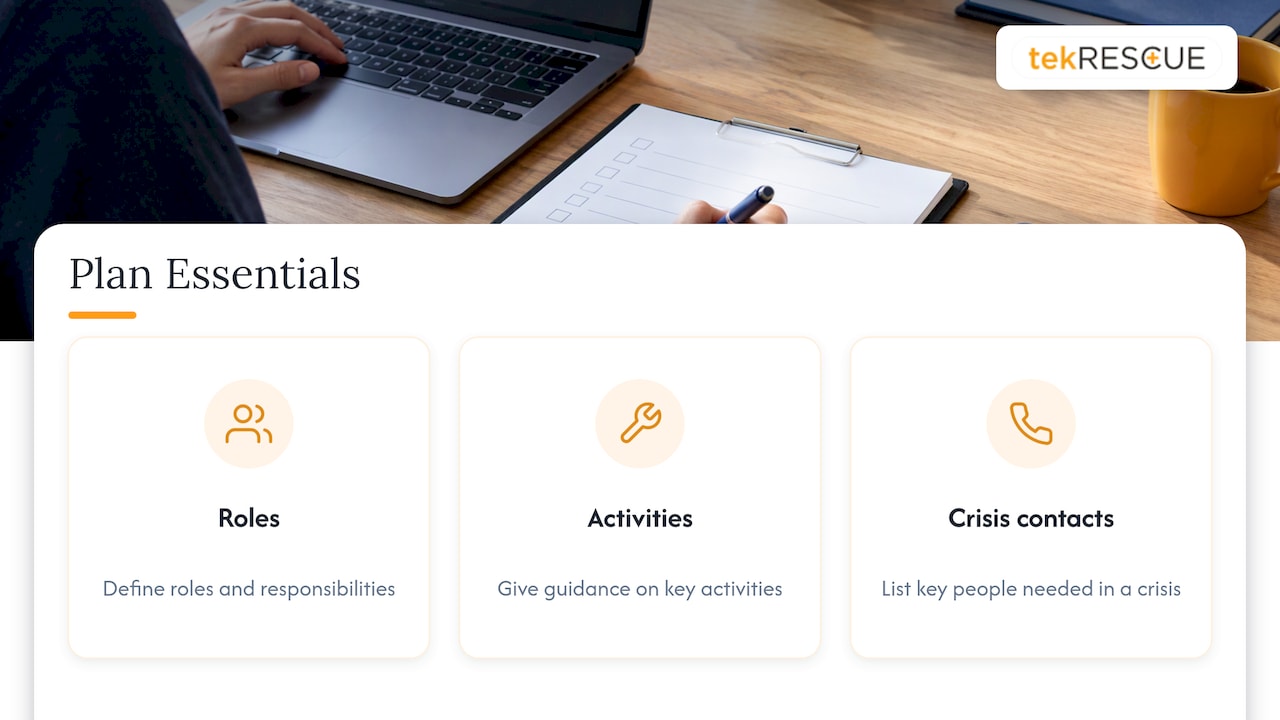
The templates that rank for this topic run dozens of pages. Most small organizations never open them again. CISA’s January 2026 guidance boils the essentials down to three things: roles and responsibilities, guidance on key activities, and a list of key people who may be needed in a crisis. Build your document around those.
Roles and responsibilities
Name a person, and a backup, for each job. At minimum:
- Incident lead: makes the calls and keeps a running log of decisions and times.
- Technical lead: isolates systems, preserves evidence, and restores.
- Leadership contact: the owner or administrator who can approve downtime, spending and outside help.
- Communications owner: speaks to employees, customers, patients and the press, so nobody improvises.
- Compliance or legal contact: decides what notifications are required.
In a ten-person company one person may hold three of these hats. That is fine as long as it is written down and a backup exists for vacations and sick days.
Key activities
This is the checklist section: how to report a suspected incident, who may disconnect a device, how to preserve logs, when to engage outside help, and how to decide when the incident is over. NIST recommends documented procedures and scenario playbooks for common incidents and for processes you will need urgently, with periodic testing or exercises. A playbook is simply a one-page version of the plan for one scenario, such as ransomware or a hijacked email account.
The crisis contact list
This is the part people skip and regret. Include mobile numbers, not desk lines, for your team, your IT provider, your cyber insurance carrier, your bank, your attorney, and any regulator you must notify. Store a printed copy and an offline copy. If email is down or encrypted, a contact list stored only in email is useless.
Incident response steps, in order
You will see four-step, five-step and seven-step versions of the same process. They differ in how finely they slice it, not in substance. The sequence below reflects the guidance HHS gives for ransomware and the structure NIST uses, which frames response inside overall cybersecurity risk management and stresses learning from each incident to improve governance and readiness.
- Prepare. Write the plan, assign the roles, inventory your systems and data, set up logging and backups, and train staff to report anything odd quickly. Everything else depends on this step, and it is the only one you can do on a calm day.
- Detect and analyze. Work out what happened. HHS says initial analysis should establish the scope, origin and status of the incident, whether it is ongoing or has spread, and how it occurred. Start your log here: what was seen, when, by whom.
- Contain. Limit the impact and stop the spread. That usually means isolating affected machines, disabling compromised accounts and blocking malicious connections.
- Eradicate. Remove the malicious software or access and fix the weakness that let it in. Restoring before you close the door invites a second hit.
- Recover. Restore data and resume operations, in priority order, and watch closely for signs of re-entry.
- Review. Hold a post-incident analysis, document lessons learned, and update the plan, the controls and the training.
Where it goes wrong: teams jump straight to recovery because the business is losing money, skip eradication, and are compromised again days later. A written plan with a clear “do not restore until” checkpoint prevents that.
Ransomware: the scenario to write first
Ransomware, malware that encrypts your files and demands payment to unlock them, is the scenario most small businesses and clinics should script first. HHS’s ransomware fact sheet lays out the response: determine the scope and whether the attack is ongoing, isolate affected systems, contain and eradicate the ransomware, remediate the vulnerabilities, then restore data and resume operations.
Some specifics worth putting in your playbook:
- Isolate fast. CISA’s Ransomware Guide advises identifying impacted systems and isolating them immediately. If several systems or subnets are hit, it says taking the network offline at the switch level may be necessary. Your playbook should say who is allowed to make that call.
- Communicate out of band. The same guide recommends out-of-band communications during coordinated isolation, meaning a channel the attacker cannot see, such as phone calls or a messaging account that is not on your network. Put the phone numbers in the contact list.
- Triage the restore. Restore in order of criticality: the systems tied to health and safety, revenue and other critical services come first, according to CISA.
- Prove your backups. HHS recommends periodic backup restoration tests and consideration of offline backups, because some ransomware can remove or disrupt online backups. A backup you have never restored is a hope, not a recovery plan.
Prevention shortens every one of these steps. Our guide to preventing ransomware attacks covers the controls, and our piece on IT business continuity for small business covers keeping the doors open while you recover.
Run a drill before you need the plan
A plan nobody has rehearsed fails in the first hour, usually on small things: nobody knows the insurer’s claim number, the backup admin password lives on the encrypted server, two people both think the other is calling the lawyer. A drill finds those gaps while they cost nothing.
The common format is the tabletop exercise, a discussion-based rehearsal. CISA describes it this way: a facilitator presents a scenario and provides updates as participants practice their roles. Here is a simple way to run one in about 90 minutes:
- Pick a realistic scenario. For example: an employee reports that files on the shared drive have been renamed and a ransom note is on the screen.
- Invite the whole chain. Leadership, the technical lead, whoever handles communications, and the compliance contact. Include your IT provider if you use one.
- Feed the scenario in stages. Every 10 to 15 minutes, add a twist: the backup server is also encrypted, a reporter calls, patient records may be involved.
- Make people answer in role. “Who decides to take the network down?” should get a name, not a debate.
- Hold a blameless retrospective. CISA’s guidance calls for a formal, blameless review that reconstructs the timeline, identifies improvements, updates policies and procedures, and communicates findings to staff.
- Fix and assign. Each gap becomes a task with an owner and a date. Update the plan and the contact list the same week.
Run one at least once a year and after any major change in systems, vendors or staff. The blameless part is not politeness. If people fear being blamed, they report problems late, and late reporting is how small incidents become large ones.
Incident response policy versus plan
The two are related but different. The policy is the short governing statement; the plan is the operating manual. NIST says incident response policies commonly state management commitment, purpose and objectives, scope, key definitions, roles and authorities, prioritization and recovery guidance, and performance measures. One or two pages is plenty for a small business. The policy gives the plan its authority, so have the owner sign it.
If you handle patient data: HIPAA adds deadlines
Healthcare providers and their business associates, the vendors who handle patient data for them, carry extra obligations. Your plan should state them so nobody has to look them up mid-crisis.
- Backups are a legal requirement. HHS notes that covered entities and business associates must implement a data backup plan as part of the Security Rule contingency plan, citing 45 C.F.R. § 164.308(a)(7).
- Notify individuals. The Breach Notification Rule generally requires notice to affected individuals without unreasonable delay and no later than 60 calendar days after discovery of a breach of unsecured protected health information (45 C.F.R. § 164.404).
- Notify HHS. For breaches affecting 500 or more individuals, HHS must be told at the same time as the individuals. For fewer than 500, the report to HHS is due within 60 days after the end of the calendar year (45 C.F.R. § 164.408).
Sixty days is a ceiling, not a target. The clock starts at discovery, so your plan should say who records the discovery time and who decides whether the event is a reportable breach. For a medical practice, our HIPAA incident response plan for the first 12 hours goes deeper, and our overview of data breach incident response walks through the aftermath. Questions about whether a specific event is a reportable breach belong with your healthcare compliance attorney.
Where tekRESCUE fits
Writing the plan is half the work. The other half is having people who have done this before when the call comes. tekRESCUE provides incident response alongside cybersecurity, risk assessment, managed IT and HIPAA compliance services for small and medium-sized businesses, including healthcare providers, from our base in San Marcos, Texas, serving Austin, Hays County and the surrounding area. Because those services sit under one roof, the plan, the backups, the monitoring and the compliance paperwork can be designed to work together rather than in separate binders. If you want to see where your gaps are first, start with a cybersecurity risk assessment. For a look at how an event unfolds from first sign to cleanup, read the anatomy of a cyber incident.
Our perspective
Most small businesses we talk to do not lack a plan because they are careless. They lack one because the templates they find are written for a security department they do not have. The fix is not a longer document. It is a shorter one that names real people, real phone numbers and real decisions.
Attackers move faster than any human team can type. They log in with stolen credentials, move sideways through a network and look like normal activity until the encryption starts. That is why the first hour matters, and why the plan has to be rehearsed rather than filed.
Our work centers on compliance and security management, including HIPAA and NIST standards, and on keeping the day-to-day IT environment in shape for small and medium-sized businesses. We think an incident response plan belongs next to your backups, your access controls and your compliance program, not in a drawer. If you run a business, here is the uncomfortable truth: the question is not whether you will have an incident, but whether your team will know what to do in the first hour.
Randy Bryan
FAQ
What are the main steps of an incident response plan?
The core sequence is prepare, detect and analyze, contain, eradicate, recover, and review. Some frameworks fold these into four phases and others split them into seven, but the order of work is the same. The review step feeds back into preparation, so each incident makes the next response faster.
How often should we test the plan?
Run a tabletop drill at least once a year and again after major changes to your systems, vendors or key staff. NIST recommends periodic testing or exercises. Test backup restores on a schedule too, since HHS recommends periodic restoration tests.
Do we need a separate ransomware response plan?
You need one general plan and a short ransomware playbook inside it. The playbook covers isolation, out-of-band communication, restore priorities and the decision on who contacts insurers, counsel and, for healthcare, regulators. Ransomware is common enough that most small organizations should script it first.
Who has to approve the plan?
CISA describes the plan as formally approved by senior leadership. For a small business, that means the owner or top administrator signs it, so the incident lead has clear authority to act, including taking systems offline.
Sources
- CISA: Incident Response Plan (IRP) Basics
- NIST SP 800-61 Rev. 3: Incident Response Recommendations and Considerations for Cybersecurity Risk Management
- HHS: Fact Sheet: Ransomware and HIPAA
- CISA and MS-ISAC: Ransomware Guide
- NIST SP 800-66 Rev. 2: Implementing the HIPAA Security Rule
Recommended
Table of Contents