
Vendor Risk Management for Small Business: A Practical Guide
Vendor risk management is the routine of finding out which outside companies touch your data and systems, judging how much damage each could cause, and checking on them for as long as they work for you. If you run a small business or a medical practice, you do not need a 40-page program. You need an accurate vendor list, a tiered review, contracts that name security duties, and a calendar for re-checking. The reason is blunt: when a vendor is breached, the law holds the organization that owns the data responsible, not the vendor. Your IT provider, billing service, cloud host and web host all sit inside your risk, whether you have reviewed them or not.
This guide walks through a program a small team can run, with the HIPAA specifics for healthcare providers.
Table of Contents
TL;DR
- Vendor risk management covers the full life of a vendor relationship: selection, assessment, contract, monitoring and offboarding.
- Start by listing every vendor and sorting them by the data they touch and the access they hold. Spend your effort on the top tier.
- A questionnaire is a snapshot. Re-review high-risk vendors on a schedule and after any incident or major change.
- If you handle patient information, every vendor that touches it needs a signed Business Associate Agreement before it gets access.
- Offboarding matters as much as onboarding: cut credentials, integrations and data access the day a contract ends.
Table of Contents
- What vendor risk management means for a small business
- Step 1: Build a complete vendor inventory
- Step 2: Tier your vendors by what they could break
- Step 3: Assess the vendor before you sign
- Step 4: Put security duties in the contract
- Step 5: Monitor, because the questionnaire is a snapshot
- Step 6: Offboard cleanly
- Vendor risk management under HIPAA
- A worked example: a five-provider dental practice
- Where small businesses go wrong
- Our perspective
- How tekRESCUE can help
- FAQ
- Sources
What vendor risk management means for a small business
You will see two terms used almost interchangeably: vendor risk management and third-party risk management. The difference is scope. A vendor is a company you pay to supply goods or services under contract. A third party is wider and can include contractors, consultants, affiliates and other outside parties. Vendor risk management is the vendor-focused part of a wider third-party program. For a business with fewer than a few hundred employees, the practical advice is the same: treat them as one routine and cover everyone who can reach your data, your systems or your customers.
The risks fall into a few groups that TechTarget’s overview lists as cybersecurity, operational, financial, reputational and regulatory or compliance risk. In plain terms:
- Cybersecurity: the vendor is breached, or its credentials into your systems are stolen, and attackers walk in through the trusted door.
- Operational: the vendor goes down and your website, phones, scheduling or billing stop with it.
- Financial: the vendor fails or is acquired and your service disappears or changes.
- Reputational: a vendor’s failure becomes the story your customers hear about you.
- Compliance: a vendor mishandles regulated data and you answer for it.
There is also fourth-party risk: the vendors your vendors depend on. You cannot audit them directly, but you can ask your vendor who they rely on and whether those companies are held to the same security terms.
Step 1: Build a complete vendor inventory
You cannot manage what you cannot list. Pull vendors from three places: your accounts payable records, your list of software subscriptions and logins, and your IT team’s list of integrations and remote-access accounts. The third source is the one most owners miss. A forgotten remote-support tool or an old marketing plug-in can hold more access than a vendor you pay every month.
For each vendor, record five things:
- What the vendor does for you.
- What data it can see (customer records, payment data, patient information, employee data, nothing sensitive).
- What systems it can reach, and how (login, API, remote session, physical access).
- Who inside your company owns the relationship.
- When the contract renews and how it can be ended.
A spreadsheet is enough. The point is accuracy, not software.
Step 2: Tier your vendors by what they could break
Not every vendor deserves the same scrutiny. A office-supply company and the company that hosts your patient scheduling system are different animals. Sort vendors into three tiers using four questions: how sensitive is the data, how deep is the system access, how badly would you suffer if the vendor went down, and does a regulation apply to what they handle?
| Tier | Typical vendors | Review depth |
|---|---|---|
| High | Managed IT provider, cloud host, billing or payment processor, EHR or practice-management platform, anyone with administrator access | Full questionnaire, evidence review, contract security terms, review at least yearly |
| Medium | Marketing platforms, web hosts, email services holding customer lists | Shorter questionnaire, confirm basic controls, review every year or two |
| Low | Vendors with no data and no system access | Contract on file, no further review |
The federal government’s own small-business guidance takes the same approach. NIST’s Risk Management Framework Quick Start Guide for small businesses describes a repeatable seven-step process for organizations of any size that begins by sorting systems by their impact on confidentiality, availability and integrity, then selecting and tailoring controls to match. Tiering your vendors is the same idea applied to the companies connected to those systems.
Step 3: Assess the vendor before you sign
For high-tier vendors, ask for evidence, not reassurance. A solid pre-contract review has three parts.
Documents. Ask for independent audit reports or certifications the vendor already holds, such as a SOC 2 Type II report or ISO 27001 certificate, plus its security policies and a summary of its most recent penetration test. A SOC 2 report is an outside auditor’s opinion on how a service provider protects customer data over a period of time. Read the scope section, because a report that covers one product tells you nothing about a different one.
A questionnaire. A vendor security questionnaire is a standard list of questions about how the vendor protects data. Keep it matched to the tier: a medium-tier vendor does not need 200 questions. Cover at least data protection, access controls, encryption, incident response and backups. You do not have to invent the questions. CISA publishes a vendor supply chain risk management template, with an August 2025 guide for small and medium-sized IT and communications businesses, built from standardized questions meant to communicate a vendor’s supply chain risk posture.
A decision. Score the result. A simple method is likelihood times impact: how likely is something to go wrong, and how bad would it be? Then choose one of three outcomes: approve, approve with required fixes written into the contract, or walk away. Write down who made the call and why. If an incident happens later, that record shows you exercised diligence.
Watch for these warning signs in answers: refusal to share any audit evidence, no named person responsible for security, no incident response plan, shared logins for administrators, and no ability to say where your data is stored.
Step 4: Put security duties in the contract
A questionnaire describes what a vendor says it does today. A contract makes it a duty. For high-tier vendors, the agreement should address:
- Data handling: what the vendor may do with your data, where it is stored, and what happens to it at the end of the contract.
- Security standards: the controls the vendor must maintain, such as encryption and multi-factor authentication.
- Breach notification: a specific time limit for telling you about an incident, not just a promise to notify “promptly.”
- Subcontractors: the vendor must hold its own vendors to the same terms.
- Audit rights: your ability to request evidence of its controls on a regular basis.
- Exit terms: return or destruction of data, and termination of access.
Have an attorney review anything with real exposure, especially if the vendor handles regulated data. For a business using a managed IT provider, this is also where you confirm what the provider monitors, how fast it responds, and what it must do if something goes wrong. If you are comparing arrangements, our guide to managed IT services for small business shows what a service agreement typically covers.
Step 5: Monitor, because the questionnaire is a snapshot
A vendor that passed your review in January can change its staff, its software and its security posture by June. Monitoring is how you notice.
The Federal Reserve’s 2024 guide for community banks, Conducting Due Diligence on Financial Technology Companies, is written for banks, but its logic transfers to any small business. It says ongoing monitoring lets you confirm the quality of a third party’s controls, escalate significant issues such as repeat audit findings, financial deterioration, security breaches, data loss, service interruptions or compliance lapses, and respond when you find them.
For a small team, that translates to a calendar:
- High-tier vendors: refresh the questionnaire and evidence at least once a year, and meet quarterly if the vendor runs critical systems.
- Medium-tier vendors: review every one to two years.
- Trigger events: re-review immediately after a vendor reports a breach, is acquired, changes hosting providers, or makes a major change to the service you use.
- Access reviews: every quarter, check who at the vendor still has accounts on your systems and remove anything unneeded.
Security rating services and automated scanners exist, but they only see what is visible from outside. They do not replace a conversation and a document review for the vendors that matter most.
Step 6: Offboard cleanly
When a contract ends, the relationship does not end by itself. Accounts stay active, integrations keep running and data sits on someone else’s servers. On the day of termination:
- Disable the vendor’s user accounts and revoke API keys, tokens and remote-access tools.
- Rotate any shared passwords the vendor knew.
- Get written confirmation that your data has been returned or destroyed.
- Update your inventory and your network documentation.
- Keep the contract and the destruction certificate on file.
Vendor risk management under HIPAA
If you are a medical, dental or behavioral-health practice, vendor risk management is not optional housekeeping. It is part of how you meet the law.
Under HIPAA, a vendor that creates, receives, maintains or transmits protected health information (PHI) on your behalf is a business associate. A Business Associate Agreement, or BAA, is the contract that defines what the vendor may do with PHI, requires safeguards, sets breach notification duties and establishes audit rights. According to DBL Lawyers’ 2026 HIPAA checklist, every vendor that touches PHI, including cloud hosts, billing services, EHR platforms and telehealth tools, must sign a BAA before it accesses data, and due diligence should include a review of policies, architecture diagrams, penetration test summaries and compliance attestations. Our page on what a Business Associate Agreement must cover goes through the clauses.
Three practical points for practices:
Map where PHI lives first. NIST’s HIPAA Security Rule guide, SP 800-66r2, tells regulated entities to map where electronic PHI is created, received, maintained, processed and transmitted, including web portals, internal system flows, storage locations and exit points, before starting the risk assessment. That map shows you which vendors are really in scope. Your HIPAA risk assessment should list them.
Watch the proposed rule. In early 2025, HHS proposed changes to the Security Rule. Bradley’s summary of the proposal reports it would require regulated entities to assess the risk of downstream business associate relationships based on written verifications from the business associate, and would require business associates and subcontractors to notify covered entities within 24 hours of activating a contingency plan. The authors describe this as a notable shift from the long-standing approach of relying mostly on the assurances in a BAA. A proposal is not a final rule, so check HHS for its current status. Practices that already tier vendors and collect written evidence will be well placed whichever way it goes.
Plan for a vendor incident. If a business associate has a breach, your own notification clock and patient obligations are in play. Have a written process ready. Our HIPAA incident response plan covers the first 12 hours.
A worked example: a five-provider dental practice
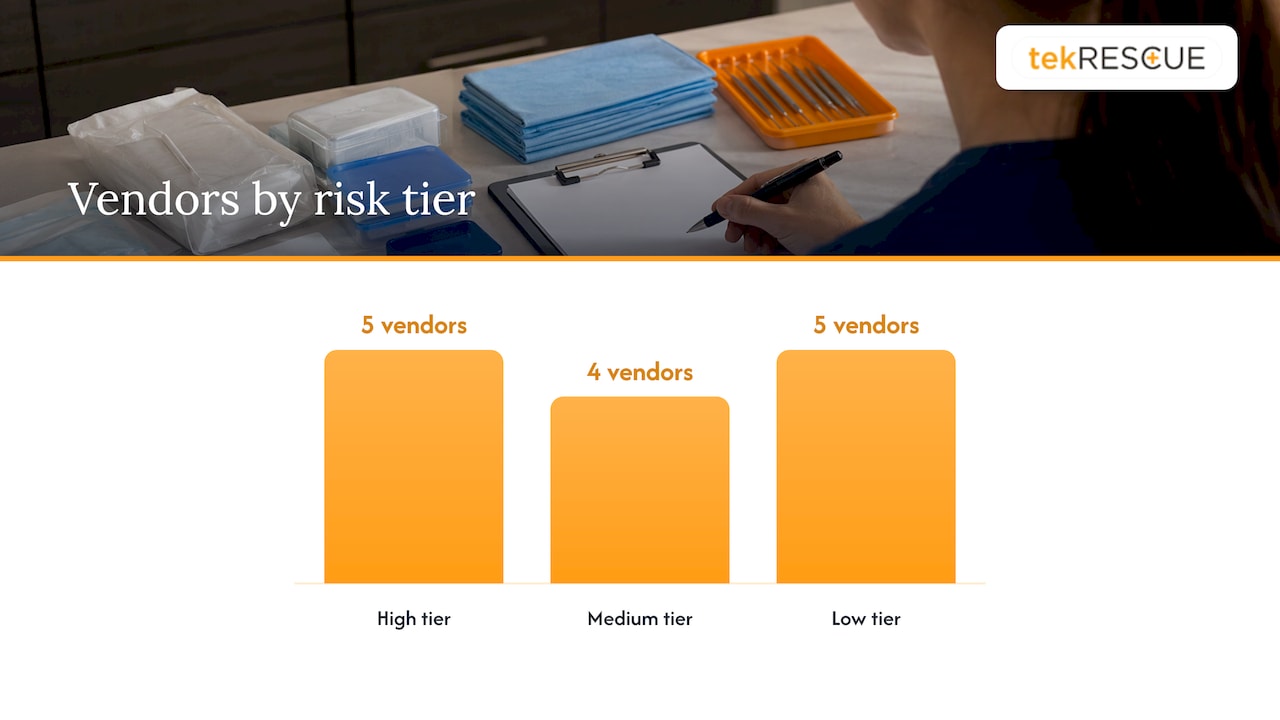
Here is how the routine plays out for a practice that is hypothetical but typical. The office lists 14 vendors. Five are high tier: the practice-management software, the cloud backup service, the billing company, the managed IT provider and the patient-email platform. All five handle PHI.
The office manager checks that each has a signed BAA, and finds two that are missing or years old. She sends those vendors a tier-matched questionnaire and asks for their latest audit reports. One vendor cannot produce any evidence, so the practice puts a remediation deadline in writing. She adds a 15-day breach-notification clause when each contract renews. The practice then sets a yearly review date for each of the five and a quarterly check of who has remote access. Four medium-tier vendors get a short questionnaire. Five low-tier vendors get nothing beyond a contract on file.
Total effort: a few days to set up, then a few hours each quarter. That is the realistic size of a small-business program.
Where small businesses go wrong
- Trusting the sales page. A vendor’s marketing is not evidence. Ask for documents.
- Treating the review as one-time. Risk changes after you sign.
- Ignoring the IT provider. Your managed IT provider usually holds the keys to everything. It belongs in the top tier.
- No owner. If nobody is named, the review does not happen. Give every vendor an internal owner.
- Forgetting offboarding. Old accounts are an easy way in.
- Reviewing everyone equally. Equal scrutiny means shallow scrutiny on the vendors that matter.
Strong basic controls on your own side reduce what any vendor failure can do to you. Our list of five cybersecurity controls every small business needs is a good baseline.
Our perspective
Most small businesses we talk to have the same blind spot. They lock down their own network, then hand an administrator login to a vendor they have never reviewed. Attackers know this. The vendor is the softer door into your business.
We treat vendor risk as part of cybersecurity and compliance, not a separate paperwork exercise. For healthcare providers, that means HIPAA risk assessment, BAAs and incident response planning belong in one conversation. For other small and midsize businesses, it means knowing who has access, what they can reach and what happens when one of them has a bad day.
You do not need an enterprise program. You need an honest inventory, a tiered review, clear contract terms and someone who keeps the calendar. If you would rather have a specialist team carry that load alongside your day-to-day IT, that is the work we do.
Randy Bryan
How tekRESCUE can help
We provide cybersecurity services and risk assessment, managed IT services, HIPAA compliance and incident response for small and midsize businesses and healthcare providers in Austin, San Marcos, Kyle, New Braunfels and the surrounding Texas communities. If you want help working out which vendors carry the most risk to your business, start with a conversation through our cybersecurity page.
FAQ
What is the difference between vendor risk management and third-party risk management?
Third-party risk management is the broader program covering every outside party connected to your business, including contractors, consultants and affiliates. Vendor risk management is the part focused on companies that supply goods or services under contract. For a small business, one combined routine covers both.
How often should I review my vendors?
Review high-risk vendors at least once a year and re-check access quarterly. Medium-risk vendors can be reviewed every one to two years. Always re-review after a breach, an acquisition or a major change to the service.
What should a vendor security questionnaire cover?
At minimum: data protection, access controls, encryption, incident response and backups, plus any audit reports or certifications the vendor holds. Match the length to the vendor’s tier. CISA’s published vendor template is a ready starting point.
Do I need a Business Associate Agreement with every vendor?
You need one with every vendor that creates, receives, maintains or transmits protected health information for you. Vendors with no access to PHI do not need one. Have the agreement signed before the vendor touches any patient data.
Who is responsible if my vendor is breached?
If the breached data is your customers’ or patients’ information, you remain responsible for it, even though the breach happened at the vendor. That is why contract terms, evidence review and a written incident process matter. For legal questions about a specific situation, speak with your attorney.
Sources
- TechTarget: What is vendor risk management (VRM)?
- NIST SP 1314: Risk Management Framework Small Business Quick Start Guide
- CISA: Operationalizing the Vendor Supply Chain Risk Management Template for SMBs
- Federal Reserve: Conducting Due Diligence on Financial Technology Companies
- NIST SP 800-66r2: Implementing the HIPAA Security Rule
- DBL Lawyers: HIPAA Compliance Checklist 2026
- Bradley: Top 10 takeaways from the new HIPAA Security Rule NPRM
Recommended
Table of Contents