
Five Pillars for Marketing Teams’ AI Content Strategy
An AI content strategy is a documented system for using AI tools to research, draft, edit, and distribute content while keeping a human editor accountable for accuracy and brand voice at every stage. The single best approach treats AI as a production accelerant, not an author. Speed comes from AI handling research and first drafts; quality and search visibility come from brief architecture, editorial review, and measurement that a person owns and defends.
TL;DR:
- A successful AI content strategy requires a documented system of briefs, review gates, and measurement tied to business outcomes, not just tool use.
- Scaling content production without quality controls can lead to low-value pages that damage search rankings and brand trust.
- Effective implementation depends on clear audience mapping, detailed brief architecture, and well-defined ownership of each workflow stage.
- Tool selection should prioritize integration and data handling policies over brand names, ensuring each step has an accountable owner to prevent quality leaks.
- Measuring success involves tracking revenue-influenced conversions and operational efficiencies, with regular reviews to adapt strategy and tools over time.
Table of Contents
Table of Contents
- What Is an AI Content Strategy, and Why Does It Matter Now?
- The Core Pillars of a Working AI Content Strategy
- How Do You Roll Out an AI Content Strategy Without Wrecking Your Site?
- Which AI Tool Categories Actually Belong in Your Stack?
- Governance and Quality Gates That Protect Your Brand
- What Metrics Actually Prove Your AI Content Strategy Is Working?
- How tekrescue Applies These Principles in Practice
- Where AI Earns Its Place, and Where Teams Get It Wrong
- Put This Strategy to Work With Help That Knows the Guardrails
- Sources
- FAQ
What Is an AI Content Strategy, and Why Does It Matter Now?
An AI content strategy is different from an employee occasionally pasting a prompt into a chatbot. It’s a repeatable system, a brief format, a review checklist, a distribution plan, and a scorecard tied to business results, all designed so AI output meets the same bar as work from your best writer.
That distinction matters because adoption has outrun performance. By 2026, nearly all B2B marketers report using AI tools somewhere in their content process, but only a minority say those tools produced measurable performance gains. Everyone has the tool; few have the system around it. That gap is exactly what a documented strategy is built to close.
You don’t need a formal AI strategy to write one blog post faster. You need one when:
- You’re publishing at a scale where inconsistent quality would damage brand trust across dozens of pages a month.
- Your business relies on owned channels (your website, email list, resource hub) rather than paid reach to generate leads.
- Compliance or accuracy stakes are high, such as healthcare, finance, or legal content where a factual error carries real risk.
- You’re trying to build topical authority in search and in AI answer engines, both of which reward depth and consistency over one-off posts.
The Core Pillars of a Working AI Content Strategy
Every AI content strategy that holds up under scale rests on five structural pillars. Skip one and the whole system leans on the others until it tips over.

Audience and intent mapping. Before any AI tool touches a keyword, you need a map of who you’re writing for, what job each piece of content does, and how your content pillars connect to entities and topics your audience actually searches. This is strategy work, not prompt work.
Brief architecture. A brief is the contract between your strategist and the AI tool. It should specify the target reader, the search intent, required subtopics, tone, banned claims, and any data points that must be sourced. Section-by-section brief prompting, rather than one giant prompt for a full article, consistently produces cleaner drafts and cuts rewrite time.
Editorial workflow. Draft, edit, fact-check, approve. Each stage needs an owner and a sign-off, not a vague assumption that “someone will catch it.”
Distribution plan. Content built for your own website, email list, and knowledge base compounds in value over time. Teams that tie AI output to owned channels and revenue signals outperform teams chasing raw volume.
Measurement and governance. Someone has to own the scorecard and the quality bar, or both quietly erode.
Pro Tip: Build your brief template before you touch any AI drafting tool. A strong brief format outlasts every tool swap your team will make over the next three years.
How Do You Roll Out an AI Content Strategy Without Wrecking Your Site?
Rolling out AI content in one uncontrolled wave is how sites end up with dozens of thin, off-brand pages that hurt rankings instead of helping them. A staged pilot protects you from that outcome.
- Audit your current process and record a baseline. Track your average time-to-publish, your current organic traffic and conversion rate on recent content, and your editorial rewrite ratio before AI enters the picture. You can’t prove improvement without a starting line.
- Pilot one content type. Pick a single format, a blog explainer, a comparison guide, a service page, and run it through the full loop: brief, AI draft, human edit, fact-check, publish. Define success criteria in advance (time saved, engagement, ranking movement) rather than judging by gut feel afterward.
- Define handoffs and quality gates. Decide exactly who signs off at each stage and what happens when a draft fails the gate. A gate with no consequence isn’t a gate.
- Scale only after governance proves itself. Once the pilot hits its success criteria, expand into templates and, where appropriate, programmatic content. Programmatic and template-driven pages can scale efficiently, but only when human-reviewed templates and reliable data sources back them; skip that review step and you generate low-value pages fast.
- Set a review cadence. Monthly for KPIs, quarterly for the strategy itself. AI tools and search algorithms both shift fast enough that a strategy set in stone becomes outdated within a year.
Pro Tip: Resist the urge to pilot five content types at once. One clean pilot with real numbers beats five muddy ones you can’t compare against each other.
Which AI Tool Categories Actually Belong in Your Stack?
Tool selection matters less than most marketers assume, and integration matters more. Rather than chasing the newest platform, map your stack to the stages your content actually moves through: research, drafting, optimization, repurposing, and orchestration. Tool roundups consistently group AI content tools into these same functional categories, and the category matters far more than the brand name attached to it.
Data should flow in one direction through your stack: research findings feed the brief, the brief feeds the draft, the draft feeds human editing, and the edited piece feeds publishing and distribution. Each handoff is a place where quality can leak out if nobody owns it.
When you evaluate any tool, whether it’s a research assistant, a drafting model, or an automation platform, check for:
- Clear data handling policies, including whether the vendor trains on your inputs.
- Audit logs that show who prompted what and when.
- Prompt templating support, so your brief architecture actually plugs into the tool instead of living in a separate document.
- Cost against the specific time or quality gain it delivers, not against a generic productivity promise.
- Contract terms and service commitments you can actually enforce.
A partner platform built for editorial planning and automation can be a useful reference point when you’re mapping what “good orchestration” looks like before you commit to a stack. The most common integration mistake is connecting tools without a shared brief format between them, which turns your pipeline into five disconnected steps instead of one workflow.
Governance and Quality Gates That Protect Your Brand
Generative tools will confidently produce a wrong statistic, a fabricated case study, or an off-brand tone shift, and they’ll do it without any signal that something went wrong. Governance is what catches that before it publishes.
A living style guide, one that documents your brand’s voice rules for AI drafts specifically, needs version control just like your briefs do. Update it every time you catch a recurring problem, and store past versions so you can trace when a rule changed.
Your factual review checklist should include:
- Every statistic traced back to its original source, not to a summary of a summary.
- Subject matter expert sign off on any claim touching regulated topics like health, finance, or legal guidance.
- Citation practice that links the actual source, not a paraphrase presented as fact.
- A plagiarism and originality check, since AI models can echo phrasing from training data closely enough to create real risk.
- A data privacy checklist for any AI tool touching client or patient information, with vendor contract language that prevents your confidential inputs from training their models.
Gartner’s guidance on generative AI is direct on this point: integration with existing processes and clear measurement matter more than the model itself, especially for regulated industries where a vendor’s data handling terms carry real legal weight. Skipping this step to move faster almost always costs more time later, once a factual error or compliance gap surfaces after publication.
What Metrics Actually Prove Your AI Content Strategy Is Working?
Production speed alone tells you nothing about whether AI content is helping your business. You need metrics on both sides: whether content connects to revenue, and whether the AI-specific workflow is actually efficient.
| Metric type | What to track | Why it matters |
|---|---|---|
| Revenue-connected | Organic MQLs, influenced pipeline, content-assisted conversions, time-to-convert | Ties content output directly to business outcomes rather than vanity traffic |
| Operational | Production time per piece, rewrite ratio, factual error rate | Shows whether AI is actually saving editorial time or just shifting the work |
| AI visibility | Citation and AI Overview appearances for target queries | Reflects whether your content earns trust from generative search engines, not just traditional rankings |
Report these to stakeholders as a before-and-after comparison against your pilot baseline, not as a snapshot in isolation. A structured approach to optimizing content for AI-driven search will help you interpret citation rate changes, which behave differently from traditional keyword rankings and need their own benchmark.
How tekrescue Applies These Principles in Practice
tekrescue builds AI content workflows around the same brief architecture and quality gates outlined here, because loose prompting produces loose results for clients in regulated fields like healthcare and financial services just as fast as it does anywhere else.
In practice, that means:
- Compliance-aware editorial workflows for clients operating under HIPAA and FTC standards, where an unreviewed AI claim carries real regulatory exposure.
- Brief systems built before drafting begins, not retrofitted after a first AI draft disappoints a client.
- Measurement tied to search visibility and lead generation, not just publishing volume.
Where AI Earns Its Place, and Where Teams Get It Wrong
The strategist as orchestrator model wins because AI is genuinely fast at research and first drafts, and genuinely bad at knowing what it doesn’t know. The most common failure I see is a team that skips the brief, skips the quality gate, and mistakes volume for a strategy. Prioritize the brief and the review gate first. Everything else, tools included, is a downstream decision.
— Randy Bryan
Put This Strategy to Work With Help That Knows the Guardrails
A practical alternative to hiring a full in-house content team from scratch is to work with a partner that runs compliance-aware content processes for small and medium-sized businesses, including those subject to HIPAA and FTC requirements.
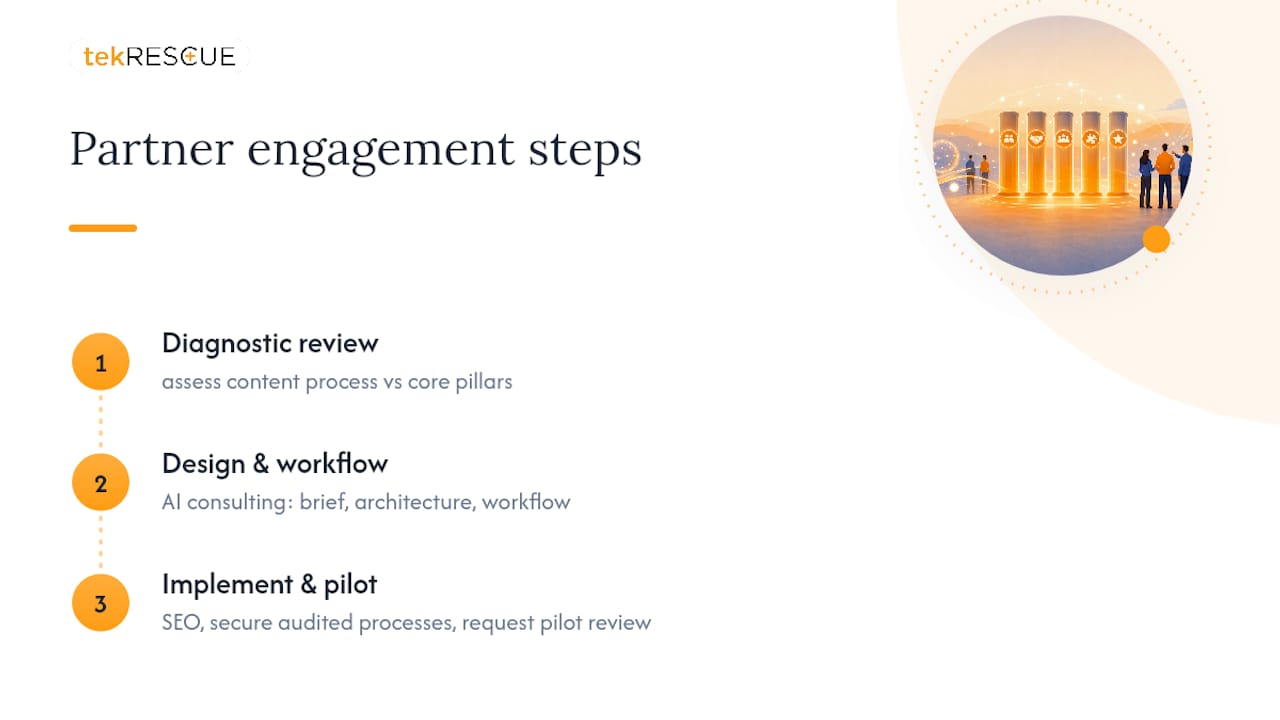
Service offerings may include AI consulting to build brief architecture and workflow, SEO to improve ranking and visibility with AI search engines, and secure, audited processes for regulated industries. An initial step can be a diagnostic engagement—a review of the current content process against core pillars—to identify gaps before scaling.
If you want to see what a content system built for AI-era search actually looks like, start with tekrescue’s guide to generative engine optimization and request a pilot review from there.
Sources
For deeper reading, see Gartner’s guide on generative AI for content and customer experience, SearchEngineLand on the strategist-as-orchestrator role, and the Marketscale synthesis on AI adoption versus performance gains.
- B2B content marketing in 2026: AI adoption is near-universal, but performance gains are not
- Use generative AI to enhance content and customer experience — Gartner
- AI Content Marketing: How to Build a Scalable B2B Content Engine — MV3 Marketing
FAQ
What Is the Difference Between AI Content Marketing and an AI Content Strategy?
AI content marketing describes the tactics, using AI to write, optimize, or repurpose content. An AI content strategy is the documented system of briefs, workflows, and measurement that governs how those tactics get used consistently.
Do I Need a Big Budget to Start an AI Content Strategy?
No. A single pilot content type with a clear brief, a human editor, and a defined success metric costs far less than scaling an unproven process across dozens of pages.
How Long Before an AI Content Strategy Shows Results?
Operational gains like faster drafting show up within the first pilot cycle. Revenue-connected results like influenced pipeline typically take a full quarter of consistent publishing to assess.
Can AI Content Hurt My Search Rankings?
Yes, if it publishes without editorial review or fact-checking, since factual errors and thin, repetitive pages damage both traditional rankings and AI citation rates. Quality gates exist specifically to prevent that outcome.
What’s the First Step If I Want Help Building This System?
Start with an honest audit of your current content process, then pilot one content type with defined success criteria before scaling; tekrescue offers a diagnostic engagement built around exactly that sequence.
Recommended
Table of Contents