
3 HIPAA Aware Medical SEO Moves That Drive Local Patient Leads
The three highest-leverage moves for medical practice SEO are cleaning up your Google Business Profile and NAP data, publishing named provider bios with proper schema, and building location and service pages that answer exactly what patients search for. Local signals like reviews and GBP completeness tend to move first, often within six to twelve weeks, while content and authority gains take months longer. Every tactic has to respect HIPAA and E-E-A-T constraints, because a single exposed detail or unverified clinical claim can undo the trust you’re trying to build.
TL;DR:
- Local signals like Google Business Profile completeness and review velocity tend to impact rankings within six to twelve weeks, while content and authority efforts take several months.
- Completing all GBP fields, fixing NAP inconsistencies, and adding appointment links are the fastest ways to influence local search visibility.
- Building detailed provider bios with schema markup and linking location pages to authoritative service content is essential for ranking higher in search results.
- Publishing clinical content with clear author attribution, citations, and disclosing AI assistance improves E-E-A-T and search performance over time.
- Ongoing schema management, technical site health, and a disciplined review request process are critical to maintaining and improving long-term medical SEO results.
Table of Contents
Table of Contents
- Medical Practice SEO Checklist: 30/90/180 Days
- Why Does Medical SEO Work Differently Than Other Industries?
- Google Business Profile Optimization for Medical Practices
- How Do You Build Provider Pages That Actually Rank?
- Publishing Patient Content That Meets E-E-A-T Standards
- Getting More Patient Reviews Without Breaking HIPAA
- Technical Site Health Checklist for Medical Websites
- Managing Multiple Locations Without Creating Duplicate Content
- What KPIs Should You Track for Medical SEO?
- How tekRESCUE Structures Compliance-Aware SEO Rollouts
- What Actually Breaks Medical SEO in Practice?
- How tekRESCUE Helps You Fix This Faster
- Sources
- FAQ
Medical Practice SEO Checklist: 30/90/180 Days
Medical practice SEO rewards sequencing. Fix the fastest signals first, then layer in content and authority work that compounds over time.
First 30 days:
- Complete every field on your Google Business Profile, including hours, attributes, and services.
- Audit your name, address, and phone number (NAP) across your website, directories, and social profiles.
- Fix inconsistent hours and add missing attributes (telehealth, wheelchair access, languages spoken).
- Add appointment booking links directly to your GBP listing.
- Publish provider bios for your most-searched physicians first.
Next 90 days:
- Launch location and service pages targeting specific procedures and conditions.
- Start a structured review request program tied to appointment completions.
- Add basic schema markup and FAQ sections to your top pages.
Days 91 through 180:
- Scale provider bios across your full roster.
- Run a full citation cleanup across medical directories like Healthgrades and Zocdoc.
- Pursue local link opportunities with health organizations, hospitals, and community partners.
- Establish a content cadence built around real patient questions, not generic blog filler.
Why Does Medical SEO Work Differently Than Other Industries?
Patients searching for a doctor rarely browse. They type a symptom, a specialty, or a neighborhood, and they expect an answer within seconds, not a scroll. That urgency is why the Map Pack and your Google Business Profile often capture the click before your website ever loads. If your listing is thin or outdated, you lose the patient before your homepage even gets a chance.
Medical content also falls squarely into Google’s “Your Money or Your Life” (YMYL) category, and the scrutiny is real. Google’s own guidance on helpful, people-first content makes clear that health topics need named authorship, credible review, and citations that hold up. A blog post that sounds confident but cites nothing will lose to a shorter page with a named clinician’s byline and a linked reviewer.
Split your priorities into two buckets. Local signal wins, meaning GBP completeness and review velocity, move fast and cheap. Content and E-E-A-T wins, meaning clinical articles with named authors and legitimate citations, move slower but build the authority that keeps you ranking once competitors catch up on the basics.
Google Business Profile Optimization for Medical Practices
Your Google Business Profile is doing more work than your homepage for most new-patient searches, and small details on it carry outsized weight. Start with category selection. Choose the most specific primary category available (say, “Pediatric Dentist” rather than just “Dentist”) and add every relevant secondary category your practice actually performs, along with a full services list.
Attributes matter more than most practices realize. Patients filter by insurance accepted, telehealth availability, and accessibility features before they ever click through to your site. Leaving these blank is like telling Google you don’t know your own practice.
A few specific actions make the biggest difference:
- Upload fresh, dated photos of your entrance, waiting room, and team at least quarterly.
- Add appointment links with UTM parameters so you can track which listing clicks actually convert.
- Post GBP updates for seasonal spikes (flu shots, allergy season) and any service changes.
- Populate the Q&A section yourself with pre-approved answers before random users fill it with guesses.
- Respond to every review, even the three-star ones, within 48 hours.
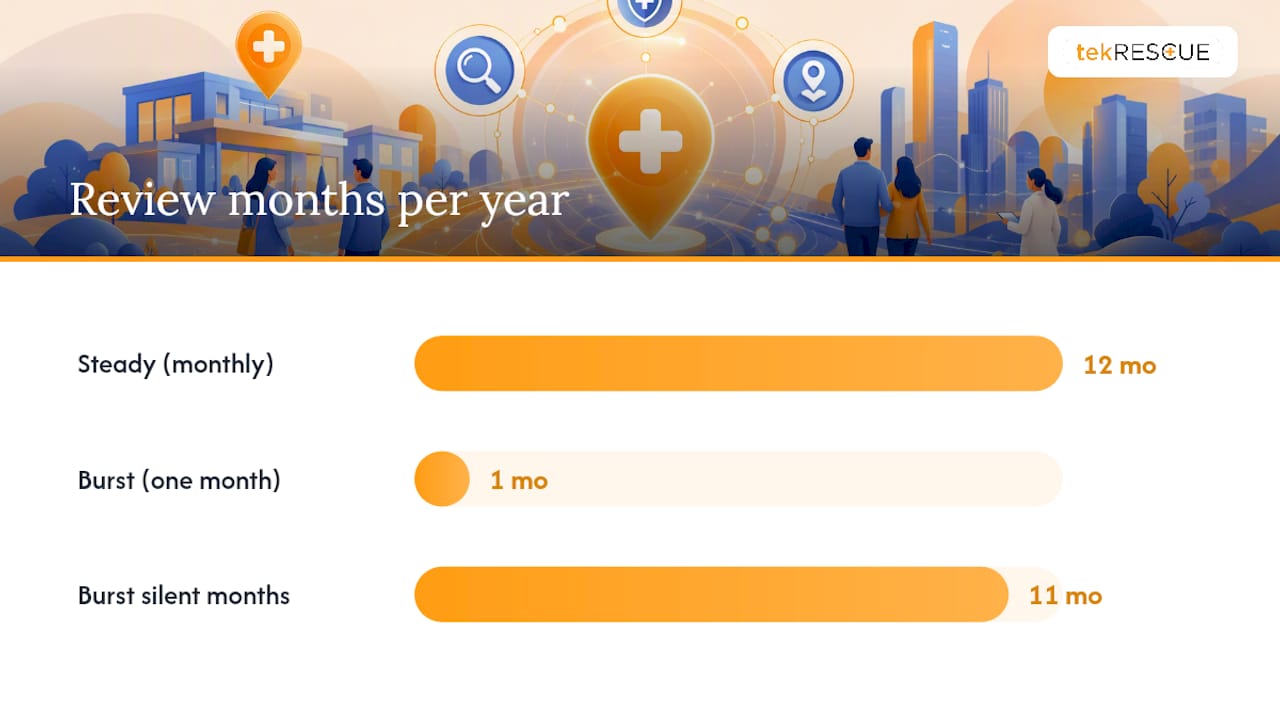
Review velocity, the steady drip of new reviews rather than a one-time pile, tends to outperform raw review count for map-pack competitiveness, according to Birdeye’s local healthcare SEO research. That single insight should reshape how you think about review generation: five reviews a month for a year beats sixty reviews in one push and then silence.
Building a compliant review request flow is where most practices stumble. You want to make asking easy without exposing any protected health information in the request itself. A text sent right after a visit, with a generic “how was your visit today?” prompt and a direct link, works far better than an email that references specific treatment details.
Pro Tip: Set your review request to trigger 90 minutes after a completed appointment, not immediately at checkout. Patients answering from the parking lot are more candid than patients still standing at the front desk.
Local ranking studies consistently point to GBP completeness, review signals, and citation consistency as the dominant factors search engines weigh for the map pack in medical practice search results, which is exactly why this section carries more weight than almost anything else in this checklist.
How Do You Build Provider Pages That Actually Rank?
Every provider on your staff needs a dedicated bio page, not a shared “Meet the Team” paragraph buried three scrolls down. A provider bio that ranks and converts needs the full name, credentials, specialties, education, hospital affiliations, a link to the National Provider Identifier (NPI) profile, languages spoken, and a clear scheduling call to action.
Location pages need their own non-negotiable list:
- Exact NAP matching every other listing, letter for letter.
- Hours, including holiday hours, updated before the holiday, not after.
- Parking details and building access notes.
- Accepted insurance plans listed by name.
- Services offered at that specific location, not a copy-pasted company-wide list.
- An embedded Google Map, not just a static address.
Structured data ties this together. Map your schema types deliberately: MedicalOrganization for the practice, Physician for each provider, and LocalBusiness for each physical location. Add FAQPage markup to your most-visited service and condition pages so common patient questions can surface directly in search results.
Linking architecture should flow in one direction: your locations hub links to each location page, each location page links to its assigned providers, and provider pages link out to relevant service pages. That structure gives search crawlers, and increasingly AI answer engines, a clear map of what belongs where.
Publishing Patient Content That Meets E-E-A-T Standards
Clinical content lives or dies on the opening two to four sentences. Answer the patient’s question immediately, then expand with context, caveats, and next steps. A page that opens with three paragraphs of background before answering “does this medication interact with ibuprofen” will lose both the reader and the AI system trying to extract an answer from it.
Byline discipline is not optional at this point. Every clinical page needs a named clinician as author, their credentials listed, and a visible medical reviewer with a link to their own profile page. Search Engine Journal’s analysis of health content in AI search found that pages surfacing clear author and reviewer signals get cited more often by AI overviews than anonymous or thinly attributed pages.
Citation discipline matters just as much. When you make a clinical claim, cite primary literature or a recognized health authority, the way peer-reviewed research indexed on PMC gets cited in academic writing. Never phrase content as prescriptive medical advice; frame it as general information and point patients toward a consultation for anything specific to their case.
- Open every clinical page with a direct answer, not a definition or a history lesson.
- Name the author and the medical reviewer on every page, with linked profiles.
- Cite primary sources, not other blogs, when making a clinical claim.
- Disclose any AI-assisted drafting explicitly, and only publish it after clinician review.
Pro Tip: If a piece of content was drafted with AI assistance, say so in a short disclosure line near the byline. Transparency here builds more trust than pretending every word was typed by the physician personally, and it protects you if the policy landscape around AI disclosure tightens.
Getting More Patient Reviews Without Breaking HIPAA
Timing decides whether a review request works. Send it right after a visit or a telehealth call, while the experience is still fresh, and keep the flow to 10 or 15 seconds on mobile. Anything longer than a tap, a star rating, and an optional comment box will lose most patients before they finish.
Response templates need to stay short and generic. Thank the patient, acknowledge the feedback, and invite anyone with a specific concern to follow up privately by phone or a secure message. Never confirm, deny, or reference any detail about their visit, diagnosis, or treatment in a public reply, even if they mentioned it themselves in their review.
Prioritize Google first, since it feeds both organic search and the Map Pack directly. Then layer in specialty directories where they genuinely matter, Healthgrades and Zocdoc for most primary care and specialist practices, since patients cross-reference those sites before booking.
- Trigger review requests within a few hours of appointment completion.
- Keep response templates under three sentences and free of any patient-specific detail.
- Track sentiment themes like bedside manner, wait times, and appointment access separately from star ratings.
- Fix the recurring complaint, not just the review that mentioned it.
Pro Tip: If “long wait times” shows up in three reviews in a month, that’s an operations problem wearing an SEO costume. Fix the scheduling gap before you fix the review response.
Technical Site Health Checklist for Medical Websites
A mobile-first build is not a preference at this point; it’s the baseline. A large majority of web traffic now comes from mobile devices, and a slow-loading provider bio page on a phone costs you the appointment before the patient ever reads your credentials.
Make sure your content is not trapped behind unrendered JavaScript that crawlers struggle to parse. Keep your XML sitemap current and your robots.txt file free of accidental blocks on pages you actually want indexed. This one technical mistake quietly kills more medical practice SEO campaigns than any content problem.
- Meet current Core Web Vitals targets for load speed, interactivity, and visual stability.
- Deploy MedicalOrganization, LocalBusiness, and Physician schema consistently, and validate every deployment with a rich results testing tool.
- Set canonical tags and 301 redirects correctly whenever a provider changes locations.
- Throttle new page publishing so crawlers can process your existing pages without a backlog forming.
Managing Multiple Locations Without Creating Duplicate Content
Every location with its own address, hours, or provider roster earns a dedicated page. A location that’s purely a satellite office with no unique staff or hours can sometimes live under a hub page instead, but don’t default to that shortcut just to save build time.
Templates keep multi-location sites consistent, but the template itself is not the content. Each page needs unique local data: which providers work there, which insurance plans that specific office accepts, actual hours, and actual parking notes. A template with the city name swapped out is the fastest way to build near-duplicate pages that Google quietly stops indexing.
Set operational rules and hold to them:
- Update provider location changes within 48 hours across the website and every directory listing.
- Run a full NAP audit on a quarterly cadence, not just once at launch.
- Redirect old provider or location URLs immediately when a physician relocates.
- Cap new page publishing to a reasonable percentage of your existing indexed base per month.
Agency audits of multi-location medical practices consistently show that page-coverage math, locations multiplied by providers multiplied by services, has to drive your content plan, or you end up with hundreds of thin pages that dilute rather than build authority.
What KPIs Should You Track for Medical SEO?
Track GBP actions first: calls, direction requests, and appointment link clicks. These respond fastest to the work you do in the first 30 days. Organic new-patient bookings and review velocity follow close behind as secondary indicators of momentum.
Expect GBP and review improvements to show measurable movement in 6 to 12 weeks. Content-driven rankings for competitive specialties take longer, typically 4 to 12 months depending on how saturated your specialty and market already are.
- Set up UTM-tagged appointment links so you can trace bookings back to their source.
- Add call tracking to distinguish GBP-driven calls from organic website calls.
- Build a conversion funnel that tracks all the way to completed appointments, not just form submissions.
- Test changes deliberately: run controlled listing copy tests, A/B test your booking flow, and stage content experiments incrementally rather than changing everything at once.
How tekRESCUE Structures Compliance-Aware SEO Rollouts
A GBP cleanup project should start with a full audit of every listing and directory entry tied to a practice, followed by a standardized NAP correction pass and a recurring audit cadence, typically quarterly, to catch drift before it compounds.
Review request flows need to be built HIPAA-aware from the first draft, not patched later. That means generic trigger messages with no visit-specific language, and response templates that thank the patient publicly while routing any real concern to a private channel.
For multi-location and multi-provider clients, a schema mapping checklist paired with a publish-throttle rule set keeps growth from outrunning what search engines can properly index:
- Map every provider to Physician schema with linked NPI references.
- Map every office to LocalBusiness schema with unique service and insurance fields.
- Cap monthly page publishing relative to the current indexed page count.
- Review the entire schema deployment quarterly against updated rich results standards.
This section reflects the practical experience of Randy Bryan and tekRESCUE’s implementation work with healthcare clients navigating HIPAA and FTC advertising requirements.
What Actually Breaks Medical SEO in Practice?
The failures I see repeated across practices are rarely exotic. They’re duplicated location pages built from the same template with a city name swapped in, orphaned provider bios with no internal links pointing to them, and a Google Business Profile that hasn’t been touched since a physician left two years ago. None of these require a redesign to fix.
If you’re deciding between hiring outside help or handling this in-house, the honest answer depends on staff bandwidth, not budget alone. A practice with someone who can dedicate a few hours weekly to NAP audits and review responses can handle the maintenance layer internally. The technical schema work and the initial content architecture, though, tend to go faster with someone who has done it before.
Three fixes deliver disproportionate return for the effort: a full NAP audit, publishing real provider bios instead of a shared team page, and turning on a structured review request flow. None of them require a new website. All three can start this week.
— Randy Bryan
How tekRESCUE Helps You Fix This Faster
tekRESCUE is the alternative to piecing together medical SEO from generic templates and guesswork: a HIPAA-aware partner that builds GBP cleanup, provider bio rollout, and technical crawlability into one coordinated project instead of three disconnected vendor invoices. For a practice trying to fix duplicated location pages or a stale Google Business Profile without risking a compliance misstep, coordination can make the difference between a checklist that gets half-finished and one that actually ships.
The immediate next steps are straightforward: a GBP and NAP audit to find where your listings conflict, a provider-bio rollout built with proper schema, and a technical crawl to catch indexing gaps before they cost you rankings. If your practice needs a website that can actually carry this kind of SEO work, tekRESCUE’s approach to building sites that convert visitors is a solid place to start. Reach out to get a quote on where your practice stands today.
This article is general information, not a substitute for advice from a qualified doctor. Consult a qualified healthcare professional about your own circumstances before acting on anything here.
Sources
- PMC article (example source for medical literature)
- Statista: Share of website traffic coming from mobile devices
- Google: Creating helpful, people-first content
- How to create health YMYL content that performs in AI search — Search Engine Journal
FAQ
What Does SEO Mean in Healthcare?
SEO in healthcare means optimizing a practice’s website, Google Business Profile, and provider pages so patients searching for care find that practice first, while meeting the stricter trust and accuracy standards Google applies to medical (YMYL) content.
What Are Good SEO Practices for a Medical Practice?
The strongest practices combine a complete, accurate Google Business Profile with consistent NAP data, named provider bios backed by schema markup, and clinical content that opens with a direct answer and cites credible sources.
What Does SEO Stand For?
SEO stands for search engine optimization, the practice of improving a website’s visibility in unpaid search results. In medicine, it extends to local listings, provider-level pages, and AI answer engines, not just traditional search rankings.
Table of Contents