

$9,000 Over 5 Years? Small Business Website Cost + Vendor Checklist
A professional small-business website typically costs between $2,500 and $12,000 to build, with most owners landing near $3,000 to $8,000 for a solid five-page site, and $50 to $500 a month afterward to keep it running. DIY builders can get you live for under $500 in year one. If you’re deciding between doing it yourself, hiring a freelancer, or going with an agency, the sections below break down exactly where that money goes.
TL;DR:
- Small business website costs typically range from $2,500 to $12,000 for a professional build, with ongoing maintenance averaging $50 to $500 per month.
- DIY website options can cost under $500 in the first year but offer limited customization and support, suitable for very simple needs.
- Feature additions like ecommerce or multi-location sites can increase total costs by $1,500 to $10,000, depending on complexity and integrations.
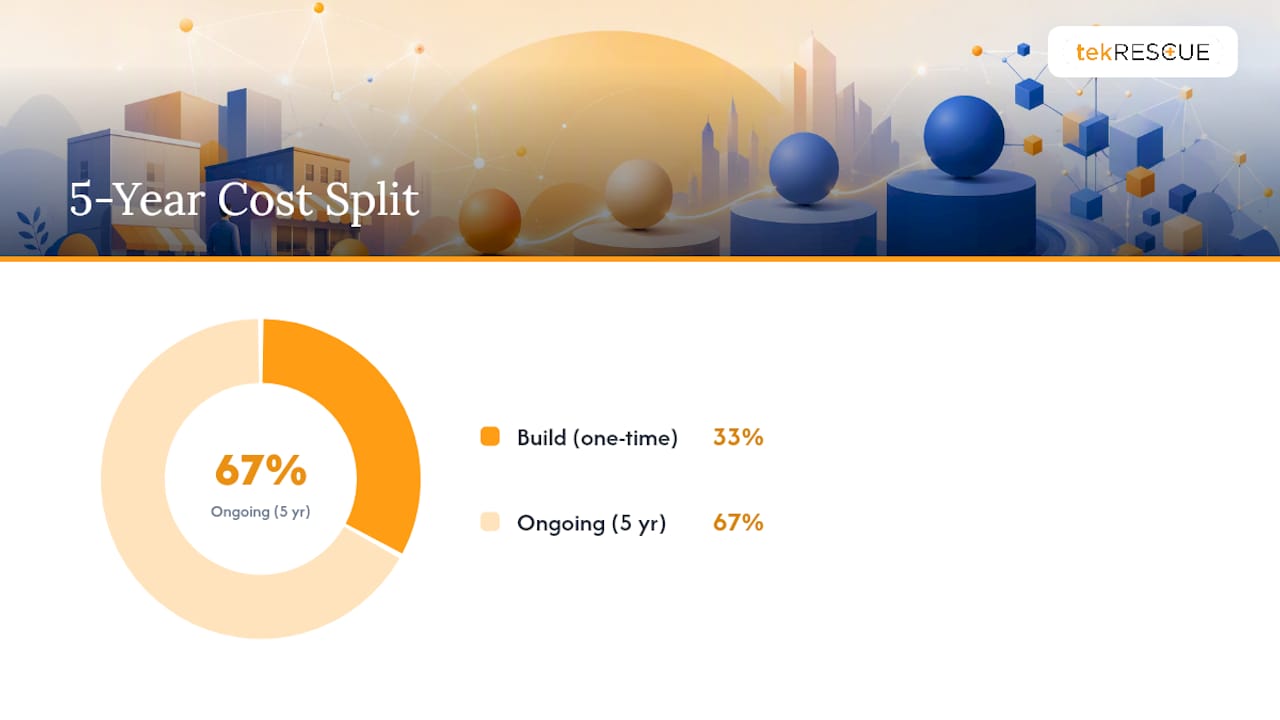
- For ongoing expenses, a $3,000 freelancer site with $100 monthly maintenance totals around $9,000 over five years, making recurring costs a significant part of the budget.
- Budgeting for security and compliance, especially for sensitive data handling, is crucial, as security costs are often overlooked but essential for risk management.
Table of Contents
Table of Contents
- How Much Does a Small Business Website Cost? Quick Cost Snapshot
- What Does Each Build Path Actually Deliver?
- What Drives the Cost Up? Pages, Features, and Compliance
- What Will a Small Business Website Cost You Every Year After Launch?
- How Should You Budget for a Website and Estimate Its ROI?
- What Questions Should You Ask a Website Vendor Before You Sign?
- Why Pricing a Website Right Also Means Securing It Right
- Ready to Build a Website That Fits Your Budget and Your Growth?
- Sources
- FAQ
How Much Does a Small Business Website Cost? Quick Cost Snapshot
Here’s the range breakdown by build path, based on current industry pricing data:
- DIY builder (Wix, Squarespace): costs primarily subscription fees and a domain, generally low in the first year, according to Forbes.
- WordPress + managed hosting: $500 to $3,000 upfront, plus $145 to $640+ per year in hosting and plugin costs, per GoDaddy.
- Freelancer build (5 pages): generally runs in the range of multiple thousands of dollars, according to an analysis of 600+ project quotes.
- Boutique agency: $5,000 to $12,000 for the same scope, with more strategy and design polish baked in.
- Full custom agency build: generally starts in the higher thousands and often much more, when integrations, multiple locations, or a web application layer are required.

Statistic Callout: A DIY site can run as little as $0 to $450 in its first year, while professional builds generally start around $1,500 and climb from there depending on scope.
Adding ecommerce typically tacks on $1,500 to $5,000 depending on catalog size and payment integrations. For total cost of ownership, a $3,000 freelancer build with $100 a month in hosting and maintenance adds up to roughly $9,000 over five years once you account for renewals, security monitoring, and content updates. Timelines run two to four weeks for a simple template site, six to ten weeks for a custom freelancer or boutique build, and three to six months for a full custom agency project with integrations.
What Does Each Build Path Actually Deliver?
Picking a build path is really about matching your budget to how much hand-holding, customization, and long-term flexibility you need. Here’s what each tier actually gets you:
- DIY builders. You’re building it yourself using a drag-and-drop platform. Expect 10 to 40 hours of your own time, limited customization, and no dedicated support if something breaks. This fits a sole proprietor who needs a digital business card, not a growth engine.
- Template plus freelancer. A freelancer installs a pre-built theme (often using a tool like Elementor on WordPress) and customizes colors, copy, and layout. This cuts development time significantly while still letting you tweak branding. Turnaround is usually two to three weeks.
- Custom freelancer or boutique agency. Here you’re paying for actual user-experience design, conversion-focused layout, and quality assurance testing across devices. This is where a site stops looking like a template and starts looking like it was built for your business specifically.
- Full agency or custom build. Justified when you need CRM integrations, multi-location architecture, or a genuine web application (booking engines, client portals, custom dashboards). This tier involves project managers, developers, and QA specialists working as a team, not one person wearing every hat.
Hourly rates vary widely by region and skill level. US-based freelancers commonly charge $75 to $135 an hour, while agencies bill $100 to $300 an hour for specialized teams, according to the same project-cost dataset. A contract scope should spell out exactly how many hours or revisions that rate buys you.

Pro Tip: Ask any vendor for a fixed-price quote on defined deliverables rather than an open hourly estimate. Scope creep on hourly billing is how a $3,000 project quietly becomes $9,000.
What Drives the Cost Up? Pages, Features, and Compliance
Base pricing scales with page count and feature complexity, and understanding this breakdown lets you sanity-check any quote you receive:
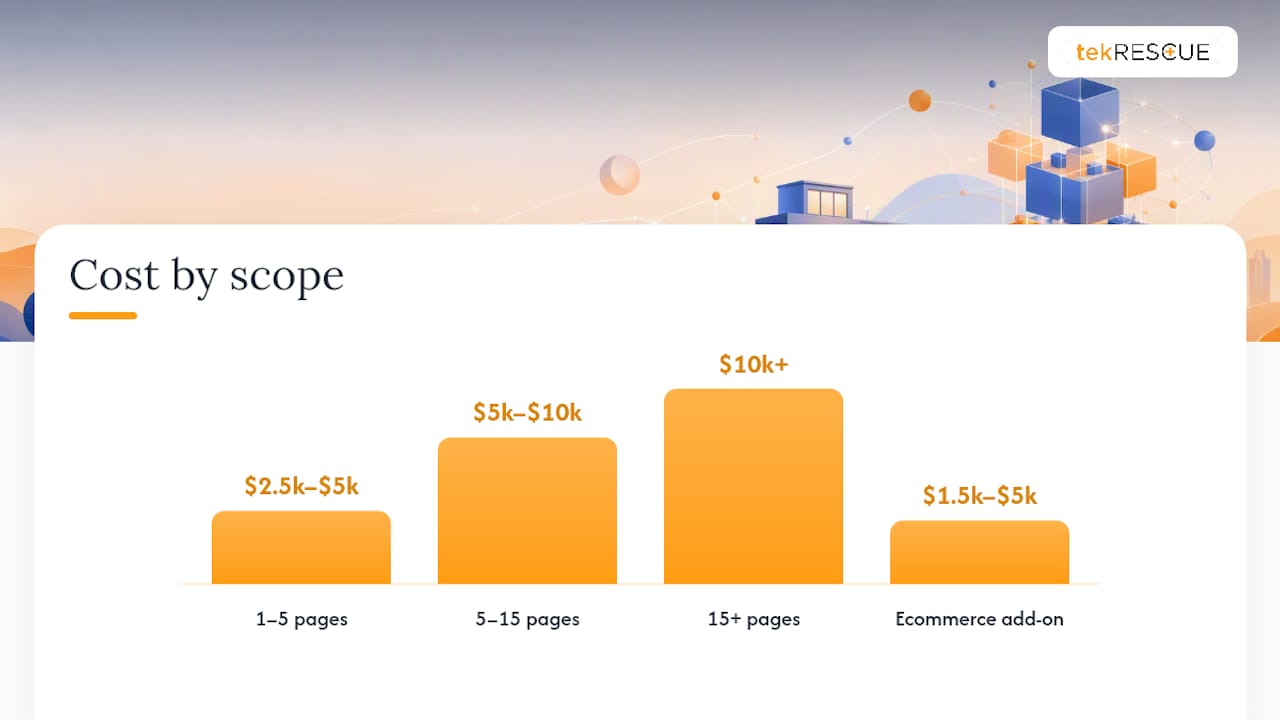
- 1 to 5 pages: the baseline range most freelancers quote, typically $2,500 to $5,000.
- 5 to 15 pages: expect $5,000 to $10,000 as content strategy, internal linking, and additional design templates multiply the work.
- 15+ pages or multi-location sites: $10,000 and up, often requiring a content management structure built for scale.
Feature add-ons stack on top of the base build. Ecommerce cart and checkout functionality adds $1,500 to $5,000 depending on product count and payment gateway complexity. Booking systems, membership portals, and CRM or ERP integrations each typically add $500 to $3,000 individually, since each requires custom configuration and testing.
Statistic Callout: Basic hosted builder sites run $145 to $640+ per year, but development costs for complex custom sites can exceed $10,000 once you layer in specialized features.

Design tier matters too. A template costs the least but offers the least differentiation. Premium customization sits in the middle, adjusting layout and branding without a ground-up rebuild. Full custom UX design costs the most but delivers a site built specifically around how your customers actually convert.
If you handle sensitive data, healthcare intake forms or payment information, compliance work adds real cost. HIPAA-ready forms, encrypted data handling, and secure hosting configurations typically add several hundred to a few thousand dollars depending on how much personal health information the site touches. This isn’t optional for medical practices or any business bound by federal privacy standards. It’s a line item, not an afterthought.
What Will a Small Business Website Cost You Every Year After Launch?
The build is a one-time expense. What surprises most owners is the recurring bill, which never stops once the site goes live. Ongoing maintenance for small-to-medium business websites commonly runs $50 to $500 a month depending on complexity, and that range covers hosting, security monitoring, plugin subscriptions, and periodic content updates.

Hosted site builders bundle hosting and security into one subscription, which makes costs predictable but sometimes higher over time. Self-hosted WordPress lowers the platform subscription cost but raises maintenance overhead, since you’re now responsible for updates, backups, and security patching yourself or through a managed provider, per GoDaddy’s cost comparison.
Here’s what a typical annual budget breaks down to:
Costs scale with traffic and transaction volume. An ecommerce site processing thousands of orders a month needs more server capacity and payment processing bandwidth than a five-page brochure site, and that scaling shows up directly in your hosting tier.
Run the math on a $3,000 freelancer build with $100 a month in combined hosting and maintenance. Over five years, that’s $6,000 in ongoing costs added to the $3,000 build, for a total of $9,000, as the project cost data confirms. The build itself is often the smaller number in that equation.

Pro Tip: Budget the ongoing cost before you sign off on the build. A cheap build with an expensive maintenance plan can cost more over five years than a pricier build with efficient hosting.
How Should You Budget for a Website and Estimate Its ROI?
Deciding how much to spend now versus later comes down to a few practical rules of thumb rather than guesswork.
- Set a floor, not just a ceiling. Most professional small-business sites start around $1,500, and going meaningfully below that usually means sacrificing either design quality or functionality you’ll need later.
- Calculate your lead value. If one new customer is worth $500 to your business and your site generates two leads a month it wouldn’t have otherwise, that’s $1,000 a month in value against a $3,000 build. Payback happens in three months.
- Phase the build instead of cutting corners. Launch a lean five-page site focused on conversion, then add booking systems, blogs, or ecommerce in a second phase once revenue justifies it. This approach, outlined in tekrescue’s guide to building a digital foundation for growth, keeps early spending focused on what actually generates business.
- Prioritize conversion mechanics over cosmetics. A fast-loading site with clear calls to action and simple contact forms outperforms a beautifully animated site that takes six seconds to load. Speed and clarity convert. Decoration doesn’t.
- Reserve budget for a retainer. Many small businesses see the best return by starting lean and investing the savings into an ongoing content and SEO retainer rather than a bigger upfront build.
What Questions Should You Ask a Website Vendor Before You Sign?
Every proposal should answer these questions before you commit money:
- Who owns the code and content once the project is finished, you or the vendor?
- What’s included in the hosting and backup plan, and what happens if the site goes down?
- How many rounds of revisions are included, and what costs extra?
- What’s the maintenance scope after launch, and what’s the monthly retainer if you want ongoing support?
- What’s the payment schedule, and is any portion tied to acceptance testing rather than just a delivery date?
Red flags to watch for: a quote with no itemized breakdown, a vendor who can’t explain what happens to your site if you stop paying a monthly fee, or anyone unwilling to put ownership terms in writing. If a proposal seems dramatically cheaper than the ranges above, ask what’s being cut. It’s usually either QA testing, mobile optimization, or post-launch support.
A reasonable warranty period covers 30 to 90 days of bug fixes at no charge. Beyond that, expect a monthly support retainer in the $100 to $500 range depending on site complexity. Your contract checklist should include: clear ownership language, a defined payment schedule tied to milestones, a written list of deliverables, and an acceptance test before final payment releases. TekRescue’s own breakdown of project phases from idea to launch shows what a well-structured timeline actually looks like.
Pro Tip: If a vendor won’t put maintenance costs in writing before you sign the build contract, assume they’re higher than average and plan accordingly.
Why Pricing a Website Right Also Means Securing It Right
Most small businesses treat website cost as a design and development question. It’s also a security question, and that’s where a lot of budgets fall short. A site that handles customer data, whether that’s a contact form, a payment gateway, or patient intake forms, carries real risk if it isn’t built and maintained with security in mind. An effective approach bundles design, SEO, security hardening, and ongoing support into one package because these pieces don’t work well in isolation. A beautifully designed site with no security monitoring is a liability waiting to surface.
Continuous maintenance isn’t a luxury add-on. It’s what keeps a site fast, keeps plugins patched, and keeps compliance requirements like HIPAA-ready data handling intact as your business grows. The businesses that get the best return on their website investment are the ones that budget for the full lifecycle from day one, not just the launch date.
— Randy Bryan
Ready to Build a Website That Fits Your Budget and Your Growth?
Some providers build small-business websites with design, SEO, security, and managed support handled together, so you’re not juggling separate vendors for your site, your hosting, and your compliance needs — learn about effective AI tools for small businesses that can speed content production and marketing. Packages typically start in the range expected from a boutique agency build, with ongoing support priced to match your site’s complexity rather than a one-size-fits-all retainer. If you’re weighing a DIY builder against hiring help, an advantage of working with a managed partner is that security patching, backups, and SEO upkeep happen automatically instead of becoming one more task on your plate. See how tekrescue builds websites that convert visitors into customers and request a project estimate to see where your business fits in these ranges.
Sources
- How Much Does A Website Cost? (2026 Guide)
- How much does a website cost in 2026?
- Average Website Cost in 2026 — Data from 600+ Project Quotes
- Ongoing Website Costs After Launch in 2026 | Website Cost Estimator
FAQ
Is $1,500 a Good Price for a Website?
Yes, for a simple, professionally built site. $1,500 sits near the entry point for professional builds according to Forbes, though a full five-page custom site with a freelancer typically runs $2,500 to $5,000.
Do I Need an LLC to Run a Website?
No, you don’t need an LLC to launch or own a business website. It’s a separate legal decision about liability protection, unrelated to website cost or platform choice.
Is It Worth Making a Website for a Small Business?
Yes, for most small businesses a website pays for itself through lead generation alone. If one customer is worth several hundred dollars and the site generates even a couple of leads a month, payback often happens within a few months.
Why Is Owning a Website So Expensive?
The build cost is only part of the bill. Hosting, security monitoring, plugin subscriptions, and content updates add $50 to $500 a month, and over five years those recurring costs often exceed the original build price.
What’s Included in a Typical Small Business Website Package?
A typical package from a provider like tekrescue bundles custom design, basic SEO setup, hosting configuration, and security hardening, so you’re not sourcing each piece separately from different vendors.
Recommended
Table of Contents