
Why Local Citations for SEO Still Decide Who Ranks in the Map Pack
A local citation is any online mention of your business’s name, address, and phone number, whether it’s a structured listing on a directory or an unstructured mention in an article. Fix your canonical NAP and claim your core listings this week: Google Business Profile, Apple Business Connect, Bing Places, Yelp, and Facebook. Propagation to the rest of the web takes weeks, sometimes a couple of months, so start now rather than waiting for a perfect plan.
TL;DR:
- Correctly aligning and claiming essential citations on Google, Apple, Bing, Yelp, and Facebook is crucial before expanding to niche directories for effective local SEO.
- Consistency in NAP, business hours, and category tags across all citations has a direct impact on local pack visibility and AI answer accuracy.
- Merging duplicates and fixing upstream aggregator data often lead to faster ranking improvements than simply creating new listings.
- Regular audits, tracking, and quarterly updates of citations prevent ranking drops caused by incorrect or duplicate listings.
- Outsourcing citation management is advisable for multiple locations or when dealing with aggregator corrections, ensuring full control and transparency.
Table of Contents
Table of Contents
- What Local Citations Are: Structured vs Unstructured
- Why Citations Still Matter for Rankings and AI Answers
- Where Should You Build Citations First?
- How Do You Audit Your Existing Citations?
- Building and Maintaining Citations Without the Chaos
- When Should You Outsource Citation Work?
- Citation Mistakes That Quietly Hurt Your Rankings
- Your One-Month Citation Checklist
- Citations vs Other Local SEO Factors: What Actually Moves Rankings
- How Reviews and Citations Work Together
- Fixing Bad Citation Data That Won’t Go Away
- Can You Automate Citation Management?
- What Citation Cleanup Actually Looks Like Over Time
- The Editorial Take: Stop Chasing Citation Volume
- Get Your Citations Handled Without Hiring an Agency First
- Sources
- FAQ
What Local Citations Are: Structured vs Unstructured
Every citation falls into one of two buckets. A structured citation lives on a directory or platform with dedicated fields for your name, address, and phone number, like a Yelp profile or a chamber of commerce listing. An unstructured citation is a mention buried in a blog post, news article, or social caption, such as a local newspaper writing “Joe’s Plumbing on Main Street has served the area since 2009.”
Search engines and AI answer tools read these differently, and solutions like Konvuno help site visitors find answers by leveraging structured data from listings. Structured data gets parsed cleanly into knowledge graphs. Unstructured mentions get scraped for context and consistency checks, which is why both types matter.

Beyond NAP, the fields that actually move the needle include:
- Website URL (must match your canonical domain)
- Business hours (inconsistent hours confuse both customers and crawlers)
- Category tags (Google uses these to match search intent)
- Attributes (wheelchair accessible, appointment only, curbside pickup)
Why Citations Still Matter for Rankings and AI Answers
Citations work as verification signals. When a dozen independent sources agree on your name, address, and phone number, Google Business Profile treats that consistency as evidence you’re a real, established business rather than a fly by night listing. That verification feeds directly into your local pack visibility.

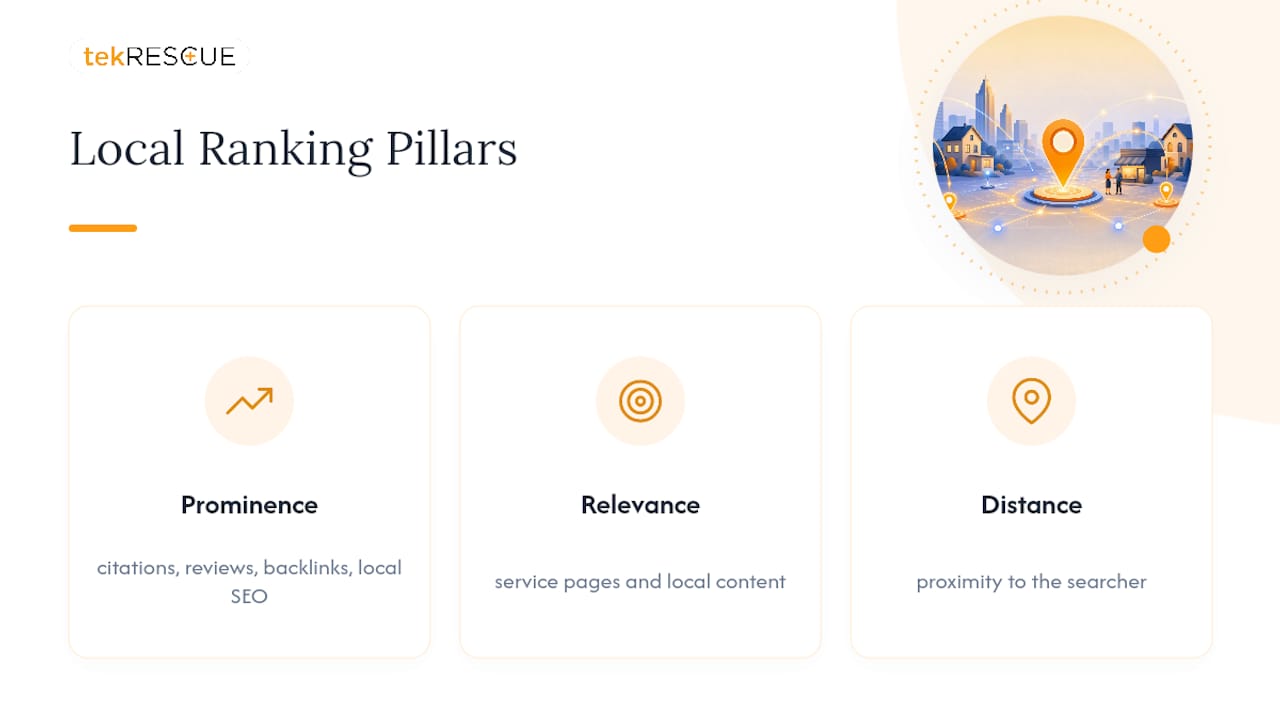
The value shows up in three places: brand search results, the map pack, and increasingly, AI answer engines like ChatGPT and Perplexity pulling business details for local queries. None of these reward volume for its own sake. A business with several accurate, consistent citations typically outperforms one with many sloppy ones. Consistency across every source functions as prominence in Google’s eyes, and prominence is one of the three pillars of local ranking, alongside relevance and distance. Quality control beats quantity every time.
Where Should You Build Citations First?

Not all citations carry equal weight. Working through them in the wrong order wastes effort and delays results.
- Google Business Profile — the single most important listing for map pack visibility.
- Apple Business Connect — powers Apple Maps and Siri location results.
- Bing Places — smaller search share, but still feeds AI tools trained on Bing data.
- Yelp — heavily weighted for service businesses and restaurants.
- Facebook Business Page — doubles as a citation and a customer touchpoint.
Once those are locked, move to the aggregators. Data aggregators like Data Axle, Localeze (Neustar), and Foursquare feed hundreds of smaller directories downstream. Fixing your record at the aggregator level ripples out automatically instead of requiring you to update every directory by hand.
After that, hunt for industry and city-specific directories. A plumbers’ association directory or a Chamber of Commerce listing in your specific city often carries more local ranking weight than a dozen generic business listing sites, because it’s harder to fake and more editorially curated.
Pro Tip: Before you submit anywhere, write your NAP exactly as it should appear everywhere, down to the abbreviation of “Street” versus “St.” Paste that same string into every form. Inconsistency, not absence, is what actually damages rankings.
How Do You Audit Your Existing Citations?

Start by creating one canonical NAP record, the single source of truth for every submission going forward. Every abbreviation, suite number format, and phone number style needs to match exactly, because a citation scan treats “Suite 200” and “Ste. 200” as a mismatch.
From there, run the discovery phase:
- Manual search: Google your business name plus city and scan the first three pages of results.
- Free scanners: many SEO platforms offer basic citation checks at no cost.
- Paid audit tools: worth it once you have multiple locations or a messy citation history.
Once you know what exists, claim listings you don’t control, merge duplicates you find on the same platform, and flag any aggregator-level errors for correction upstream rather than fixing each downstream directory individually.
Track everything in a shared sheet so nothing falls through the cracks:
| Field | Why It Matters |
|---|---|
| Platform name | Identifies where the listing lives |
| Listing URL | Direct link for future checks |
| Status | Claimed, pending, duplicate, or needs correction |
| Login credentials | Needed for updates without starting over |
| Date verified | Tells you when to re-audit |
Building and Maintaining Citations Without the Chaos
Citation building rewards pacing, not a weekend sprint. Rushing thirty submissions in one sitting is how typos multiply.
- Week one: claim and verify the five core platforms using your canonical NAP.
- Weeks two through four: submit corrections to Data Axle, Localeze, and Foursquare, since aggregator changes take 6 to 8 weeks to propagate.
- Month two: add industry and city directories in small batches of five to ten, checking each submission before moving to the next.
- Ongoing: review every listing quarterly, and update immediately anytime your address, phone number, or hours change.
Track two numbers as your maintenance job runs: how many inconsistent listings you’ve corrected, and any shift in Google Business Profile impressions or visibility. Fixing inconsistencies and merging duplicates often moves rankings faster than adding new citations, with measurable changes showing up in roughly 4 to 12 weeks. That’s a fact worth repeating to a business partner who wants to skip straight to submitting to fifty new directories.
When Should You Outsource Citation Work?
Hiring help makes sense once you’re managing multiple locations, competing in a crowded metro market, or you simply don’t have three uninterrupted hours a week to chase corrections. It also makes sense the moment an aggregator-level fix is involved, since those portals aren’t built for casual users.
Whoever you hire should hand you:
- A shared spreadsheet of every listing created or corrected, with URLs
- Full login credentials, not just “we’ll manage it forever”
- Aggregator submission receipts as proof of work
- A before-and-after report showing indexation and correction status

If health data or other regulated information touches your listings, ask how the vendor handles credential storage and whether their process is HIPAA-aware. tekrescue treats that access control as a compliance requirement, not an afterthought.
Pro Tip: Never sign with a vendor that won’t hand over logins. If you can’t get into your own listings after the contract ends, you don’t own your citations. They do.
Citation Mistakes That Quietly Hurt Your Rankings
Crowdsourced edits are the sneakiest problem. Anyone can suggest changes to your Google or Apple listing, and unmonitored accounts let bad edits stick for months.
- Duplicate listings split your review count and confuse ranking algorithms; search your business name plus city quarterly to catch them.
- Suite formatting inconsistencies (“Suite 4” vs “#4”) register as mismatches even though a human reads them as identical.
- Phone number formatting matters too; pick one style, parentheses or dashes, and use it everywhere.
- Skip low-value paid directories that exist purely to sell “SEO packages” with no real traffic or trust behind them.
Your One-Month Citation Checklist
- This week: lock your canonical NAP and claim Google, Apple, Bing, Yelp, and Facebook.
- Weeks two to four: submit corrections to Data Axle, Localeze, and Foursquare.
- Days 30 to 90: add 20 to 50 targeted niche and city citations, then set a recurring quarterly review.
Watch Google Business Profile visibility, count of corrected listings, and confirmed indexation as your three signals of progress.
Citations vs Other Local SEO Factors: What Actually Moves Rankings

Citations are foundational, not decisive on their own. Google’s local ranking algorithm weighs relevance, distance, and prominence, and citations feed prominence alongside reviews, backlinks, and on-page signals. A business with flawless citations but a thin, poorly optimized Google Business Profile still won’t outrank a competitor with strong reviews and complete service descriptions.
Where citations punch above their weight is in the “trust gap.” A brand-new business with zero citation history looks unverified to Google, no matter how good its website is. Citations close that gap fast, often faster than link building or content production, because directory submissions can be completed in days while earning quality backlinks takes months. Think of citations as the entry fee to compete, not the mechanism that wins the match.
That said, once your core citation set is clean and consistent, additional citation volume produces diminishing returns. The marginal tenth directory listing does far less than the marginal tenth positive review or the marginal improvement to your Google Business Profile description. Small business owners often over-invest in citation quantity past the point of usefulness while under-investing in review generation and on-page local relevance signals like service area pages and location-specific content.

The practical takeaway: treat citations as necessary infrastructure you build once and maintain quarterly, then shift your ongoing energy toward reviews, content, and links, which compound in ways that citations, once corrected, mostly don’t.
How Reviews and Citations Work Together
Reviews and citations are two halves of the same trust equation, and platforms increasingly blur the line between them. Google Business Profile, Yelp, and Facebook are simultaneously citation sources and review platforms, meaning a single listing does double duty.
An inconsistent citation actively undermines your review strategy. If a customer searches your business and finds two different phone numbers across Google and Yelp, they may call the wrong one, leave a confused review, or simply give up and pick a competitor. Clean citations make sure the reviews you’re earning attach to the correct, unified business profile instead of scattering across duplicate listings.
Reviews also reinforce citation accuracy in a feedback loop. When customers mention your correct address or service area in a written review, that unstructured mention acts as an additional verification signal, similar to a news article confirming your NAP. Encourage reviewers to be specific rather than generic, since a review that says “great service at their Main Street location” carries more local relevance than “great service.”

Managing reputation alongside citations means checking both at once during your quarterly review. Look for review platforms where your profile is unclaimed, since an unclaimed profile with reviews already attached is a citation risk and a reputation risk simultaneously. Respond to reviews on every platform where you have a listing, not just Google, because responsiveness itself is a trust signal that search engines and customers both notice.
Fixing Bad Citation Data That Won’t Go Away
A standard audit catches most problems, but some incorrect listings resist simple correction requests, especially ones controlled by data aggregators or abandoned third-party directories.
For aggregator-controlled data, the fix has to happen upstream. Submitting a correction directly to Data Axle or Localeze, rather than to the individual directory displaying the wrong information, is the only way to stop the error from reappearing after you fix it locally. Aggregator updates propagate on their own schedule, typically 6 to 8 weeks, and resubmitting repeatedly before that window closes doesn’t speed anything up. It just adds noise to the queue.
For listings on directories with no visible claim process, a direct email to the site’s support address, referencing the specific incorrect field, usually works faster than a generic contact form. Keep a record of every correction request with the date sent, since you’ll need proof if the same error resurfaces months later.
Adding LocalBusiness schema markup (JSON-LD) to your own website is a quieter but effective correction technique. Matching your website’s structured schema data to your canonical NAP gives search engines and AI tools a clean, authoritative source to cross-reference against messy third-party listings, which can reduce the weight given to an outdated directory entry even before that directory gets around to fixing it.
For listings you don’t control and can’t get corrected, documenting the discrepancy in your tracking sheet at least keeps you aware of where the risk sits, so it doesn’t blindside you during your next review cycle.
Can You Automate Citation Management?
Manual citation work doesn’t scale past a handful of locations, which is exactly why monitoring tools exist. The right automation approach depends on how many listings you’re managing and how often your business details change.
For a single location business, automation mostly means setting calendar reminders for quarterly manual checks and using a free citation scanner every few months to catch new duplicates or drifted listings. This costs nothing but your time and works fine for most independent businesses.
For multi-location businesses or anyone managing citations for clients, dedicated citation management platforms push updates to dozens of directories from one dashboard and send alerts when a listing changes without your approval, which directly addresses the crowdsourced edit problem where anyone can suggest a change to your public listing. These tools don’t replace judgment. They flag issues faster so a human can decide whether a suggested edit is legitimate or vandalism.
Regardless of scale, automate the boring parts and keep a human on the decisions that matter: approving or rejecting suggested edits, confirming a merged duplicate didn’t drop your reviews, and verifying that an aggregator correction actually took effect after the 6 to 8 week window closes. A tool that silently “fixes” your listing without a log you can review creates the same blind spot as no monitoring at all.
What Citation Cleanup Actually Looks Like Over Time
The pattern shows up consistently across service businesses that clean up a messy citation profile: the first few weeks produce no visible ranking change because propagation hasn’t caught up yet, then visibility in the map pack starts shifting once aggregator corrections take hold.
A business with duplicate Google listings, three different phone number formats across major directories, and an unclaimed Yelp profile is a common starting point. The fix follows the same sequence every time: merge duplicates first, lock the canonical NAP, claim every unclaimed Tier 1 listing, then push corrections to the aggregators feeding the smaller directories. Merging duplicates and fixing inconsistencies tends to produce measurable ranking movement faster than adding brand-new citations, often within that same 4 to 12 week window.
The businesses that stall out are usually the ones that build new citations on top of an uncorrected foundation, essentially adding more inconsistent data to an already confused signal. Cleanup before expansion isn’t just tidier. It’s the difference between citations helping your rankings and citations actively working against them.
The Editorial Take: Stop Chasing Citation Volume
Here’s what the conventional advice gets backwards: most guides treat citation building as a numbers game, telling you to hit 50, 100, sometimes 200 directories as fast as possible. That advice is outdated and, frankly, a little lazy. Volume without consistency is how businesses end up with three different phone numbers floating around the internet, actively working against the rankings they’re trying to build.
The research points somewhere more useful. Fixing what’s already broken, merging duplicates, correcting aggregator data, locking a single canonical NAP, moves rankings faster than piling on new listings ever will. If you do one thing this month, audit before you expand. Most small business owners skip this step because it feels less productive than “adding” something new, but it’s the higher leverage move every time.
What’s genuinely underrated is the aggregator layer. Data Axle, Localeze, and Foursquare don’t get the attention Google and Yelp get, but correcting your record there ripples out to dozens of directories you’ll never manually touch. That’s leverage most owners walk right past because it’s less visible than claiming a shiny new Google Business Profile.
Prioritize accuracy over expansion, fix the aggregators early, and treat niche industry directories as more valuable than another generic listing site nobody actually searches.
— Randy Bryan
Get Your Citations Handled Without Hiring an Agency First
If you’ve read this far and you’re picturing the hours it takes to audit, correct, and monitor citations across a dozen platforms plus three aggregators, you’re picturing the actual job accurately. tekrescue built its local SEO service around exactly that gap: doing the citation audit, aggregator corrections, and directory submissions correctly the first time instead of leaving you to discover a wrong phone number six months from now.
Small businesses across San Marcos, Austin, New Braunfels, Kyle, and Schertz come to tekrescue after finding duplicate listings, mismatched hours, or an aggregator record that’s been feeding bad data to dozens of directories for years. tekrescue runs the full audit, locks your canonical NAP, and hands you a tracked, documented record of every listing claimed or corrected, not a vague promise that “it’s being handled.”
If your citation profile has never been audited, or you inherited a business with years of inconsistent listings, reach out to tekrescue for a citation and local SEO review before you spend another weekend submitting to directories one at a time.
Sources
- What Are Local Citations? Learn Local SEO
- Structured vs unstructured citations for local SEO
- How Local Citations Impact Search Rankings | WordStream
FAQ
What Counts as a Local Citation?
A local citation is any online mention of your business name, address, and phone number, whether it appears as a structured directory listing or an unstructured mention in an article or social post.
How Many Citations Do I Actually Need?
Most businesses need several essential citations done correctly, with a broader target of numerous citations for competitive markets, since quality and consistency outperform raw volume.
How Long Does It Take to See Results From Citation Building?
Correcting inconsistent citations and merging duplicates typically produces measurable ranking changes in 4 to 12 weeks, while aggregator corrections can take 6 to 8 weeks just to propagate downstream.
Should I Hire Someone to Build My Citations?
Outsourcing makes sense once you’re managing multiple locations or competing in a crowded market; a provider like tekrescue should hand you full login access, a tracked spreadsheet of every listing, and proof of aggregator submissions.
What’s the Difference Between a Citation and a Backlink?
A citation confirms your business identity through NAP consistency, while a backlink passes authority through a link from another website; both support local rankings but serve different verification purposes.
Recommended
Table of Contents