
Vector Database Basics: What They Are and How They Work
A vector database stores information as lists of numbers, called vectors, that represent meaning. It then finds the items closest in meaning to a query instead of matching exact words. That one idea powers much of the AI your business now touches: smarter search, chatbots that answer from your own documents, and product recommendations.
If you run a business, here is the uncomfortable truth. You may already be feeding customer files, contracts, or patient records into AI tools that rely on this technology. Understanding the basics is the first step to using it well and to keeping that data protected.
Table of Contents
TL;DR
- A vector database stores embeddings, which are numerical representations of text, images, or audio, and retrieves results by similarity of meaning.
- Traditional SQL databases excel at exact matches and transactions. Vector databases excel at “find me things like this.”
- Their biggest business use today is retrieval-augmented generation (RAG), which gives an AI model your own current information to answer from.
- Many small businesses do not need a standalone vector database. Some relational databases now handle vector search.
- Anything you put into a vector database is still business data. It needs the same access control, backups, and compliance attention as the rest.
Table of Contents
- What is a vector database, in simple terms?
- Vectors and embeddings, explained
- How a vector database finds what you are looking for
- Vector database vs. traditional database
- Why vector databases matter for AI: RAG
- Other business uses
- Do you actually need one?
- The security side nobody puts in the demo
- Our perspective
- How tekRESCUE can help
- A simple starting plan
- FAQ
- Sources
What is a vector database, in simple terms?
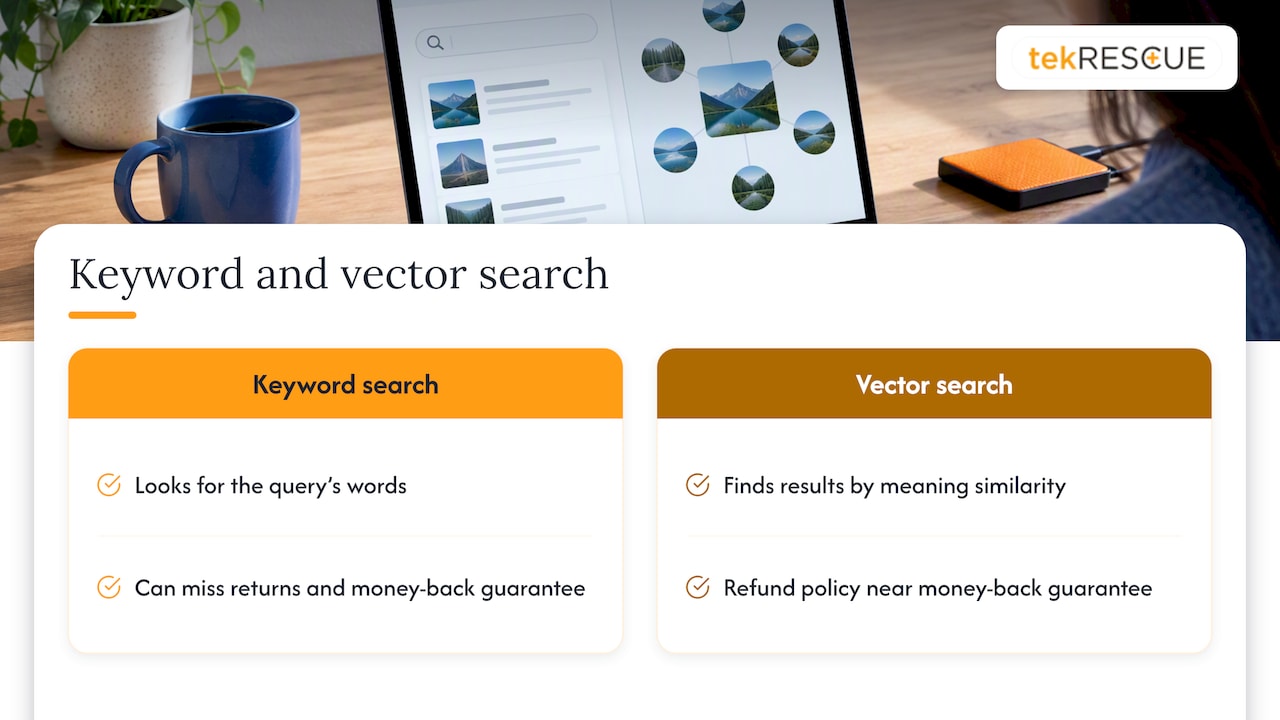
Start with how a normal search works. You type “refund policy” and the system looks for those words. If your document says “returns and money-back guarantee,” a keyword search can miss it.
A vector database solves that. Stanford HAI describes it as a database that stores data as numerical lists called vectors representing the underlying meaning of information, so you can find results by how similar they are in meaning to your search. Images or text that are conceptually related end up near each other.
Google Cloud puts it as any database that lets you store, index, and query vector embeddings, which are numerical representations of unstructured data such as text, images, or audio.
Think of a map. Every piece of content gets a location. “Refund policy” and “money-back guarantee” land on the same block. “Holiday party schedule” lands across town. The database’s job is to find the nearest neighbors to whatever you ask about.
Vectors and embeddings, explained
Two terms do most of the work here.
Vector: an ordered list of numbers, such as 0.12, -0.83, 0.45, and so on. The count of numbers is the vector’s dimension. Real embeddings often have hundreds or thousands of dimensions, which is why you will see the phrase “high-dimensional.”
Embedding: a vector produced by a machine learning model to capture the meaning of a piece of data. According to Google Cloud, embeddings are arrays of floating-point numbers that translate unstructured data into a format machine learning models can process, and semantically similar items sit closer together in vector space.
TechTarget notes that embeddings aim to capture the meaning of data points and their relationships more precisely than conventional text-based metadata.
Where embeddings come from
An embedding model reads your content and outputs the numbers. Academic work on these systems notes that the embedding model can live inside or outside the database system. In practice, most small businesses call an embedding model through a service and store the results.
One practical catch: embeddings from different models are not interchangeable. DigitalOcean’s documentation says that when you change embedding models, you need to recompute and reindex your embeddings, because models differ in dimensions and in how they organize similarity. Switching tools later has a real cost.
How a vector database finds what you are looking for
The search workflow is short:
- Embed your content. Documents, product descriptions, or support tickets are converted to vectors and stored, usually with metadata such as title, date, or department.
- Embed the question. When a user searches, their query is turned into a vector by the same model.
- Measure distance. The database compares the query vector against stored vectors.
- Return the closest matches. The nearest items come back, ranked by similarity.
Similarity metrics
The comparison uses a distance or similarity measure. Google Cloud lists dot product, cosine similarity, and Euclidean distance as common choices. MongoDB’s overview names the same three. Choosing among them matters: researchers call selecting an appropriate similarity score a critical problem, with options from simple measures to learned ones. Your embedding model’s documentation usually tells you which to use.
Approximate, not exact
Comparing a query against millions of vectors one by one is slow. So these systems use approximate nearest neighbor (ANN) algorithms, which trade a small amount of accuracy for speed on large datasets. For a company with a few thousand documents, the trade-off is barely noticeable. At millions of records, it is the reason the technology exists.
Hybrid search
Semantic search alone is not always enough. If a customer searches for an exact invoice number, you want an exact match. Advanced vector databases support hybrid queries that combine SQL-style filters on metadata, such as “only documents from this year,” with vector similarity.
Vector database vs. traditional database
The two are tools for different jobs, and they increasingly overlap.
| Traditional (relational) database | Vector database | |
|---|---|---|
| Best at | Structured data, exact lookups, transactions | Similarity and meaning-based retrieval |
| Data shape | Tables, rows, columns | High-dimensional vectors plus metadata |
| Query style | SQL: “find customers where state = TX” | “Find content most similar to this” |
| Typical use | Billing, inventory, customer records | Semantic search, recommendations, RAG |
Microsoft Learn explains that traditional databases organize data into rigid tables and are best for structured data and transactional integrity, while vector databases manage high-dimensional data optimized for similarity and semantic context.
Is SQL a vector database?
Not by itself. SQL is a query language. But the line is blurring. A VLDB 2024 paper reports that many relational databases, including Oracle, PostgreSQL, Azure SQL, and MySQL, now support vector similarity search. If you already run one of those, you may be able to add vector search without adding a new system.
There is also a distinction between a full system and a software library. Academic work argues that a true vector database management system must also provide functions like access control, backups, and scalability, not just fast vector search. For a business, that list is exactly what you should check before putting company data in one.
Why vector databases matter for AI: RAG
Large language models (LLMs) know what they were trained on. They do not know your pricing sheet, your internal procedures, or last week’s policy change. And they sometimes make things up.
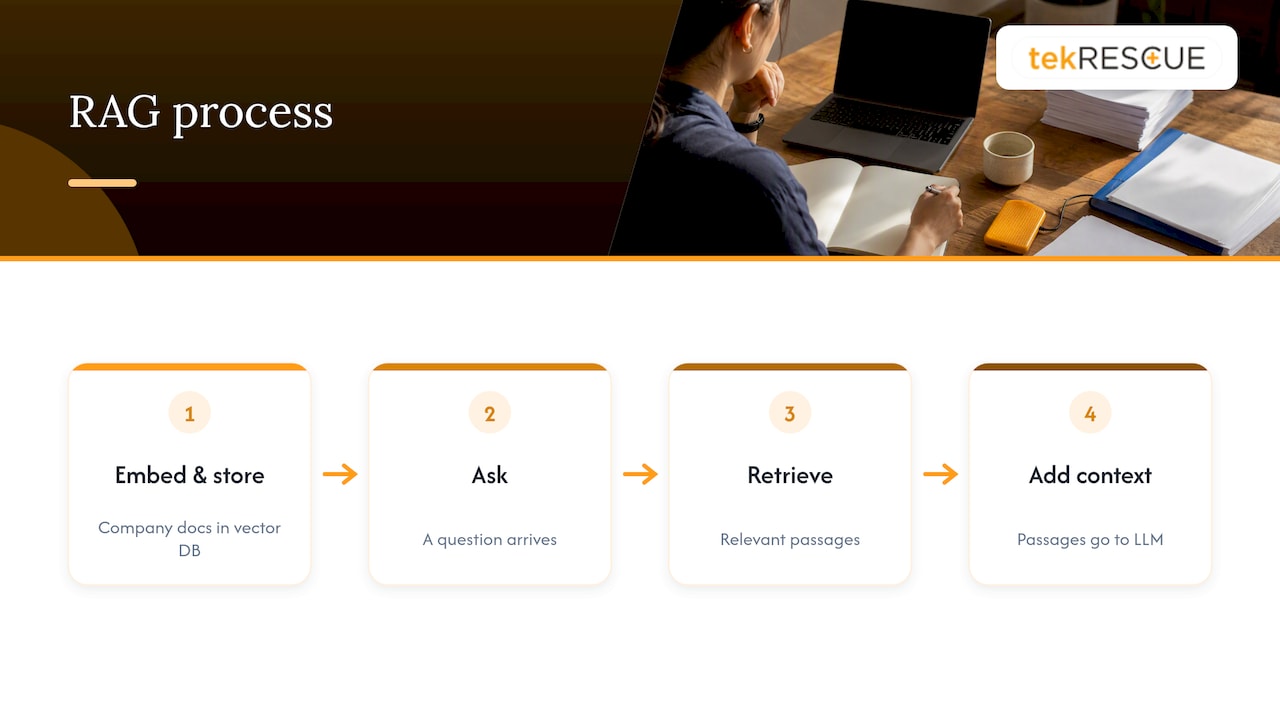
Retrieval-augmented generation (RAG) addresses this. Your documents are embedded and stored in a vector database. When someone asks a question, the system retrieves the most relevant passages and hands them to the model as context. Microsoft Learn identifies RAG as a critical use case, giving LLMs recent or proprietary context. Microsoft Azure adds that this improves accuracy and reduces hallucinations.
Experts on a VLDB 2024 panel described vector databases as external knowledge bases that address LLM limits, including hallucinations and missing domain-specific or real-time knowledge.
Does ChatGPT use a vector database?
The answer depends on what you mean. OpenAI publishes a Retrieval API for semantic search over your own data, and it states that the API is powered by vector stores that serve as indices for your data. So if you build a custom assistant on OpenAI’s platform and upload company files, a vector store is part of how it finds the right passages. We have not seen a published statement of how the consumer chat app answers every question internally, so we will not claim to know.
Other business uses
Beyond chatbots, vector search shows up in practical places:
- Recommendations. Google Cloud’s BigQuery documentation describes recommending product substitutes based on customer behavior and similarity.
- Log analytics. The same documentation says vector search can help triage anomalies and speed up investigations. That one matters to security teams.
- Internal knowledge search. Staff ask a question in plain language and get the right policy page, not a list of 40 files.
- Customer support. Matching a customer’s question to the closest existing answer. Our piece on AI in customer service covers how that plays out.
TechTarget observes that vector databases were once a niche technology and are now used more widely to support AI and machine learning, including generative AI.
Do you actually need one?
Here is a practical way to decide. Oracle’s guidance says to weigh data types, performance, and whether you need exact matches or flexible similarity retrieval. Turn that into questions:
- Is your data mostly unstructured? Documents, emails, images, and call transcripts benefit. Orders and invoices do not.
- Do people search in natural language and get poor results today? That is a semantic search problem.
- Are you building an AI assistant on your own content? That is RAG.
- How big is the collection? A few thousand documents rarely justifies a separate system.
- Do you already run a database with vector support? Start there. The open-source pgvector extension, for example, lets PostgreSQL store and query embeddings alongside the rest of your data.
If you answered no to the first three, you probably do not need one yet. Many businesses get further by cleaning up their data and website content first.
The security side nobody puts in the demo
Vector databases are often introduced as an AI feature, and security comes later. That order is backwards.
Embeddings are derived from your real content. A vector store built from client files, financial records, or patient notes is a concentrated copy of sensitive information, and it sits next to a new set of tools, connectors, and credentials. Treat it like any other system holding regulated data:
- Control who and what can query it. Service accounts and AI connectors need least-privilege access, not a shared admin key.
- Encrypt and back it up. The academic definition of a full vector database system explicitly includes access control and backups. If a product lacks them, you inherit the gap.
- Know what went in. If HIPAA-covered information or customer financial data is being embedded, compliance obligations follow it. Do not load it into a tool until you have confirmed how the vendor handles that data.
- Plan for incidents. If an AI pipeline is compromised, you need logs and a response plan before the problem, not after.
Our perspective
We work with small and mid-sized businesses on web development, SEO, managed IT, cybersecurity, and AI consulting. Here is what we see when owners ask about vector databases.
First, the technology is real, but the pressure to buy it is often louder than the need. Most owners we talk to want something simpler: an assistant that answers questions from their own documents, or search that works. That is a business problem first and an infrastructure choice second.
Second, security is the weak link nobody budgets for. Every new AI tool adds data stores, API keys, and integrations. Each is a place an attacker can reach. For healthcare practices and firms handling financial data, the compliance exposure arrives the day the first record is embedded, not the day the project launches.
Third, content quality decides the result. A vector database retrieves what you give it. Outdated, contradictory, or messy documents produce outdated, contradictory answers. We would rather help you fix the source material and lock down access than sell you another system. That same content discipline is what makes your pages show up in AI-driven search, a topic we cover in our guide to optimizing content for AI search.
— Randy Bryan
How tekRESCUE can help
If you are weighing an AI project, start with a plan rather than a product. Our Strategic AI Consulting helps small and mid-sized businesses decide where AI fits, and our cybersecurity services include risk assessment so you know what a new data store exposes before you build it. If your team handles protected health information, we also support HIPAA compliance. For a wider look at the topic, read how AI analyzes data and why humans should care.
A simple starting plan
- Pick one use case. Internal document search or a support assistant, not “AI everywhere.”
- Inventory the content. Remove duplicates and outdated files. Flag anything regulated.
- Check your existing database first. Ask your IT provider whether it supports vector search.
- Choose the embedding model deliberately. Changing it later means recomputing and reindexing everything.
- Set access rules before launch. Decide who can query, who can add data, and how it is logged.
- Test with real questions. Ask what your staff and customers actually ask, and check the answers against the source.
FAQ
What is a vector database in simple terms?
It is a database that stores the meaning of your content as lists of numbers and retrieves items by similarity instead of exact keywords. A search for “returns” can surface a page about “money-back guarantees.” It is the storage layer behind many AI search and chatbot tools.
Is SQL a vector database?
No. SQL is a query language for relational databases. However, several relational systems, including PostgreSQL, Oracle, and MySQL, now support vector similarity search, so you can sometimes add it to a database you already run.
Does ChatGPT use a vector database?
OpenAI’s platform offers a Retrieval API built on vector stores, so assistants you build with your own uploaded files can use one. We have not found a published description of the consumer chat app’s internals, so we do not make claims about it.
What is a vector database used for in a business?
The most common uses are retrieval-augmented generation for AI assistants, semantic search across documents, and recommendations. Each works by retrieving the content closest in meaning to a question or a customer’s behavior.
Do small businesses need a vector database?
Often not as a separate product. If you have a modest amount of content, or already run a database with vector support, start there. A dedicated system makes sense when you have large volumes of unstructured data and a clear AI use case.
Sources
- What is a Vector Database? | Stanford HAI
- What is a vector database & how does it work? | Google Cloud
- Vector Search | DigitalOcean Documentation
- What is a vector database? | TechTarget
- Vector Database Management Techniques and Systems | Purdue
- Vector database management systems: Fundamental concepts | arXiv
- What Are Vector Databases? | MongoDB
- Understanding Vector Databases | Microsoft Learn
- Vector Databases: What’s Really New and What’s Next? | VLDB
- What is a vector database? | Microsoft Azure
- Introduction to embeddings and vector search | BigQuery
- What Is Vector Search? | Oracle
- Retrieval | OpenAI
- Vector Similarity Search with PostgreSQL’s pgvector | Severalnines
Recommended
Table of Contents