
Publish in 6–8 Weeks: SEO Content Plan for Small Teams
An SEO content plan is a decided list of what you will publish, why each piece earns a place on that list, and what would get it cut. It is not a calendar of publish dates. Start by picking one territory, one pillar topic, and 5 to 10 supporting pieces around it. Most small teams can research, brief, and publish that first cluster in 6 to 8 weeks.
TL;DR:
- Focusing on keyword difficulty under 20 and high opportunity scores ensures small teams target attainable, high-impact topics within their niche.
- Building clusters around one pillar page with five to ten supporting posts optimizes topical authority without overextending limited resources.
- Starting with a clear territory statement that excludes unrelated topics prevents drift and maintains content relevance.
- Prioritizing refreshes of content that ranks near page one over creating new articles delivers better long-term results with less effort.
- Maintaining a strict six-week production cycle and defined roles keeps small teams on track and reinforces consistent publishing momentum.
Table of Contents
Table of Contents
- Building an SEO Content Plan: the Stage Map
- How Do You Pick a Content Territory?
- How Do You Match Search Intent to Content Format?
- What Metrics Matter for Small-Team Keyword Research?
- How Do You Structure Topic Clusters Around a Pillar?
- How Do You Score and Sequence Content Topics?
- What Should Every Content Brief Include?
- How Do You Run a Weekly Publishing Workflow?
- When Should You Refresh, Rewrite, or Kill Content?
- How tekRESCUE Applies This Framework With Clients
- How Do User Personas Fit Into an SEO Content Plan?
- Which On-Page SEO Elements Belong in Every Brief?
- How Should You Promote and Distribute Published Content?
- How Do You Handle Content Updates After an Algorithm Change?
- The Real Difference Between Planning and Publishing
- Let tekRESCUE Audit or Build Your Content Plan
- Sources
- FAQ
Building an SEO Content Plan: the Stage Map
An SEO content plan moves through eight stages, and the order is not optional. Skip territory definition and jump straight to keyword research, and you end up with a folder of unrelated articles that rank for nothing in particular. A content plan decides what belongs on the list and what gets rejected, which is exactly why sequence matters more here than in most marketing work.

Here is the stage map, in the order a lean team should run it:
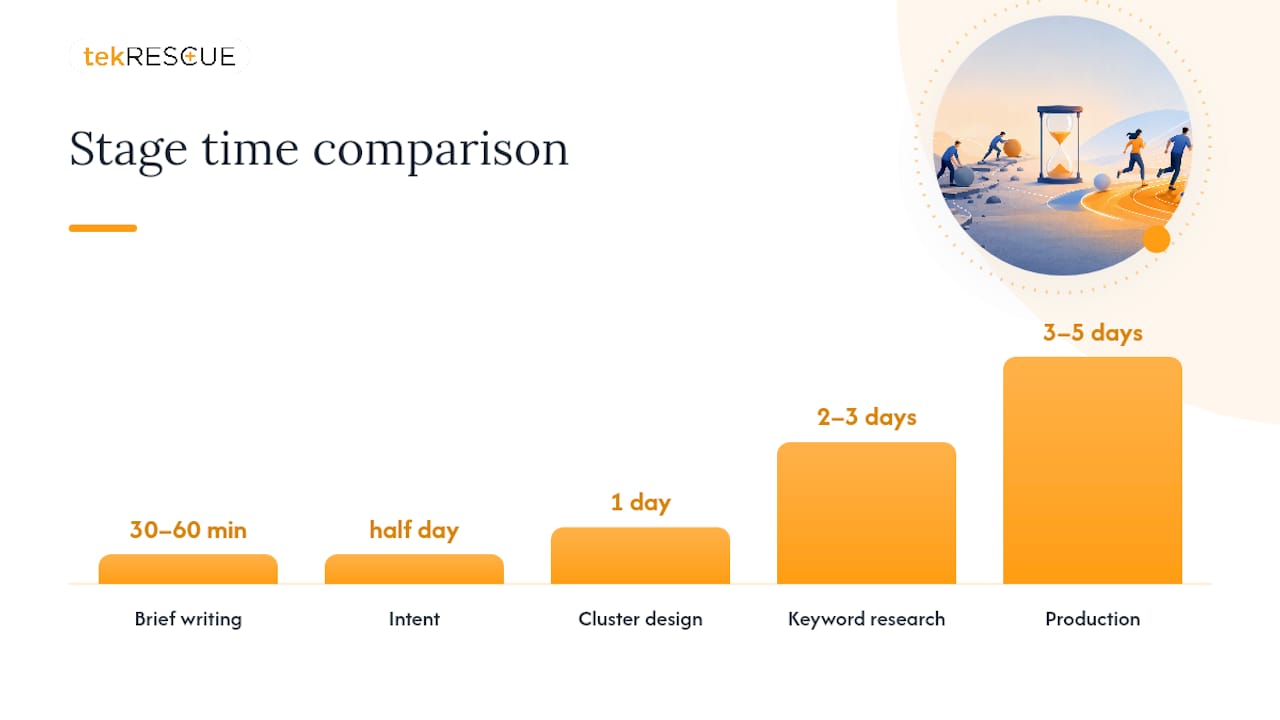
- Territory. Define the one subject area your business can credibly own. This takes an afternoon, not a sprint.
- Intent. For every candidate topic, figure out what the searcher actually wants and what format satisfies it. Half a day per batch of 20 topics.
- Keyword research. Pull volume, difficulty, and SERP composition for your shortlist. Two to three days for a first pass.
- Cluster design. Group topics under pillars and map the internal links between them. One working session, roughly a day.
- Prioritization. Score and sequence the list so early wins come first. A few hours once the cluster map exists.
- Brief writing. One brief per piece, using a standard template. Thirty to sixty minutes per brief once the template is set.
- Production. Writing, editing, and QA against a scorecard. Timeline depends on team size, but budget 3 to 5 days per long-form piece.
- Measurement. Track performance at fixed checkpoints and feed the results back into the next planning cycle.
Each stage produces something concrete you can point to later. Territory gives you a one-sentence rule. Intent gives you a format decision per topic. Keyword research gives you a scored shortlist. Clustering gives you a pillar map with linking rules attached. Prioritization gives you a sequenced production queue. Briefs give you a document every writer can work from without a meeting. Production gives you a published page that passed a quality bar. Measurement gives you a decision: refresh, leave alone, or kill.
The stages that eat the most calendar time for a two- or three-person marketing team are keyword research and production, in that order. Everything else compresses well once you have done it once and built the templates. That is the real payoff of running the stages in sequence: the second cluster takes half the time of the first because the territory rule, the brief template, and the scoring formula already exist.
How Do You Pick a Content Territory?

A territory statement is a single sentence that tells you what to write about and, more usefully, what to say no to. The template is simple: “We help [audience] do [outcome], so we own content about [territory].” Write it, print it, and use it as a veto rule every time a tempting but unrelated topic idea shows up in a brainstorm.
A strong territory statement is narrow enough to guide a decision. “We help small clinics reduce no-shows, so we own content about patient communication and scheduling software” tells you immediately that a general article on healthcare marketing trends does not belong on the list. A weak one reads like a mission statement: “We help businesses grow through better marketing.” That sentence approves everything and rejects nothing, which defeats the purpose of having it.
Before you commit to a territory, run three quick validation checks:
- Customer questions. Pull the last 50 support tickets, sales call notes, or intake forms and see what people actually ask before they buy.
- Existing assets. Check what you already have expertise, data, or case studies for. Territory should follow proof, not aspiration.
- Proprietary data. Note anything you measure or track that competitors cannot easily replicate. That becomes your strongest content, because it cannot be matched by a generic AI-generated post.
Pro Tip: Write your territory statement before you open a keyword tool. Teams that start with keywords first tend to build a list of disconnected winnable phrases instead of a plan that adds up to topical authority.

If your territory statement can approve almost any topic idea, it is too broad to function as a decision rule. Rewrite it until it excludes something.
How Do You Match Search Intent to Content Format?
Search intent falls into four practical classes: informational (someone wants to learn something), navigational (someone wants a specific site or page), commercial investigation (someone is comparing options before buying), and transactional (someone is ready to act). Get the class wrong and you get the format wrong, no matter how well the piece is written.
The fastest way to confirm intent is to look at what already ranks. Search the exact keyword and count the format types across the top 10 results. If eight of ten results are numbered listicles, Google has already decided the format that satisfies that query, and a single comprehensive guide is unlikely to outrank them regardless of quality. If the top 10 mixes comparison tables and product pages, the query sits in commercial investigation, and your content brief should call for a table, not a narrative.
Match format to what the SERP composition tells you:
- How-to and tutorial content wins informational queries where searchers need a process, not a decision.
- Listicles dominate when searchers want options fast and are still exploring, not comparing.
- Comparison pages fit commercial investigation, where the searcher already has a short list and wants differences spelled out.
- Pillar or hub pages work for broad head terms where searchers want an overview before drilling into specifics.

Set the brief fields by format. A how-to brief needs numbered steps and a materials or prerequisites list. A comparison brief needs the exact criteria to score against. A listicle brief needs the count and the selection logic. A pillar brief needs the supporting posts it will link to, decided in advance, not discovered mid draft.
What Metrics Matter for Small-Team Keyword Research?
Four metrics decide whether a keyword belongs on your shortlist: search volume, keyword difficulty, intent match, and SERP features. Skip any one of them and you risk chasing a phrase that gets traffic nobody converts on, or one that no realistic amount of effort will rank for.
Volume tells you demand exists, but it means nothing without a difficulty check against your own site’s authority. A newer site with modest domain strength should filter for keyword difficulty under roughly 20, per the small-team playbook approach recommended by Jottler, and set a minimum volume floor high enough to avoid phrases with essentially zero searchers behind them. A more established site can push into higher-difficulty terms because it already has the backlink and authority signals to compete.
Intent match matters as much as the number. A keyword with strong volume but the wrong intent class wastes a production slot. Check SERP features too: featured snippets, “People Also Ask” boxes, and video carousels each change what a page needs to include to compete for real visibility, not just a ranking position ten links down the page.

Build your shortlist from these sources:
- Free signals first. Google Search Console’s existing queries, “People Also Ask” boxes, and autocomplete suggestions cost nothing and reflect real searcher language.
- Community language. Forum threads and niche community discussions often surface the exact phrasing practitioners use, which tools sometimes miss entirely.
- Competitor gap checks. Look at what ranks for your top three competitors that you have not covered at all.
- Paid tools for scale. Once the free pass is done, a paid keyword tool fills in volume and difficulty numbers faster than manual checks.
Search visibility increasingly extends beyond the traditional ten blue links. Modern SEO strategy has to account for AI-generated answers and cross-platform visibility, which means your keyword tracker should have a column for whether an AI answer shows up for that query and which domains it cites. That cited-domain list becomes a real target for earned mentions, not just a curiosity.
Treat every keyword decision through the lens of your territory statement one more time before it makes the shortlist. A high-volume, low-difficulty term that sits outside your territory is still a rejection.
How Do You Structure Topic Clusters Around a Pillar?
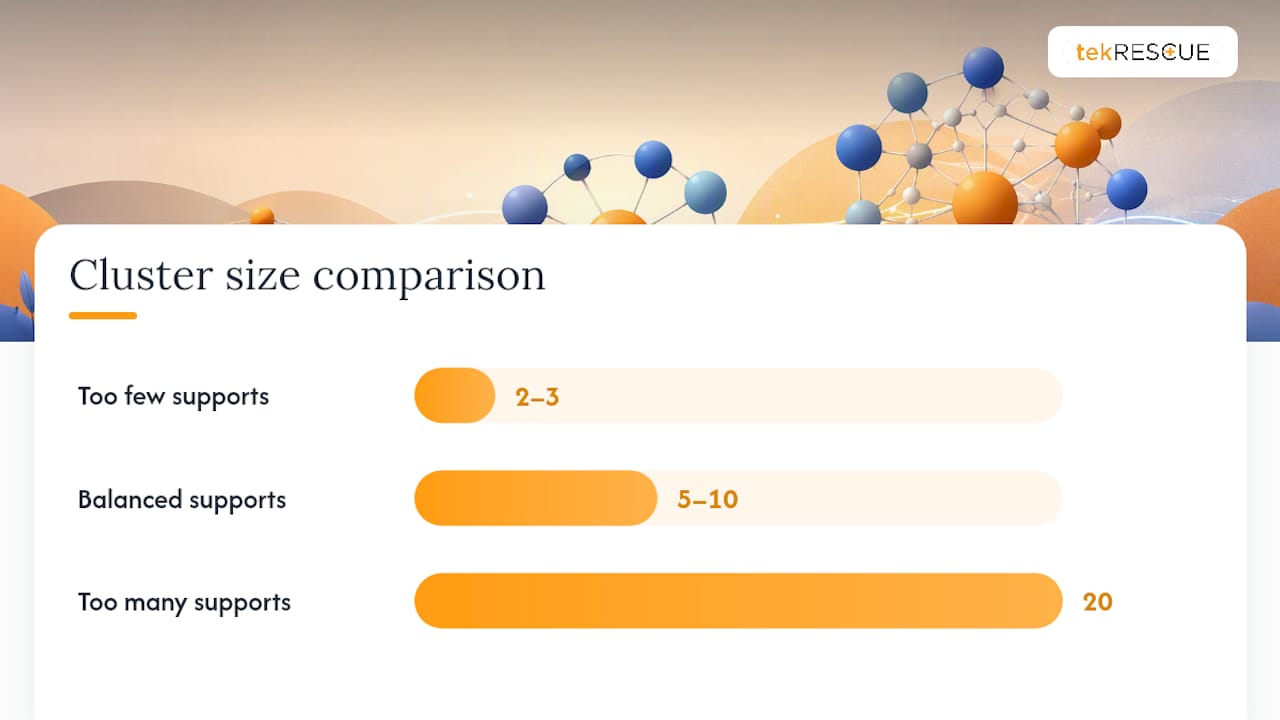
A cluster is one pillar page surrounded by 5 to 10 supporting posts that link to it and to each other, concentrating topical authority around a subject instead of scattering it across disconnected pages. Pillar and supporting-post structures are the most effective format small teams use to compete for broader head terms without the domain authority a larger competitor might have.

Sizing the cluster correctly matters more than most teams assume. A pillar with only two or three supports rarely generates enough internal linking signal to move the pillar’s own ranking. A pillar with 20 supports spreads a small team’s production capacity too thin and delays the point where any of it starts working. Five to ten supports per pillar is the range that balances depth against a lean team’s actual output.
Assigning page types up front prevents cannibalization, which happens when two pages target the same keyword and compete against each other instead of Google picking one to rank. Before you write a single brief, list every planned URL, its target keyword, and its intent class in one sheet. If two rows share a keyword or an intent class that is nearly identical, merge them into one page before production starts, not after you notice both underperforming.
Internal linking rules should be written down, not left to whoever happens to be editing that week:
- Every support links up to its pillar using descriptive anchor text that matches how the pillar is likely to be searched, not generic phrases like “click here.”
- The pillar links down to every support it belongs with, ideally in a structured list near the top or a clear navigation element.
- Supports link sideways to each other only when there is a genuine reader reason, not to hit a linking quota.
- Anchor text varies across links pointing to the same page so the link profile does not look manufactured.
A simple internal-link plan for a cluster on, say, small business website maintenance would have the pillar page linking out to supports on hosting, backup routines, plugin updates, and site security, with each support linking back up and referencing one or two sibling posts where genuinely relevant.
How Do You Score and Sequence Content Topics?
Score every topic with a simple formula before you sequence anything: Opportunity equals search volume divided by keyword difficulty, with business relevance to your territory statement as the tiebreaker when two topics land close together. This single number does more to prevent wasted production time than any amount of gut-feel prioritization.
Sequencing then follows a straightforward rubric:
- Quick wins first. Topics with high opportunity scores and direct territory relevance go into week one and two of your production queue.
- Pillar next. The pillar page itself should publish early in the cluster’s build, ideally by week three, so supporting posts have something live to link to.
- Fill-ins last. Lower-scoring but still relevant supports round out the cluster through weeks four to six.
- Reject anything that fails the territory test, regardless of how attractive its opportunity score looks in isolation.
A 6-week tactical window keeps a cluster from sprawling indefinitely. Set a hard end date for the first pillar cluster before you start, publish the pillar and at least half the supports inside that window, and treat anything not finished by week six as a candidate for the next cluster’s planning cycle instead of an open-ended backlog item.
Capacity based publishing rules matter more than ambition here. If your team can realistically produce two pieces a week, plan for two pieces a week. Committing to five and delivering one destroys the sequencing logic entirely, because quick wins that should compound early get delayed behind a pillar that never quite gets finished.
Pro Tip: Set a rejection rule alongside the scoring formula: any topic scoring in the bottom quartile of your shortlist AND falling outside the core territory gets cut before it reaches a brief, no exceptions and no “we’ll get to it later” pile.
What Should Every Content Brief Include?
A content brief needs a small number of mandatory fields, written once as a template so nobody starts a piece from a blank page. Skipping the template is the single most common reason small teams produce inconsistent output as they scale past their first few articles.
Mandatory brief fields should cover: target keyword and its intent class, the chosen format, a sample H2 outline (typically five to eight headings), the internal links the piece must include, the word count range, and the call to action or conversion goal for the page. A brief missing any of these forces the writer to make editorial decisions that should have been made during planning.
A pre-publish quality scorecard keeps standards consistent without adding a lengthy review cycle. Check readability level, metadata (title tag and meta description length), internal link count against the brief, heading structure, and whether structured schema is present where the format calls for it. Accessibility deserves a line item here too: following a simple decision framework for handling images, like alt text and meaningful file names, keeps pages usable and indexable at the same time.
| Brief element | Minimum standard | Checked by |
|---|---|---|
| Target keyword and intent | Matches shortlist scoring, single clear intent class | Editor |
| Outline | 5 to 8 H2s matching brief, no missing sections | Writer, then editor |
| Internal links | All brief-required links present with varied anchor text | Editor |
| Metadata | Title tag and meta description within standard length | Publisher |
| Readability and accessibility | Grade level appropriate to audience, image alt text present | Editor |
Handoff rules close the loop: a piece does not move to the publishing queue until it clears every row on the scorecard, and the reviewer signs off with a name attached, not a vague “looks good.” That accountability step is what keeps quality from sliding once a team is publishing three or four pieces a week instead of one.
How Do You Run a Weekly Publishing Workflow?
A repeatable weekly cadence removes the friction that kills most content plans somewhere around week eight, right after the initial enthusiasm wears off. A workable rhythm for a small team looks like: Monday for brief finalization and assignment, Tuesday through Thursday for writing and first-round editing, Friday for final QA against the scorecard and scheduling for the following week.
Tie each role to a specific artifact instead of a vague job title. The author owns the draft against the brief. The editor owns the scorecard sign-off. The publisher owns the metadata, scheduling, and internal link insertion at time of publish. The measurer, who might be the same person wearing a different hat on a small team, owns pulling performance data at the day 7, 30, and 90 checkpoints. Naming these roles even on a two-person team prevents the “I thought you were doing that” gap that quietly kills cadence.
Tooling should reduce friction, not add a new layer of complexity to manage. A CMS with a built-in editorial calendar, a shared spreadsheet for the scoring and sequencing work, and a project board for brief-to-publish tracking cover most small teams’ actual needs. Resist the pull toward heavier platforms before you have proven the workflow manually. Product review sites can be useful for evaluating specific SEO software, but treat those reviews as input for a tooling decision, never as a substitute for the editorial judgment a small team still has to apply itself.
Minimizing developer dependency matters most here. If every metadata change or internal link update needs an engineering ticket, your cadence will collapse under its own process weight within a month.
When Should You Refresh, Rewrite, or Kill Content?
Measure every published piece at three fixed checkpoints: day 7, day 30, and day 90. Each checkpoint has a decision attached to it, not just a metric to glance at.
At day 7, check indexation and initial ranking movement. If a page has not indexed at all, something is broken technically and needs an immediate fix, not a wait-and-see approach. At day 30, look at ranking position, impressions, and early click data. A piece sitting on page two of results at day 30 is a genuine candidate for a quick optimization pass rather than a full rewrite. At day 90, pull the full picture: rankings, clicks, conversions if applicable, and whether the piece is contributing to its cluster’s pillar performance.
Leading metrics to track per piece include ranking position, impressions, and click-through rate. Lagging metrics include conversions, time on page, and contribution to overall cluster authority as measured by the pillar’s own ranking movement over time.
The refresh playbook prioritizes page-two content over publishing something new. Updating a piece that is close to ranking is consistently more productive than starting from a blank page, because the piece already has some authority and relevance signal that a new page has to build from zero. Keep a prioritized refresh backlog sorted by how close each piece sits to page one, and work down that list before adding new topics to the production queue.
- Day 7: Confirm indexation and check for crawl errors.
- Day 30: Review ranking position and impressions; flag page-two pieces for the refresh backlog.
- Day 90: Assess full performance and decide refresh, leave as is, or kill and redirect.
- Ongoing: Check whether an AI answer appears for the target keyword and log which domains it cites.
Kill criteria matter as much as refresh criteria. A piece with negligible impressions at day 90, no ranking movement, and no contribution to its cluster’s pillar is a candidate for consolidation into a stronger page rather than indefinite upkeep.
How tekRESCUE Applies This Framework With Clients
The stage map above is not theoretical. It reflects how a service business with limited internal marketing headcount actually has to operate: pick a territory, prove it with one cluster, measure honestly, then repeat.
tekRESCUE works across website design and development and SEO services for small and medium-sized businesses, which puts us in the position of building content plans and the technical infrastructure underneath them at the same time. A cluster only performs if the site it lives on loads fast, structures its metadata correctly, and does not fight the content strategy with a broken internal linking setup.
A few signals worth naming plainly:
- Compliance and security work, including HIPAA and NIST-aligned practices, informs how we advise healthcare and CPA clients on content that touches sensitive claims.
- Responsive, tailored engagement replaces a one-size-fits-all package, because a five-person law firm and a thirty-person clinic need different cluster priorities.
- Client examples for property managers and service businesses show how a narrow territory statement translates into a working cluster in a specific vertical.
This framework applies most cleanly to B2B service and technology businesses where the buyer researches before contacting anyone, which describes most of tekRESCUE’s own client base.
How Do User Personas Fit Into an SEO Content Plan?
A persona is not a demographic sketch pinned to a wall. It is a working shorthand for the questions one segment of your audience asks and the vocabulary they use to ask them, and it should shape both keyword selection and format choice at every stage of the plan.
Build personas from actual behavior, not guesswork: support tickets, sales call transcripts, and search query reports from your own analytics tell you what a persona actually types into a search bar, which often differs from the polished language marketing teams default to. A small business owner researching managed IT support might search “why does my computer keep crashing,” while an office manager evaluating the same service searches “IT support pricing for small business.” Same territory, two different personas, two different briefs.
Map each persona to a stage in the buying process rather than treating them as static profiles. An early-stage persona needs informational content that builds trust before a pitch. A late-stage persona evaluating vendors needs comparison content with specific criteria. Tag every topic on your shortlist with the persona it serves, and check that your cluster has coverage across the buying stages your actual customers move through, not just the stage that is easiest to write about.
Personas also prevent a common cluster mistake: writing every supporting post at the same depth and tone. Vary technical density by persona, and your cluster ends up serving both the researcher doing due diligence and the owner who just wants a straight answer.
Which On-Page SEO Elements Belong in Every Brief?
On-page optimization is not a separate task bolted on after writing. It belongs inside the brief itself, decided before a single word gets drafted.
Title tags and meta descriptions need their target keyword near the front and a length that avoids truncation in search results, typically under 60 characters for titles and under 155 for descriptions. Heading structure should follow a single H1 with a logical H2 and H3 hierarchy underneath it, each heading reflecting a real subtopic rather than a rephrased keyword stuffed in for density.
Internal linking, covered in your cluster plan, should be specified by URL and anchor text in the brief, not left to the writer’s discretion during a first draft. Image optimization matters more than most briefs account for: descriptive file names, compressed file sizes for page speed, and alt text that actually describes the image rather than repeating the keyword. Schema markup, where the format calls for it (FAQ schema for question-based content, article schema generally), should be a checklist item at handoff, not an afterthought caught in a later audit.
URL structure deserves a line in the brief too: short, descriptive, and matching the target keyword closely without turning into a string of hyphens. Get these elements defined once as a standing part of your brief template, referenced in the practical guidance for optimizing Google-friendly content, and they stop being a separate optimization pass and start being part of how the piece gets written in the first place.
How Should You Promote and Distribute Published Content?
Publishing a piece is the midpoint of the work, not the end of it. A cluster with strong on-page fundamentals still needs a push to earn the initial traction that ranking algorithms reward.
Internal distribution costs nothing and gets skipped constantly: email newsletters, existing customer communications, and social channels your business already runs are the first distribution layer, and they should be scheduled at the same time you schedule the publish date, not thought of afterward. Repurposing a pillar’s core argument into a short social post or a slide summary extends its reach without additional writing.
External distribution takes more deliberate effort. Identify communities, forums, and industry newsletters where your audience already spends time, and share genuinely useful excerpts rather than a bare link. Outreach to sites that might link back matters most for pillar pages, since those are the pages carrying the most weight for the cluster’s overall authority.
Track which distribution channel actually drove traffic and links, and weight your next cluster’s distribution plan toward whatever worked, not whatever felt easiest to execute. A distribution plan without that feedback loop repeats the same low-yield channels indefinitely.
- Owned channels first: email list, existing social following, and any customer-facing communication already scheduled.
- Community placement: relevant forums and niche discussion spaces where a genuine answer, not a promotional link, earns attention.
- Earned links: targeted outreach to sites already covering adjacent topics, prioritized for pillar pages.
- Repurposed formats: short-form summaries or visual pulls from long-form pieces extended across additional channels.
How Do You Handle Content Updates After an Algorithm Change?
Algorithm changes are a fact of operating an SEO content plan, not an exception to plan around once and forget. The response that works is systematic, not panicked.
When a ranking shift happens across your published pieces, check whether the drop is isolated to one page or spread across the cluster. An isolated drop usually points to a content-specific issue: an outdated statistic, a competitor publishing a stronger version, or a technical problem on that specific page. A cluster-wide drop points to something bigger, often a shift in how the algorithm weighs a signal your whole site relies on, like page experience or a particular type of structured data.
Build a standing quarterly review into your measurement cadence, separate from the day 7/30/90 checkpoints on individual pieces. Use that review to check for outdated statistics, broken external links, and shifts in SERP composition for your core keywords, since a query that used to favor long-form guides can shift toward listicles or video results without warning.
Prioritize updates to pillar pages first when an algorithm shift hits, since they carry the most cluster weight, then work down to supporting posts based on their own performance data. Resist the urge to rewrite everything at once after a visible ranking change. A measured, prioritized refresh backlog, informed by the same day 7/30/90 data you are already tracking, absorbs algorithm volatility better than a reactive scramble that touches every page at once.
The Real Difference Between Planning and Publishing
Most advice on this topic treats research as the hard part and execution as something that happens automatically once the spreadsheet is full. That gets the difficulty backward. Keyword research, done with a reasonable KD filter and a clear territory rule, takes a competent marketer a few focused days. Sustaining a publishing cadence for six straight weeks against a small team’s actual capacity is what breaks most plans.
The conventional wisdom oversells sophistication and undersells sequencing. A perfectly scored spreadsheet with 200 keywords helps nobody if the team publishes three pieces and stalls. The territory statement matters more than any tool recommendation in this entire framework, because it is the only mechanism that keeps a lean team from drifting into topics that feel productive but do not compound.
If you take one thing from this and act on it this week, make it the six-week window. Pick one pillar, commit to a fixed end date, and treat anything unfinished by that date as a lesson for the next cycle, not a reason to extend the deadline. Momentum, not perfection, is what an SEO content plan is actually for.
— Randy Bryan
Let tekRESCUE Audit or Build Your Content Plan
Running this framework in-house works well once you have the time to build the territory rule, the brief template, and the scoring sheet from scratch. If your team would rather skip that setup phase, tekRESCUE builds and audits SEO content plans as part of its broader search engine optimization services for small and medium-sized businesses.
An initial engagement typically starts with an audit of what you have already published, followed by a cluster plan built around your specific territory, then a pilot cluster to prove the sequencing before scaling further. For businesses whose content plan is being undercut by a slow or poorly structured website, tekRESCUE’s website design and development work fixes the technical foundation a content plan depends on to actually convert traffic into leads.
Reach out through the SEO services page to start with an audit conversation and see where your existing content stands against the framework above.
Sources
The recommendations above draw on a handful of sources worth reading directly if you want more depth on any single stage. QuickCreator’s guide to SEO content planning for small teams frames the core distinction between a plan and a calendar. Jottler’s content plan guide covers the KD filtering approach and the refresh-over-new-content argument in more detail. Pepper Content’s 2026 guide goes deeper on pillar and cluster sizing. Backlinko’s SEO strategy guide covers the AI answer layer and cross-platform visibility shift referenced throughout this piece.
- How to Create an SEO Content Plan That Ships — Jottler Blog
- How to build an SEO content plan for 2026 | Pepper Content
FAQ
What Is an SEO Content Plan?
An SEO content plan is a decided list of what to publish, matched to search demand and business relevance, with a clear rule for what gets rejected. It differs from a content calendar, which only schedules publish dates without deciding what belongs on the list in the first place.
How Is a Content Calendar Different From an SEO Content Plan?
A content calendar schedules when pieces publish. An SEO content plan decides which pieces exist at all, based on territory, intent, and keyword scoring, and the calendar becomes a downstream artifact of that decision.
How Many Keywords Should a Small Team Target First?
Start with one pillar keyword and 5 to 10 supporting keywords for the first cluster, filtered by a keyword difficulty threshold appropriate to your site’s authority. A KD filter around 20 for newer sites keeps the shortlist realistic.
How Often Should Published Content Be Refreshed?
Check performance at day 7, day 30, and day 90, and prioritize refreshing page-two pieces over publishing new content. Updating a piece close to ranking is typically the higher-leverage move.
Does tekRESCUE Offer SEO Content Planning Services?
Yes. tekRESCUE builds and audits SEO content plans as part of its SEO services for small and medium-sized businesses, starting with an audit of existing content before building a cluster plan. Pricing is available on request through that page.
Recommended
Table of Contents