
Website Discovery Questions: A Practitioner’s Question Bank
This page gives you a categorized bank of website discovery questions you can copy straight into a kickoff call, a client questionnaire, or a project brief. Shallow discovery is the most common reason web projects fail, so the questions below are grouped by decision area, not by convenience.
You’ll find questions for:
- Strategy and business goals
- Audience and buyer beliefs
- Content and information architecture
- Functionality and integrations
- Design, brand, and accessibility
- SEO, technical, and security requirements
- Project logistics and measurement
Copy the questions relevant to your project, assign an owner to each answer, and require evidence (not opinion) before locking any decision.
Table of Contents
Key Takeaways
Effective website discovery works because it forces every stakeholder answer to carry evidence and a named owner instead of floating as an untested opinion.
| Point | Details |
|---|---|
| Answer strategy first | Confirm the site’s one job and success metric before any design conversation starts. |
| Name the buyer’s belief | Identify what visitors must believe within ten seconds to move toward action. |
| Attach evidence to every answer | Pair each questionnaire response with evidence, an owner, and a follow-up date. |
| Flag technical risk early | Surface SEO baselines, accessibility targets, and compliance needs before design begins. |
| Use tekrescue for scoped follow-through | tekrescue converts discovery answers into a prioritized scope and timeline estimate for the build. |
Table of Contents
- How Do You Run a Website Discovery Process That Actually Works?
- Strategy and Business Goals: Why Does This Website Exist?
- Who Is This Website For, and What Do They Need to Believe?
- What Pages and Content Does the Site Actually Need?
- Which Features and Integrations Change the Scope?
- What Should the Site Look and Feel Like?
- What Are the Technical, SEO, and Security Requirements?
- Timeline, Budget, and Who Signs Off
- How Will You Measure Success After Launch?
- A Condensed Discovery Checklist You Can Copy Today
- Why tekrescue Runs Discovery This Way
- Turn Your Discovery Answers Into a Scoped Project
- Sources
- FAQ
How Do You Run a Website Discovery Process That Actually Works?
Discovery works when it produces decisions with evidence attached, not a transcript of opinions. The Double Diamond model treats discovery as a divergent phase that must close before design starts. Bring the actual decision owner, not a proxy who’ll relay answers secondhand. Timebox each topic so the conversation doesn’t drift into design preferences before goals are settled. Start broad (the site’s one job), then narrow to buyers and beliefs, then proof and content, then scope and constraints. End every session naming next steps and who owns them.
Pro Tip: Apply an 80/20 rule in every discovery call: you talk 20 percent of the time, the client talks 80. Your job is to ask sharp follow-up questions, not to fill silence with your own assumptions.
Strategy and Business Goals: Why Does This Website Exist?
Before anyone touches a wireframe, the team needs a business answer, not a design answer. Nine strategic questions about buyer identity, proof, and the site’s single job routinely unlock a stalled brief faster than another round of mockups.
Ask these directly:
- What is the one job this site must do better than anything else in the business?
- What does success look like in numbers: leads, conversions, revenue, retention?
- Who is accountable if that metric doesn’t move six months after launch?
- What’s the current baseline (traffic, conversion rate, average deal size) before we touch anything?
- If we could only fix one thing about the current site, what would it be?
Capture the answer to the metric-ownership question in writing. Vague accountability is how “increase engagement” survives as a goal for three months without anyone checking a number.
Who Is This Website For, and What Do They Need to Believe?
Every page has to convince someone of something within seconds, so discovery has to name that someone precisely. Ask who the primary and secondary audiences are, what job they’re hiring the site to do, and what they need to believe by the tenth second on the page. A local plumbing company and a SaaS platform are answering completely different versions of that question, even if both say “small business owners.”

Push past stakeholder guesses. Generative research such as sales-call reviews and short customer interviews often surfaces beliefs that internal teams never articulate, because they’ve stopped noticing their own value proposition. Where the room can’t answer confidently, flag it as a research gap rather than letting someone guess and call it fact. If conversion is the goal, this is also where you connect audience behavior to what actually makes a website convert visitors into customers.
What Pages and Content Does the Site Actually Need?
Content scope is where timelines quietly explode. Discovery needs a clear inventory of required pages and an honest read on what content already exists versus what has to be written from scratch.
| Content area | Discovery question | Decision needed |
|---|---|---|
| Core pages | Which pages are non-negotiable (home, services, pricing, contact)? | Confirmed page list |
| Existing content | What can be kept, repurposed, or cut? | Keep/repurpose/remove tags |
| Proof content | Do case studies, testimonials, or data sheets exist or need creation? | Content gap list with deadline |
| Ownership | Who writes, who approves, who owns media rights? | Named owner per page |
Legal pages, blog cadence, and any regulated disclosures belong on this list too. A missing content owner is the single most common reason launch dates slip two or three weeks past the original estimate.
Which Features and Integrations Change the Scope?
Every “must-have” feature adds engineering time, so discovery needs a priority label on each one, not just a wish list. Ask which features are truly required (forms, live chat, customer portals, e-commerce, event registration, multilingual support, gated logins) versus which are nice-to-haves, using a simple must, should, could, won’t framework.
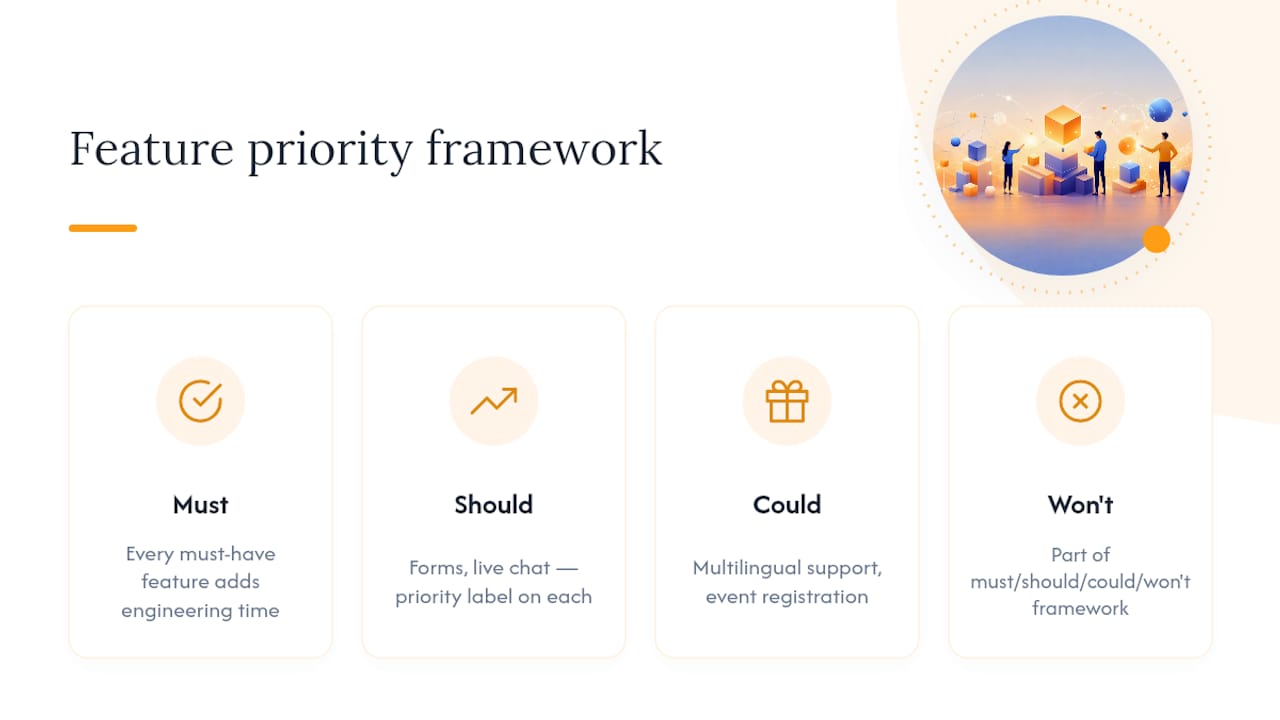
Then map the integration layer: which CRM, marketing automation platform, payment processor, or single sign-on system does the site need to talk to? Confirm who holds admin access to each existing tool, whether an API is actually available, and whether data migration is required. Name one person who owns integration testing before launch, because “we’ll figure it out later” is how integrations become the last thing tested and the first thing broken.
What Should the Site Look and Feel Like?
Brand and design questions come after strategy, not before it, so every visual decision maps back to a business claim the site needs to prove. Ask what three words should describe the brand on sight, which competitor or reference sites the client admires (and specifically why), and which existing brand assets, photography, or tone-of-voice guidelines already exist.
Accessibility belongs in this conversation, not as an afterthought bolted on before launch. Ask what accessibility level the site should target and whether any WAI-ARIA considerations apply to interactive components like forms or navigation menus.
- What’s the target WCAG conformance level, if any is required?
- Who owns final sign-off on visual design: one person, or a committee?
- What photography or imagery rights does the client already own?
- Are there colors, fonts, or layouts the client explicitly wants to avoid?
What Are the Technical, SEO, and Security Requirements?
Technical debt hides in discovery gaps, so this is where you surface it before it becomes a launch-week emergency. Ask what the current SEO baseline looks like, whether existing URLs need 301 redirects, and what the canonical strategy is for any duplicate or near-duplicate content. A structured SEO audit at this stage prevents a redesign from tanking rankings that took years to build.
Confirm who owns analytics access and what’s currently being tracked versus what should be tracked post-launch. For regulated industries, ask directly: does this site handle HIPAA-covered data, payment information, or other sensitive records that require specific hosting controls, encryption, or backup policies?
Timeline, Budget, and Who Signs Off
Logistics questions feel administrative until they’re the reason a project stalls in month four. Get specific numbers and names, not ranges and departments.
- What’s the budget range, and what are the payment terms (deposit, milestone-based, net terms)?
- Is there a hard launch date tied to an event, campaign, or fiscal deadline?
- Will the site launch all at once or in phases?
- Who provides input, who approves each milestone, and who has final sign-off authority?
- How will scope changes be handled: a formal change order, or informal agreement?
Name the final decision owner explicitly. Committees don’t approve projects. People do, and if nobody in the room can say who that person is, that’s the first thing to resolve before any other question matters.
How Will You Measure Success After Launch?
Launch acceptance criteria need to exist before launch day, not get improvised during it. Confirm the QA checklist, performance baselines, redirect mapping, and who owns DNS and SSL cutover.
On measurement, name the primary KPI, the current baseline, and who’s responsible for reporting it monthly or quarterly. On maintenance, ask about the support model going forward: patching cadence, backup frequency, and whether the internal team needs training or documentation to manage day-to-day content updates.
A Condensed Discovery Checklist You Can Copy Today
Run through this shortlist when time is limited:
- What’s the one job this site must do?
- Who’s the buyer, and what do they need to believe in ten seconds?
- What pages and proof content already exist versus need creation?
- Which features are must-have versus nice-to-have?
- What’s the budget, the launch date, and who signs off?
- What’s the primary KPI, and who owns reporting it?
For each answer, capture four fields: response, evidence, owner, and follow-up date. A broader checklist can run past a hundred questions, but use only what your project’s decision gates actually require. Mark unanswered items as “unknown, blocked” rather than guessing, and revisit them before scope gets locked.
Why tekrescue Runs Discovery This Way
Design strategists who run this kind of session well know the goal isn’t collecting answers. It’s excavating the distinctions a business hasn’t learned to say out loud yet. Discovery framed as business questions, who buys, what belief the site needs to earn, what proof closes the gap, produces a site built to support sales instead of one built to look nice in a portfolio. That’s the standard tekrescue applies before a single wireframe gets drawn.
Turn Your Discovery Answers Into a Scoped Project
Answering these questions is the hard part. Turning them into a sitemap, a messaging strategy, and a realistic timeline is where most teams get stuck without help. tekrescue takes your discovery answers and builds a prioritized scope and timeline estimate around them, so nothing gets guessed at during design. If your business is preparing a new build or overdue redesign, see how tekrescue builds websites that convert visitors into customers and get a straightforward read on what your project actually needs before you sign anything.
Sources
FAQ
What are some good discovery questions to start with?
Start with the site’s single business job, the primary audience’s core belief, and the measurable success metric. Those three answers shape every other decision, including content, design, and features.
What are the 7 C’s of a website?
Definitions vary across sources, but common versions reference content, context, community, customization, communication, connection, and commerce. Treat it as a loose planning lens rather than a strict checklist.
What are the 7 basic questions in market research?
Market research generally covers who the customer is, what problem they have, why they choose one option over another, what they value, how they decide, what objections they raise, and what would make them switch. Adapt these into audience discovery questions specific to your site.
What are some self-discovery questions for a business before a redesign?
Ask what the business does better than any competitor, what belief customers currently misunderstand, and what the site would need to prove for that belief to change. These questions surface the distinctions a redesign should highlight.
How long should a website discovery session take?
Length depends on project scope, but timeboxing each topic (strategy, audience, content, features, design, technical) keeps a session from drifting into design opinions before goals are settled, per the Double Diamond approach.
Recommended
Table of Contents