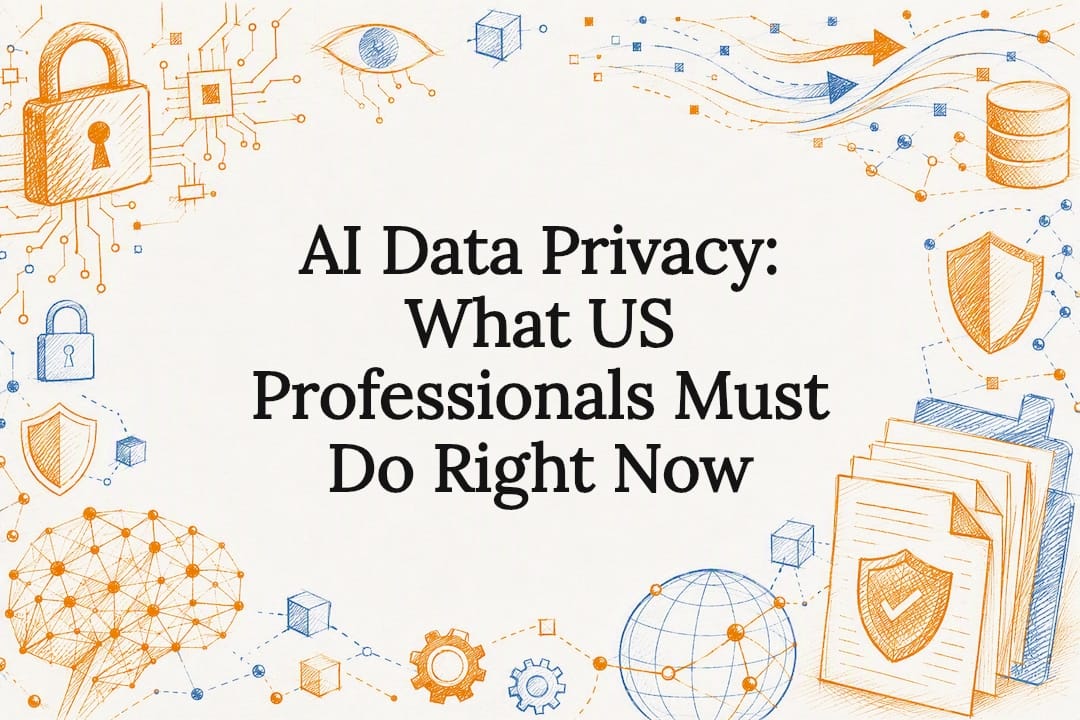
AI Data Privacy: What US Professionals Must Do Right Now
AI data privacy means protecting personal information across the entire lifecycle of an AI system: what it trains on, what it infers, what it outputs, and how long it retains all three. For US organizations, the immediate priority is not picking a framework. It’s inventorying every AI tool already in use, flagging which ones touch regulated or sensitive data, and opening a Data Protection Impact Assessment (DPIA) before deployment scales further.
Here’s the uncomfortable part: most companies find AI already embedded in their operations before legal or compliance teams know it exists. Marketing is running prompts through a chatbot. Customer service is pasting transcripts into a summarization tool. Someone in finance uploaded a spreadsheet to “just check the numbers.” Each of those is a data event, and most of them are undocumented.
Your first moves, in order:
- Inventory every AI tool touching company or customer data, sanctioned or not.
- Flag high-risk systems (anything making decisions about people or processing PII, health, or financial data).
- Open a DPIA on flagged systems before further deployment.
- Review vendor contracts for training-on-your-data clauses and retention terms.
Expect this article to reference the Federal Trade Commission (FTC), California’s CPRA, the EU’s GDPR and AI Act, and the NIST AI Risk Management Framework, all of which shape what “compliant” actually means for AI systems operating in or touching the United States.
Table of Contents
Key Takeaways
AI data privacy compliance in the US succeeds when organizations pair a documented inventory and DPIA process with the strictest applicable state law as their baseline.
| Point | Details |
|---|---|
| No federal AI privacy law exists | The US relies on FTC authority, sectoral laws like HIPAA and GLBA, and state statutes instead of one federal AI rule. |
| State law sets the real baseline | California’s CPRA, Colorado’s Privacy Act, and Virginia’s CDPA require DPIAs for high-risk automated decisions. |
| Inventory before anything else | You cannot assess AI privacy risk in systems your compliance team doesn’t know exist. |
| Vendor contracts close the biggest gaps | Request no-training, deletion, retention limit, and subprocessor disclosure clauses before signing. |
| tekrescue supports the compliance build-out | Its cybersecurity, HIPAA compliance, and managed IT services help SMBs run DPIAs and govern AI deployments in-house. |
Table of Contents
- How Is AI Data Privacy Different From Regular Data Privacy?
- What Privacy Risks Does AI Create or Make Worse?
- What US Laws Actually Govern AI Data Privacy?
- How Do GDPR and the EU AI Act Affect US Companies?
- How Do You Build an AI Privacy Compliance Program?
- Which Technical Controls Actually Reduce AI Privacy Risk?
- What Should Congress and Regulators Do About AI Privacy?
- How Do You Build a DPIA for an AI System?
- Where Has AI Data Privacy Already Gone Wrong?
- How tekRESCUE Helps You Get AI Privacy Compliance Right
- Sources
- FAQ
How Is AI Data Privacy Different From Regular Data Privacy?
Traditional data privacy asks a fairly contained question: who has access to this data, and did they consent to collect it? AI data privacy asks that question three more times, at three more stages, and the answers can change after the fact.
An AI model doesn’t just store data. It learns statistical patterns from it, and those patterns can leak back out in ways nobody explicitly programmed. Model inversion is one of the sharper examples: researchers have shown that certain models can be queried repeatedly to reconstruct fragments of the training data itself, including images or text that were supposed to stay private. Memorization is a related problem where a large language model reproduces a verbatim string from its training set, sometimes a phone number, an address, or a snippet of a medical record, when prompted the right way.

Then there’s inference risk, which is the one that catches most privacy teams off guard. An AI system doesn’t need your Social Security number to guess sensitive facts about you. Purchase history, browsing patterns, and location data can be combined to infer health conditions, sexual orientation, or financial distress with startling accuracy, none of which the person ever disclosed directly.
What makes this operationally different from old-school privacy risk is persistence and scale. A traditional data breach exposes a snapshot. A poorly governed AI system can generate new, unanticipated inferences indefinitely, at machine speed, across millions of records, long after the original data was collected for an entirely different purpose.
- Training data provenance (where did this dataset actually come from, and did the source have the right to share it?)
- Memorization and leakage (can the model be prompted to reveal training content?)
- Inference creep (what new personal facts can the system derive that were never directly provided?)
Pro Tip: Adopt a data classification and “no-paste” rule for any AI tool outside your own infrastructure: employees may never paste regulated data (PHI, financial account numbers, SSNs) into a public chatbot or API-based tool that hasn’t been vetted for a no-training clause. This single policy eliminates the majority of accidental exposures we see in SMB environments.
What Privacy Risks Does AI Create or Make Worse?
AI doesn’t invent new categories of harm so much as it amplifies old ones and adds a few that didn’t exist before generative models went mainstream. Legal and technical teams need a prioritized map, not a vague sense of unease.
Training data provenance is the first fault line. Many large models are trained on scraped public web content, and that scraping sweeps up personal information nobody agreed to contribute, sometimes including copyrighted material, medical forum posts, or social media content posted under an assumption of limited visibility. The Congressional Research Service has flagged this exact problem, noting that generative AI systems often train on scraped public data that can include personal information, which is one reason lawmakers have floated notice, opt-out, and deletion requirements for training data.
Memorization and data leakage sit second. When a model reproduces a verbatim training example on output, that’s not a hypothetical bug, it’s a documented failure mode across multiple large language models. Third comes re-identification: inputs that look anonymous in isolation (a zip code, a birth year, a job title) can be recombined by an AI system to re-identify a specific person, defeating the anonymization an organization thought it had achieved.
Fourth is a risk that lives entirely inside your own walls: prompt and output exposure. Employees paste sensitive text into consumer AI tools daily, and many of those tools retain inputs for model improvement unless a business-tier no-training agreement says otherwise. tekrescue’s own review of shadow AI risk inside small businesses found this exact pattern repeating across client environments: unsanctioned tools, undocumented data flows, no visibility for IT or legal.
- Scraped training data pulling in PII without consent or legal basis
- Model memorization surfacing verbatim sensitive strings on output
- Re-identification of “anonymized” inputs through inference
- Employee prompt-paste into tools with default data retention
None of this sits in a regulatory blind spot. A 2026 review of AI’s dual impact on privacy confirms that AI systems can both threaten and protect personal data depending entirely on how they’re implemented, and the FTC has made clear it will treat deceptive AI data practices as unfair or deceptive practices under its existing Section 5 authority, no new statute required.
What US Laws Actually Govern AI Data Privacy?
There is no single federal AI privacy law in the United States. That’s the fact every compliance officer needs to internalize first, because it means AI privacy obligations come from a patchwork: existing sectoral statutes, FTC enforcement theory, and a growing set of state laws that increasingly name AI and automated decision-making directly.
The FTC fills much of the federal gap through its authority over unfair or deceptive practices. If a company promises it won’t use customer data to train AI models and then does exactly that, the FTC can act without any AI-specific statute on the books. Sectoral laws add more texture: HIPAA governs AI systems touching protected health information, GLBA governs AI used in financial services, and SEC guidance increasingly touches AI-driven trading and disclosure tools. The White House’s AI Bill of Rights and subsequent federal fact sheets on responsible AI push agencies toward oversight, but neither creates binding statutory obligations on private companies.
States have moved faster than Congress. California’s CPRA (which amended the CCPA), the Colorado Privacy Act, and Virginia’s Consumer Data Protection Act (CDPA) each impose obligations that reach AI use directly, particularly around automated decision-making and profiling.
| Authority | What it requires for AI systems |
|---|---|
| FTC (Section 5) | Prohibits unfair or deceptive AI data practices; enforces broken promises about data use |
| HIPAA | Governs AI touching protected health information; requires BAAs with AI vendors |
| GLBA | Governs AI used in financial services and consumer financial data |
| California CPRA | Grants opt-out rights for automated decision-making; requires risk assessments for high-risk profiling |
| Colorado Privacy Act | Requires DPIAs for AI-driven decisions with legal or significant effects on consumers |
| Virginia CDPA | Requires data protection assessments for profiling that presents heightened risk |
For organizations operating in multiple states, the practical answer is a “strictest common denominator” approach: comply with the toughest applicable state rule (usually California or Colorado) and treat it as your baseline everywhere, since state DPIA requirements for high-risk automated decision-making are converging in substance even where the statutory language differs.
The NIST AI Risk Management Framework (AI RMF) isn’t law, but treat it as the closest thing to an industry standard for operationalizing all of this. It gives compliance and engineering teams a shared vocabulary, govern, map, measure, manage, that maps cleanly onto DPIA workflows and satisfies auditors who ask, “what framework are you using?”
How Do GDPR and the EU AI Act Affect US Companies?
Short answer: more than most US executives assume, especially if any customer, contractor, or dataset touches the EU. The GDPR is a rights-based regime built around lawful basis, data subject rights, and restrictions on cross-border data transfer. The EU AI Act is different in structure entirely: it’s risk-based, sorting AI systems into risk tiers and imposing labeling, documentation, and conformity assessment obligations scaled to that tier, with the strictest rules applying to “high-risk” uses like hiring, credit scoring, and biometric identification.
The practical consequence for a US company is extraterritorial reach. If your AI system processes data from EU residents, or if you train models partly on datasets containing EU-origin content, both regimes can apply regardless of where your servers sit. That creates real friction around cross-border data transfers, and it means the provenance question (“where did our training data actually come from, and did it include EU personal data?”) isn’t academic.
| Dimension | GDPR | EU AI Act |
|---|---|---|
| Core structure | Rights and lawful basis for processing | Risk tiers with scaled obligations |
| Main obligation | Consent, transparency, data subject access | Documentation, labeling, conformity assessment |
| High-risk trigger | Sensitive categories, large-scale processing | Systems affecting safety or fundamental rights |
| Cross-border effect | Restricts transfers outside adequacy zones | Applies to AI systems placed on EU market regardless of origin |
You don’t need to wait for a US mandate to adopt the useful parts. Data minimization, documented impact assessments, and clear labeling of AI-generated content are good practice regardless of jurisdiction, and they position a company well ahead of whatever federal or state rule eventually catches up.
- Map any dataset or customer base with EU touchpoints before assuming GDPR doesn’t apply
- Adopt impact assessments and labeling now, even where not yet mandatory domestically
- Treat data minimization as a default engineering practice, not a compliance afterthought
How Do You Build an AI Privacy Compliance Program?
A workable AI privacy program doesn’t require a general counsel and a compliance department of twelve. It requires a sequence, followed consistently.
- Inventory every AI system in use, sanctioned and unsanctioned, including embedded AI features inside existing SaaS tools.
- Classify the data each system touches: public, internal, confidential, regulated (PHI, financial, biometric).
- Run a DPIA or Algorithmic Impact Assessment on any system flagged high-risk, meaning it makes or informs decisions about people or processes with regulated data.
- Negotiate vendor contract terms before signing, not after deployment.
- Assign governance ownership, someone specific signs off on each DPIA, not a committee.
- Monitor and re-audit on a fixed cadence, not just at initial rollout.
Vendor contracts deserve their own line of attention because this is where most SMBs get burned. Before signing with any AI vendor, request these clauses explicitly:
- A no-training clause prohibiting the vendor from using your data to train its models
- A data deletion commitment with a specific timeline, not “upon request”
- Retention limits stated in the contract, not buried in a privacy policy that can change unilaterally
- Disclosure of subprocessors who will touch your data, and their own obligations
One recurring failure pattern shows up across nearly every AI privacy incident that reaches a compliance team’s desk: protected health information pasted into a public chatbot, a vendor processing regulated data without a signed Business Associate Agreement, or confusion about where data actually resides once it leaves your network. Practical guidance on AI model usage identifies these three failure patterns as the source of most real-world AI privacy violations, which is exactly why the vendor contract step above isn’t optional paperwork, it’s the control that prevents the most common incident.
Governance doesn’t need to be heavy to be effective. A compact framework built around tool inventory, approved-data rules, an approval workflow, mandatory human review, and an incident runbook covers most of what a small or mid-sized organization actually needs, and it scales without requiring a dedicated AI compliance hire.
For multi-state operators, apply the strictest applicable state rule as your baseline across every location rather than maintaining fifty different compliance postures. If Colorado requires a DPIA for a given automated decision type and Texas doesn’t yet have an equivalent statute, run the DPIA anyway. It’s the only version of “compliant” that survives a future Texas AI statute, and current tekrescue client engagements around AI-driven business process automation consistently show this approach costs less over eighteen months than retrofitting compliance after a new law passes.
Which Technical Controls Actually Reduce AI Privacy Risk?
Privacy-enhancing technologies (PETs) give engineering teams a menu, not a silver bullet. Each one trades privacy gain against utility, compute cost, or implementation complexity, and picking the wrong one for the use case wastes both money and goodwill with the security team.
Differential privacy adds carefully calibrated statistical noise to a dataset or model output so individual records can’t be reverse-engineered, while aggregate patterns remain usable. It’s a strong fit for analytics and reporting use cases, weaker where you need precise individual-level predictions. Federated learning trains models across decentralized devices or servers without centralizing raw data, useful when data can’t legally leave its origin (think hospital systems or multi-branch financial institutions), though it adds real engineering overhead. Synthetic data generates artificial datasets that mimic statistical properties of real data without containing actual records, good for testing and development environments, riskier for production decisions where fidelity to real-world edge cases matters.

Secure multi-party computation and homomorphic encryption let multiple parties compute on data without ever seeing each other’s raw inputs, powerful for cross-organization collaboration but still computationally expensive enough that most SMBs won’t need them yet.
Beyond PETs, the fundamentals still carry the most weight: encryption at rest and in transit, region pinning so data doesn’t silently process in a jurisdiction you didn’t authorize, and prompt filtering or redaction layers that strip PII before it ever reaches a third-party AI API. tekrescue’s guidance on layering AI defenses against evolving threats and a partner resource on data minimization under GDPR both reinforce the same principle from different angles: less data exposed means less risk, regardless of which framework is nominally in force.
- Differential privacy: strong for aggregate analytics, weaker for individual predictions
- Federated learning: keeps data decentralized, adds engineering complexity
- Synthetic data: safe for testing, less reliable for production edge cases
- Secure multi-party computation and homomorphic encryption: powerful, still costly for most SMBs
Pro Tip: Fix input risk before you invest in exotic PETs. Data classification, tenant isolation, and a no-paste policy for public AI tools eliminate the majority of real-world exposure at near-zero cost, long before differential privacy or homomorphic encryption become worth the engineering investment.
What Should Congress and Regulators Do About AI Privacy?
Lawmakers have several real levers, and each one carries a genuine trade-off rather than a free win.
Mandatory impact assessments for high-risk AI systems would formalize what California and Colorado already require at the state level, creating consistency but adding administrative burden for smaller developers. Required disclosures (what data trained a model, how outputs are used) improve transparency but raise real questions about trade secret protection for AI vendors. Opt-out mechanisms for training-data use, something the CRS has specifically flagged Congress considering, give individuals control but are hard to enforce retroactively once a model has already been trained. Labeling requirements for AI-generated content help consumers but risk becoming checkbox compliance without substantive teeth. Funding for PET research is close to a free win: it expands the toolkit available to every other option without imposing new burdens on anyone.
The strongest policy path isn’t the most restrictive one, it’s the one that pairs disclosure requirements with DPIA mandates for genuinely high-risk systems, while directing meaningful funding toward differential privacy, federated learning, and synthetic data research that reduces the underlying risk instead of just documenting it.
That mix targets the actual harm (opaque, unaccountable high-risk systems) without freezing the lower-risk AI development that most of the economy actually needs.
How Do You Build a DPIA for an AI System?
A DPIA doesn’t need to run twenty pages to be useful. It needs to force the right questions onto paper, with a named owner who signs off.
- Describe the system: what does it do, what model or vendor powers it, where does it run?
- List data elements: exactly what personal or regulated data does it touch, at input and output?
- State the purpose: why does this system need this data, specifically?
- Identify affected stakeholders: customers, employees, patients, or the public?
- Build a risk matrix: score likelihood and severity for leakage, bias, and misuse.
- Document controls: encryption, access limits, human review, retention schedule.
- State residual risk: what’s left after controls, and is it acceptable?
| Field | Purpose |
|---|---|
| System owner | Person accountable for the DPIA, not a department |
| Reviewer | Independent party who signs off before deployment |
| Acceptance criteria | Defined threshold for “acceptable residual risk” |
| Remediation timeline | Deadline for closing any identified gap |
| Review cadence | Fixed schedule for re-assessment, not one-time only |
For SMBs, a one-page DPIA with reusable fields across similar AI use cases beats an unused twenty-page template every time. Escalate to outside counsel only when the risk matrix flags something touching regulated data categories or automated decisions with legal effect, everything else can move through internal review. Practical governance research backs this lighter-touch approach: SMBs can meet governance expectations with a compact inventory, a permitted-use policy, and risk assessments scoped only to genuinely high-risk systems.
Where Has AI Data Privacy Already Gone Wrong?
Regulators are already connecting AI failures to existing legal theory rather than waiting for new statutes. The FTC has pursued “algorithmic disgorgement,” ordering companies to delete models built on improperly collected data, a remedy that makes the underlying dataset problem, not just the AI output, the enforcement target. State attorneys general have opened inquiries into AI-driven decision tools used in hiring and lending, testing whether existing anti-discrimination law reaches algorithmic decisions the same way it reaches human ones.
Watch for these red flags in vendor behavior: training-on-customer-data clauses buried in terms of service, retention exceptions carved out for “service improvement,” and vague subprocessor disclosures. Rising AI adoption means rising compliance risk across HIPAA, SOX, and state privacy regimes simultaneously, which is exactly why audits need to check AI-specific reporting and explainability, not just traditional data security controls.
- Buried training-on-your-data clauses in vendor terms of service
- Retention “exceptions” for vague purposes like service improvement
- Vague or missing subprocessor disclosures
Pro Tip: Build an AI-specific incident response playbook now, before you need it. Include steps for containing a leaking model, notifying affected individuals, and documenting the DPIA that should have flagged the risk beforehand, auditors ask for that document first.
A Practitioner’s Take on What to Fix First
If you run a business, here’s the uncomfortable truth: you cannot secure what you haven’t inventoried, and most organizations still don’t know how many AI tools their own employees are using. Start there. Inventory first, DPIAs second for anything touching regulated data, vendor contracts third, staff training fourth. Skip the inventory and every later step rests on guesswork.
For SMBs, the priority order is inventory, then vendor contracts, because that’s where the fastest exposure gets closed. For policymakers, the priority is disclosure and DPIA mandates that scale to actual risk level, not blanket rules that treat a customer service chatbot the same as a hiring algorithm. Neither audience benefits from waiting for a comprehensive federal law that may not arrive this decade.
How tekRESCUE Helps You Get AI Privacy Compliance Right
tekrescue is the practical alternative to hiring outside counsel and a separate security consultant just to figure out where your AI risk actually lives. Our cybersecurity and compliance team already builds HIPAA-aligned programs for healthcare clients and manages IT infrastructure for small and mid-sized businesses across Central Texas, which means DPIA work, vendor contract review, and AI governance fit directly into services we already deliver, not a bolt-on engagement with a new vendor. For a business trying to figure out which AI tools already touch customer data and what a DPIA should actually say, that combination saves months compared to assembling separate legal, security, and IT resources on your own.
If your organization needs a starting point, request a DPIA starter audit paired with a managed IT and AI governance review. Get in touch through our managed IT services page to scope what your business actually needs before your next AI deployment, not after an incident forces the question.
Sources
- CRS — Generative Artificial Intelligence and Data Privacy: A Primer
- Both ends of artificial intelligence impacting privacy: a review of violation and protection
This article is general information, not a substitute for advice from a qualified lawyer. Consult a qualified legal professional about your own circumstances before acting on anything here.
FAQ
Does AI keep your data private?
Not by default. Whether an AI system protects your data depends entirely on its training practices, retention policy, and whether privacy-enhancing technologies like differential privacy were built in, which is why vendor contract terms matter as much as the technology itself.
What is the 30% rule in AI?
What was Stephen Hawking’s warning about AI?
Stephen Hawking warned publicly that unchecked artificial intelligence could eventually surpass human control and pose an existential risk to humanity, a caution aimed at long-term AI safety rather than the near-term data privacy issues this article addresses.
What are the current US regulations on AI and data privacy?
There is no single comprehensive federal AI privacy law. Coverage instead comes from FTC enforcement authority, sectoral statutes like HIPAA and GLBA, and state laws including California’s CPRA, the Colorado Privacy Act, and Virginia’s CDPA.
Can tekrescue help my business run an AI DPIA?
Yes. tekrescue’s cybersecurity and managed IT services include compliance support that maps directly onto DPIA and AI governance work, particularly for businesses that already need HIPAA-aligned data protection.
Recommended
Table of Contents