
5 Compliance Essentials for Small Business Website Maintenance Plans
A website maintenance plan is a scheduled set of tasks, security patches, backups, performance checks, and content updates, that keeps a site running, secure, and compliant. For most small and medium businesses, the right immediate choice is a monthly retainer that includes automated backups and prioritized security patching rather than ad hoc fixes after something breaks.
TL;DR:
- Automate and regularly test backups, especially for sites handling sensitive or regulated data, to prevent data loss and meet compliance requirements.
- Prioritize security patches for actively exploited vulnerabilities and perform weekly patch reviews to reduce the risk of breaches.
- Conduct monthly restore tests and monthly security scans to ensure backup reliability and identify vulnerabilities early.
- Larger, regulated sites require more comprehensive plans with 24/7 monitoring, rapid incident response, and detailed compliance documentation.
- Clarify ownership, access, and response processes in contracts, and verify provider practices like backup testing and multi-factor authentication before engagement.
Table of Contents
Table of Contents
- What a website maintenance plan covers and who needs one
- Why regular maintenance matters: benefits and risks of skipping it
- Core components and a practical maintenance checklist
- Typical pricing models and realistic monthly costs
- Sample monthly plans you can adapt
- How to choose or build your maintenance plan
- How tekRESCUE approaches compliance-sensitive maintenance
- What business owners get wrong about website maintenance
- Let tekRESCUE handle the maintenance so you do not have to
- Sources
- FAQ
What a website maintenance plan covers and who needs one
A real maintenance plan spans five areas: software updates, content accuracy, security monitoring, backup management, and performance tuning. Some plans also fold in accessibility checks and compliance documentation, especially for sites that touch regulated data.
Not every site needs the same intensity. A static brochure site can often run on quarterly check-ins. A site that processes payments, stores patient records, or handles thousands of daily visitors needs continuous attention because the failure modes are more expensive and, in regulated industries, legally reportable.
The plan should spell out:
- Which party (owner or provider) handles emergency fixes versus routine tasks
- Whether a Business Associate Agreement is required for HIPAA-covered data
- Who owns backup files and where they are stored
- What response time applies when the site goes down
If your business touches protected health information, financial records, or other regulated data, the maintenance contract needs to name who is responsible for what. A vague handshake agreement is not a compliance posture.
Why regular maintenance matters: benefits and risks of skipping it
Sites that get regular attention keep their uptime, their search rankings, and their customer trust intact. Sites that do not tend to lose all three at once, usually at the worst possible time.
Under the FTC Safeguards Rule, covered financial institutions must report security breaches affecting 500 or more consumers to the FTC within 30 days of discovery. That is not a suggestion, it is a regulatory clock that starts the moment a breach is confirmed, and a neglected site is far more likely to trigger it.
The risks compound quickly:
- Unpatched software becomes the entry point attackers scan for first
- Downtime during a sales event or campaign launch costs revenue that does not come back
- Search rankings drop when broken links, slow load times, or security warnings pile up
- Regulatory exposure grows for any business handling health, financial, or personal data
Maintenance is not glamorous work, but skipping it rarely saves money. It just moves the cost to a worse moment.
Core components and a practical maintenance checklist
A working maintenance plan breaks into five recurring categories, each with its own rhythm.
Security and patching should follow a simple rule: enable automatic updates wherever possible, and when they are not automatic, CISA advises prioritizing patches for vulnerabilities listed in its Known Exploited Vulnerabilities catalog. Not every patch is equally urgent, but the ones actively being exploited in the wild move to the front of the line. A vulnerability assessment helps identify which gaps matter most before an attacker finds them.
Backups and disaster recovery follow the 3-2-1 rule that CISA recommends: three copies of your data, on two different types of media, with one copy stored off-site. A backup nobody has tested is a guess, not a safety net, and restore testing belongs on the calendar, not just the backup job itself.
Performance monitoring catches slow-loading pages, broken scripts, and server strain before visitors notice.
Content and editorial maintenance means fixing broken links, updating stale pages, and retiring content that no longer serves the business.
Accessibility and compliance checks matter more each year. WCAG 2.2, the current W3C guidance, requires meeting all Level A and Level AA success criteria for a site to be considered accessible at that standard.
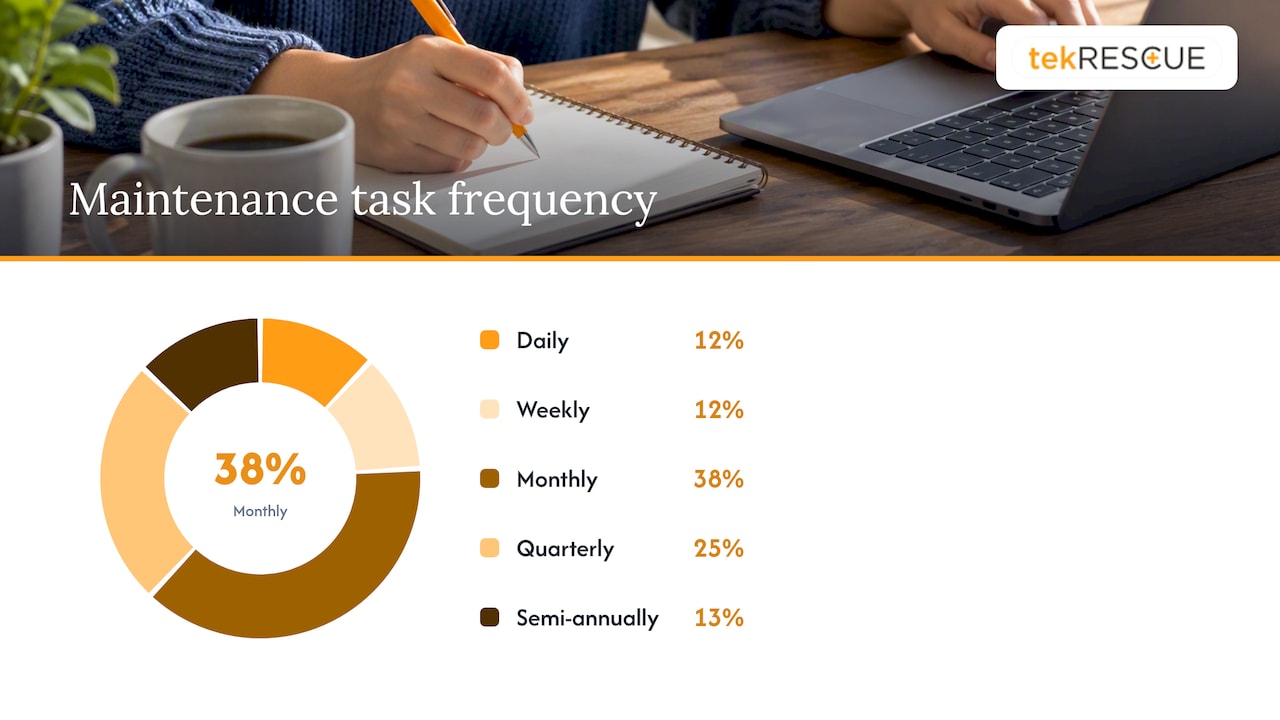
| Task | Recommended frequency |
|---|---|
| Security patch review | Weekly |
| Automated backup | Daily |
| Backup restore test | Monthly |
| Broken link check | Monthly |
| Performance and speed audit | Quarterly |
| Accessibility spot-check | Quarterly |
| Full content review | Semi-annually |
| Analytics and reporting review | Monthly |
Pro Tip: Automate what you can, but put restore testing on a human’s calendar, because an untested backup only feels safe.
Typical pricing models and realistic monthly costs
Maintenance pricing generally falls into three structures: hourly billing for occasional fixes, a flat monthly retainer, and tiered service-level agreements that scale with response time and scope.
- Hourly or as-needed: Works for very low-traffic sites but leaves gaps between visits when problems can fester unnoticed.
- Monthly retainer: Bundles routine patching, backups, and a fixed number of content updates into one predictable bill.
- Tiered SLA plans: Add faster response times, security monitoring, and compliance support as you move up tiers.
Cost drivers include the platform’s complexity, whether the business handles regulated data, traffic volume, and how much custom code sits behind the site. An e-commerce store with a payment gateway and a healthcare practice with patient forms both carry more maintenance weight than a five-page brochure site, and providers price accordingly. tekRESCUE’s own website maintenance and management pricing is available on request, since scope varies by platform and compliance needs.
Sample monthly plans you can adapt
Most providers structure plans in three tiers. Here is a template you can use to compare proposals or scope your own:
- Basic (brochure sites): Automated backups, monthly security patch review, uptime monitoring, and a quarterly content check. Best for low-traffic sites with no e-commerce or regulated data.
- Standard (growing businesses): Everything in Basic, plus monthly restore testing, a security scan, broken-link cleanup, and a monthly performance report. Fits sites with moderate traffic or a contact form collecting customer data.
- Premium (regulated or high-traffic sites): Everything in Standard, plus 24/7 uptime monitoring, priority incident response, accessibility audits against WCAG 2.2, and compliance documentation support for HIPAA or FTC Safeguards obligations.
The right tier depends on what happens if the site goes dark for a day: a brochure site loses a little credibility, an e-commerce store loses sales, and a healthcare portal may trigger a reporting obligation.
How to choose or build your maintenance plan
Start with three questions: what does downtime cost you, how much regulated data does your site touch, and how much of this can your team realistically handle in-house? The answers set your budget and your minimum requirements.
Before signing anything, clarify these contract points:
- Who holds admin access to the site and hosting account
- How often backups are tested, not just taken
- What the incident response process looks like and how fast it starts
- Whether a Business Associate Agreement is included for HIPAA-covered data
- What happens to your content and code if you switch providers
When vetting a provider, ask about their patch cadence, their backup testing schedule, and whether they confirm multi-factor authentication and TLS on your hosting environment. FTC guidance for businesses recommends confirming exactly these practices before trusting a vendor with your site.
Red flags include vague answers about backup testing, no written incident response process, and reluctance to put access and ownership terms in writing. A risk assessment checklist is a useful tool to bring into that conversation, whether you build the plan yourself or hire it out.
Pro Tip: If a provider cannot tell you the last time they tested a restore, treat that as a missing answer, not a small one.
How tekRESCUE approaches compliance-sensitive maintenance
For clients in regulated industries, the starting point is always a documented risk analysis. HHS guidance identifies risk analysis as the foundational first step under the HIPAA Security Rule, before any safeguard gets implemented. tekRESCUE builds maintenance plans around that same sequence for healthcare and financial clients.
Operational steps we recommend to every compliance-sensitive client:
- Run a documented risk analysis before writing the maintenance scope
- Schedule restore tests on a fixed monthly cadence, not an occasional one
- Assign specific people, not job titles, to backup verification and incident response
- Put Business Associate Agreements in place wherever HIPAA-covered data touches the site
For businesses that want a starting point, the practical next steps are a security audit, a prioritized task list ranked by risk, and a proposed maintenance cadence built around your actual traffic and data exposure, not a generic template.
What business owners get wrong about website maintenance
The biggest misconception is that maintenance means occasional fixes when something visibly breaks. By the time a site visibly breaks, the real damage, a missed patch, an untested backup, has usually been sitting there for weeks.
Small budgets do not need to buy everything at once. The highest-value first move is almost always automated backups paired with restore testing, because that single habit turns a disaster into an inconvenience. Everything else, from accessibility polish to advanced monitoring, can follow once that foundation holds.
— Randy Bryan
Let tekRESCUE handle the maintenance so you do not have to
Running a maintenance schedule alongside everything else your business demands is a recipe for the exact gaps this article warns about. tekRESCUE offers website maintenance and management built around the same priorities covered here: prioritized patching, tested backups, and compliance documentation for clients who need HIPAA or FTC Safeguards support.
Engagements typically start with a review of your current setup, a prioritized list of what needs attention first, and a proposed monthly cadence scoped to a site’s actual risk, not a one-size-fits-all package. For businesses handling sensitive data, we also support Business Associate Agreements and ongoing cybersecurity services alongside the maintenance work itself.
If your site has gone more than a few months without a security review, that is the moment to reach out and get a scoped plan back before something forces the issue.
Sources
- Update business software | CISA
- Safeguards rule notification requirement now in effect
- Web Content Accessibility Guidelines (WCAG) 2.2
- Risk analysis guidance | HHS
FAQ
How much does it cost to pay someone to maintain a website?
Costs vary by pricing model, whether hourly, flat monthly retainer, or tiered SLA, and by factors like compliance needs, traffic volume, and platform complexity. tekRESCUE’s website maintenance and management pricing is available on request since scope depends on the specific site.
What should a maintenance plan include?
A complete plan covers security patching, automated backups with restore testing, performance monitoring, content updates, and analytics reporting. Sites handling regulated data should also include compliance documentation and, where HIPAA applies, a signed Business Associate Agreement.
How much does a website maintenance cost?
Pricing depends on the tier and the site’s complexity, with hourly billing suited to low-traffic sites and retainer or SLA plans scaling up for e-commerce or regulated platforms. Ask any provider for a scoped quote based on your specific traffic, platform, and compliance requirements rather than a generic rate.
Do websites need monthly maintenance?
Most active sites benefit from monthly attention at minimum, since patches, backups, and content can drift out of date quickly without a fixed cadence. Sites handling e-commerce transactions or regulated data typically need weekly or continuous monitoring rather than a monthly-only check.
Recommended
Table of Contents