
Build Continuous Security Awareness Training for SMBs in One Quarter
Security awareness training teaches employees to recognize and shut down cyber threats before they cause damage, and it measurably lowers human-driven risk when the program runs continuously, targets specific roles, and gets tracked with real behavioral data. The National Institute of Standards and Technology (NIST) frames it as foundational personnel training tied directly to how well an organization protects its own information.
TL;DR:
- Continuous, role-based microlearning and regular simulation tests significantly improve employee threat recognition and reporting behavior.
- Training should start within the first week of employment and be repeated quarterly, adapting to current attack tactics and AI-driven impersonation.
- Measuring success relies on phishing click rates and reporting speed rather than completion percentages alone, showing actual risk reduction.
- Small businesses can implement cost-effective, role-specific programs by combining affordable tools with integrated technical controls and leadership involvement.
- Annual training is obsolete because rapid advancements in attack methods, including AI deepfakes, require ongoing, adaptive security awareness efforts.
Table of Contents
Table of Contents
- What Does Security Awareness Training Actually Cover?
- Core Modules and Learning Formats That Actually Stick
- Building a Program That Changes Behavior, Not Just Checks a Box
- How to Measure Whether the Training Is Working
- A 6-Step Starter Plan for Building or Fixing Your Program
- What Small Businesses Get Wrong About Training Vendors
- Why Annual Training Is Already Obsolete
- How tekrescue Helps SMBs Build a Program That Sticks
- Sources
- FAQ
What Does Security Awareness Training Actually Cover?
A real program is built around the threats employees encounter daily, not a generic compliance checklist. NIST’s own SP 800-50 guidance recommends a life-cycle approach that ties curriculum directly to organizational risk, and that means covering ground employees can act on immediately.
The core curriculum should include:
- Phishing and email threats, including how attackers spoof senders and mimic internal requests
- Smishing and vishing, the SMS and voice-call versions of the same con
- Social engineering and impersonation, from fake vendor invoices to callers posing as IT support
- Password hygiene and multi-factor authentication (MFA), the two controls that stop the most account takeovers
- Data handling and classification, so employees know what counts as sensitive and how to report a mistake
Here’s a distinction most programs blur: awareness builds the mindset (staying suspicious of urgency and unusual requests), while training builds the skill (knowing exactly which button reports a phishing email). Programs that only do one tend to stall.
Core Modules and Learning Formats That Actually Stick
Annual PowerPoint sessions do not change behavior. What works is a mix of short, frequent touches paired with real-world testing, and that shift is why microlearning has become the standard delivery model across the industry.
- Microlearning modules. Five-to-ten-minute lessons on a single threat, delivered monthly rather than dumped in one annual session.
- Scenario-based videos. Short dramatizations of an actual attempt, like a fake payroll change request, tend to stick longer than abstract warnings.
- Simulated phishing tests. Controlled fake attacks across email, and increasingly SMS and voice, that measure who clicks and who reports.
- Multichannel and AI-threat simulations. Adaptive Security’s guidance recommends testing against deepfake voice calls and AI-generated impersonation attempts, not just email, since attackers have moved well beyond the inbox.
- Role-based tracks. Finance staff get wire-fraud scenarios; HR gets W-2 phishing; developers get credential and code-repository risks.
- Gamification and remediation flows. Point systems for reporting simulated phishing, paired with an automatic short refresher module for anyone who clicks.
Public courses can supplement in-house content too. Coursera’s beginner security awareness course runs about two hours, a useful baseline option for organizations without a dedicated learning platform.
Building a Program That Changes Behavior, Not Just Checks a Box
Behavior change starts with timing. New hires should complete baseline awareness training in their first week, before they ever touch sensitive systems or a company inbox. From there, the content has to branch by role: a nurse handling patient records faces different exposure than a bookkeeper approving vendor payments.
Cadence matters more than most organizations assume. NIST’s SP 800-50 framework treats training as a continuous life cycle, not a once-a-year event, and Fortinet’s 2025 Security Awareness and Training Global Research Report backs that up with a clear pattern: organizations running continuous or quarterly programs report fewer incidents than those running annual-only training.
A program that sticks usually includes:
- Onboarding training completed within the first week of hire
- Quarterly content refreshes tied to current attack trends
- Visible leadership participation, including executives sitting through the same modules
- Policy documents that match what the training actually teaches
- Learner privacy protections so simulation results aren’t used punitively
Pro Tip: Have your CEO or department heads fail a simulated phishing test publicly (internally, not to the whole company) at least once. Nothing builds buy-in faster than leadership admitting they got fooled too.
How to Measure Whether the Training Is Working
Completion percentages tell you almost nothing about actual risk reduction. TechTarget’s guidance on security awareness training makes the case plainly: outcome-based metrics matter far more than attendance logs.
Track these instead:
- Phishing click rate, the percentage of employees who click a simulated malicious link
- Reporting rate, the percentage who flag the email instead of clicking or ignoring it
- Mean time to report, how quickly a suspicious message gets flagged after it lands
- Repeat-failure rate, which employees or departments click simulations more than once
- Human risk score, a composite figure some platforms generate by role or department
Fortinet’s research points to a consistent pattern: organizations running continuous, adaptive programs with regular simulations see measurably fewer security incidents than those relying on annual-only training. Build a simple quarterly report for leadership that shows click rate trending down and reporting rate trending up. That single chart does more to justify a training budget than any completion certificate ever will.
A 6-Step Starter Plan for Building or Fixing Your Program
You don’t need an enterprise budget to run a program that works. Here’s a sequence that fits most small and mid-sized organizations within a single quarter.
- Assess risk and prioritize roles. Identify who handles money, patient data, or credentials, and start there. A cybersecurity risk assessment checklist helps structure this step.
- Choose delivery channels and cadence. Pick microlearning plus quarterly simulations over a single annual event.
- Run baseline phishing simulations. You need a starting click rate before you can prove improvement.
- Remediate with microlearning. Anyone who clicks gets a short, specific module within 48 hours, not a lecture.
- Measure and report. Track the five metrics above and share results with leadership every quarter.
- Iterate. Update scenarios based on what’s actually landing in inboxes that quarter, including new AI-driven impersonation tactics.
Keep repeat offenders out of the penalty box. Publicly punitive programs make employees hide mistakes instead of reporting them, which defeats the entire purpose. Handle reporting privately, and reserve real consequences for negligence, not honest mistakes.
What Small Businesses Get Wrong About Training Vendors
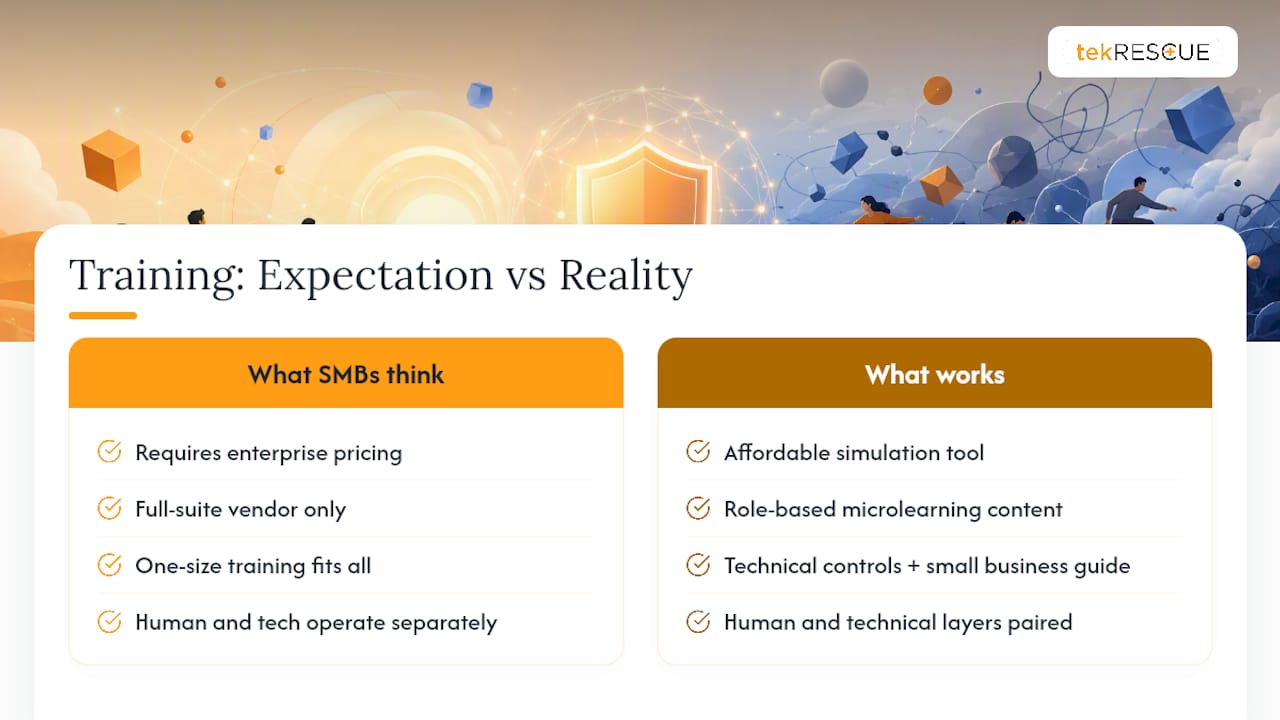
Small and mid-sized organizations often assume a real security awareness program requires enterprise pricing. It doesn’t. Pairing an affordable simulation tool with role-based microlearning content, alongside the technical controls outlined in a small business cybersecurity controls guide, covers most of what larger competitors are paying far more for.
Security providers work with small and mid-sized businesses across healthcare, professional services, and finance to build awareness programs that map directly to compliance obligations, including HIPAA-aligned requirements for practices handling patient data. That work typically pairs training rollout with the underlying technical controls, from MFA enforcement to network security best practices, so the human layer and the technical layer reinforce each other instead of operating in isolation. The goal is straightforward: give a compliance auditor evidence that training happened, and give leadership proof that it actually reduced risk.
Why Annual Training Is Already Obsolete
Attackers now use AI to generate convincing voice clones and deepfake video in minutes, something that would have taken a skilled team days two years ago. A once-a-year training session simply cannot keep pace with that shift. Quarterly, role-based programs aren’t a luxury upgrade; they’re the baseline response to a threat landscape that changes faster than an annual calendar allows.
Completion tracking measures attendance, not safety. A program that tracks click rates, reporting speed, and repeat-failure patterns tells leadership something a certificate never will: whether the workforce is actually getting harder to fool. Treat this as ongoing risk control, not an HR formality to close out before the audit.
— Randy Bryan
How tekrescue Helps SMBs Build a Program That Sticks
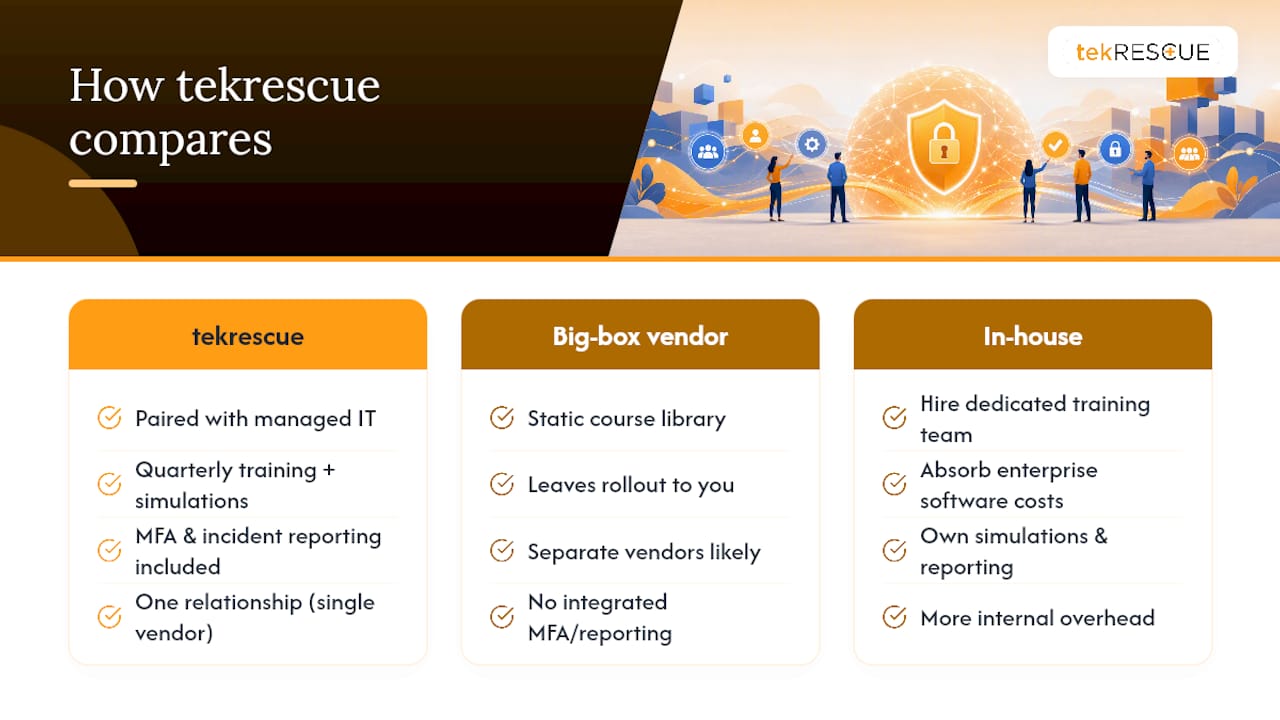
tekrescue gives small and mid-sized businesses a way to run a real security awareness program without hiring a dedicated training team or absorbing enterprise software costs. Where a big-box compliance vendor sells a static course library and leaves you to figure out the rest, tekrescue pairs training rollout with the managed IT and security work already protecting your network, so simulations, MFA enforcement, and incident reporting all live under one relationship instead of three separate vendors.
That matters most for healthcare practices and professional services firms juggling HIPAA-aligned obligations alongside day-to-day operations. tekrescue’s managed IT services can fold quarterly training, phishing simulations, and reporting straight into your existing support plan. If you’re not sure where your program stands today, request a readiness assessment and get a clear picture of which roles carry the most exposure before you spend a dollar on a course platform.
Sources
- awareness training – Glossary | CSRC
- 2025 Security Awareness and Training Global Research Report
- What is security awareness training? | TechTarget
- Cybersecurity Awareness Training Topics: The 2026 Curriculum for Reducing Human Risk
FAQ
What is security awareness training?
Security awareness training teaches employees to recognize threats like phishing, social engineering, and unsafe data handling, and to respond correctly when they encounter one. NIST defines it as foundational personnel training that clarifies each person’s role in protecting organizational information.
What is safety awareness training?
Safety awareness training generally refers to workplace physical safety programs, like OSHA-related hazard training, while security awareness training focuses specifically on cyber and information-security risks such as phishing and data handling. Some organizations bundle both under a broader employee training umbrella, but the content and goals differ.
What are the three main areas in security awareness training?
Most programs build around three pillars: recognizing threats (phishing, smishing, vishing, social engineering), protecting access and data (passwords, MFA, data classification), and reporting incidents quickly and without fear of punishment. tekrescue structures training around these same three pillars when working with SMB clients.
What is the main objective of security awareness training?
The main objective is reducing human-driven risk by turning employees into an active line of defense rather than the weakest link. Measured against outcomes like phishing click rates and reporting speed, not just course completion, that objective becomes something a business can actually track.
Recommended
Table of Contents