
US Compliance Teams: Make AI for Healthcare Compliance Audit Ready
Yes, AI can automate and scale many healthcare compliance tasks, but only when governed under documented lifecycle controls, HIPAA-aware risk analysis, and continuous monitoring. Regulators are watching closely: the HHS OCR expects AI systems to show up in your risk analysis, while the NIST AI Risk Management Framework and ONC’s source-attribute rules set the bar for documentation. What follows is the checklist and the operational steps that make AI for healthcare compliance defensible rather than reckless.
TL;DR:
- Proper inventory and classification of AI tools are essential, with particular attention to those handling electronic protected health information to ensure compliance.
- Lifecycle governance must include mapping AI use cases to design, validation, deployment, or monitoring stages, with documented ownership and vendor transparency.
- HIPAA requires ongoing risk analyses, detailed data flow diagrams, signed business associate agreements, and audit logs for any AI touching patient data, not a one-time effort.
- AI-related breach obligations differ depending on whether tools fall under HIPAA or FTC jurisdiction, with non-HIPAA health apps subject to stricter breach notification timelines.
- Continuous monitoring, proper documentation, staff training, and integration with existing health IT systems are vital to maintaining audit readiness and avoiding common compliance pitfalls.
Table of Contents
Table of Contents
- Where AI Touches Healthcare Compliance Today
- Lifecycle Governance: Aligning NIST, FDA, and ONC Expectations
- HIPAA Obligations: Risk Analysis, Inventory, BAAs, and Breach Rules
- Privacy-Preserving Data: De-Identification, Synthetic Data, and Differential Privacy
- Contracts and Procurement: Getting Vendor Agreements HIPAA-Ready
- Making Compliance Continuous: Monitoring, Evidence, and Remediation
- A Prioritized Checklist for Compliance Teams Adopting AI
- How We Support HIPAA-Ready AI Adoption
- Fitting AI Compliance Tools Into Your Existing Health IT Stack
- Clinical Decision Support: Where the Compliance Risk Gets Sharper
- Bias, Fairness, and the Ethics of Compliance Automation
- Getting Staff Ready for AI in a Compliance Context
- Practical Perspective: Common Missteps and Quick Wins
- Get Your AI Governance Program Audit-Ready
- FAQ
- Sources
Where AI Touches Healthcare Compliance Today
AI has moved past pilot projects. It now sits inside clinical workflows, contract review, and the audit trail itself, and each of those touchpoints carries different regulatory weight.
The use cases compliance teams see most often include:
- Clinical decision support (CDS) that flags drug interactions, risk scores, or diagnostic suggestions
- Contract review and clause extraction tools scanning vendor agreements for HIPAA and data-use language
- Automated evidence collection that pulls logs, access records, and policy attestations for audits
- PHI analytics used for population health, fraud detection, or claims review
The dividing line that matters most is simple: if an AI tool touches, stores, or infers from electronic protected health information, it falls under HIPAA. If it sits outside a covered entity’s or business associate’s data flow, such as a consumer wellness app, it may instead fall under the FTC’s jurisdiction. That distinction decides which breach notification clock applies and who you have to call first.
The first action for any compliance team is to inventory every AI tool in use, tag each one by data sensitivity (does it touch ePHI, de-identified data, or no health data at all), and rank them by regulatory impact. Skipping this step is the single most common audit finding we see referenced in OCR enforcement guidance, because tools adopted informally by clinical or IT staff rarely make it onto a risk register until something breaks.
Lifecycle Governance: Aligning NIST, FDA, and ONC Expectations
Total product life cycle, or TPLC, governance treats an AI system the way the FDA treats a medical device: something that needs oversight from design through retirement, not just at launch. For healthcare compliance teams, this framing matters because the three agencies that shape AI oversight (NIST, FDA, and ONC) each expect a different slice of that lifecycle to be documented.
NIST AI RMF. NIST’s AI Risk Management Framework and its generative AI profile treat trustworthy AI as ongoing lifecycle work, not a one-time certification. The framework organizes activities around four functions: govern, map, measure, and manage. For a compliance team, that translates into assigning clear ownership of AI risk, documenting what each model does and with what data, testing performance and bias before and after deployment, and having a defined process to respond when something drifts.
FDA TPLC guidance. The FDA’s guidance on AI-enabled medical devices recommends a total product life cycle approach and endorses Predetermined Change Control Plans, or PCCPs, for managing model updates without re-triggering a full review each time. If your organization uses or sells AI-enabled devices, a PCCP style plan should spell out what changes are allowed, how they get validated, and who signs off.
ONC HTI-1 and DSI. ONC’s HTI-1 final rule created the Decision Support Interventions certification criterion, requiring source attributes and intervention risk management, or IRM, practices for predictive DSIs, with maintenance obligations that began January 1, 2025, according to the HTI-1 DSI fact sheet. In practice, that means health IT developers need to maintain something close to a model card: what data trained the model, what population it was validated on, and what its known limitations are.
A practical way to sequence adoption:
- Map every AI use case to its TPLC stage: design, validation, deployment, or monitoring.
- Assign an owner for each stage who signs off before the system moves forward.
- Request source attributes and IRM summaries from every vendor supplying a predictive DSI.
- Build a PCCP style change log for any AI tool that updates its model after deployment.
- Schedule a recurring review, at minimum annually, tied to your HIPAA risk analysis cycle.
Pro Tip: Ask every AI vendor for their model card or IRM summary before signing. If they cannot produce one, assume you will be building the documentation yourself.
HIPAA Obligations: Risk Analysis, Inventory, BAAs, and Breach Rules
HIPAA does not have a separate chapter for artificial intelligence. It has the Security Rule’s risk analysis requirement, and AI tools fall squarely inside it. HHS guidance on risk analysis has long held that covered entities must include all ePHI in scope and perform ongoing risk analysis and management, and proposed Security Rule updates referenced in OCR’s 2025 enforcement commentary make clear that regulators expect AI systems and their training data to be explicitly assessed for risk to ePHI.
That means an AI tool that touches patient data needs to appear in your technology asset inventory the same way a server or an EHR module does. Leaving it out is not a technicality. It is the kind of gap OCR enforcement actions have repeatedly flagged.
Documentation a compliance team should be able to produce on short notice includes:
- Data flow diagrams showing where ePHI enters, moves through, and exits each AI system
- Access control records showing who and what (including service accounts) can query the model
- Signed business associate agreements with every AI vendor that touches ePHI
- Audit logs covering model inputs, outputs, and administrative changes
- TEVV artifacts (test, evaluation, validation, and verification records) showing the model was checked before and after deployment
One documented settlement illustrates the stakes directly: HHS OCR’s enforcement guidance ties a HIPAA settlement to inadequate risk analysis practices, underscoring that an incomplete inventory, AI included, is treated as a Security Rule failure, not a minor oversight.
Breach notification gets more complicated once AI tools sit outside traditional HIPAA coverage. The FTC’s updated Health Breach Notification Rule clarified in April 2024 that it applies to health apps and similar technologies not covered by HIPAA, and it requires notifying the FTC within 60 calendar days of discovering a breach affecting 500 or more individuals. If your organization deploys a patient-facing AI tool that is not a HIPAA business associate (a symptom checker or wellness app, for example), that rule, not HIPAA, likely governs your breach clock.
Privacy-Preserving Data: De-Identification, Synthetic Data, and Differential Privacy
Feeding real patient data into an AI model, whether for training or for retrieval-augmented inference, raises the same question every time: how much of that data still identifies a person after you process it?
HIPAA recognizes two de-identification paths. Safe Harbor removes 18 specific identifiers (names, dates tied to an individual, geographic subdivisions smaller than a state, and others). Expert Determination relies on a qualified statistician to certify that re-identification risk is very small given the methods applied. Both have limits. Safe Harbor can still leave a dataset re-identifiable when combined with outside data sources, and Expert Determination’s conclusions depend entirely on the assumptions the statistician builds in.
Synthetic data and differential privacy are increasingly used to reduce that exposure further. Research compiled by HHS ASPE on AI training datasets notes that synthetic datasets reduce direct PHI exposure but can introduce bias or lose statistical utility compared to the real data they replace. Differential privacy adds mathematical noise to query results, limiting what an attacker can infer about any individual, but it does not eliminate the possibility of model leakage, where a trained model memorizes and later reproduces fragments of its training data.
Operational controls that keep these tradeoffs manageable:
- Segment access so only approved roles can query models trained on identifiable or limited datasets
- Use secure enclaves for any training pipeline that touches raw ePHI before de-identification
- Log every training run and inference query tied to sensitive data, not just production access
- Test explicitly for memorization and leakage before a model touching PHI goes live, and again after retraining
Pro Tip: Treat de-identification as a process, not a one-time filter. Re-run your leakage tests every time a model is retrained, because a safe dataset today can become identifiable once new outside data sources appear.
Contracts and Procurement: Getting Vendor Agreements HIPAA-Ready
Legal and procurement teams increasingly lean on AI-assisted clause recommendation engines to speed up contract review, and for high-volume vendor pipelines, that speed is genuinely useful. But a generic contract review tool trained on commercial agreements will miss the health-specific language that actually matters: BAA triggers, permitted-use restrictions on ePHI, and audit access rights. Any clause engine used for healthcare vendor contracts needs a playbook tuned to those terms, not a generic commercial template.
Contract language worth insisting on before signing any AI vendor agreement:
- A signed business associate agreement whenever the vendor’s tool creates, receives, maintains, or transmits ePHI.
- Audit log access so your team, not just the vendor, can review what the model did and when.
- A change control clause requiring advance notice and documentation before any model update that could affect accuracy or safety, mirroring the PCCP approach the FDA endorses.
- Data deletion and return provisions that specify what happens to your data, and any derivative training artifacts, at contract end.
- Service-level commitments for patching and vulnerability remediation, with defined timelines rather than vague “best efforts” language.
- Human-in-the-loop and acceptance testing requirements, setting a performance baseline the vendor must meet before go-live and maintain afterward.
Our internal risk assessment checklist walks through how these controls map to a broader vendor risk review, which is worth running in parallel with contract negotiation rather than after signature.
Making Compliance Continuous: Monitoring, Evidence, and Remediation
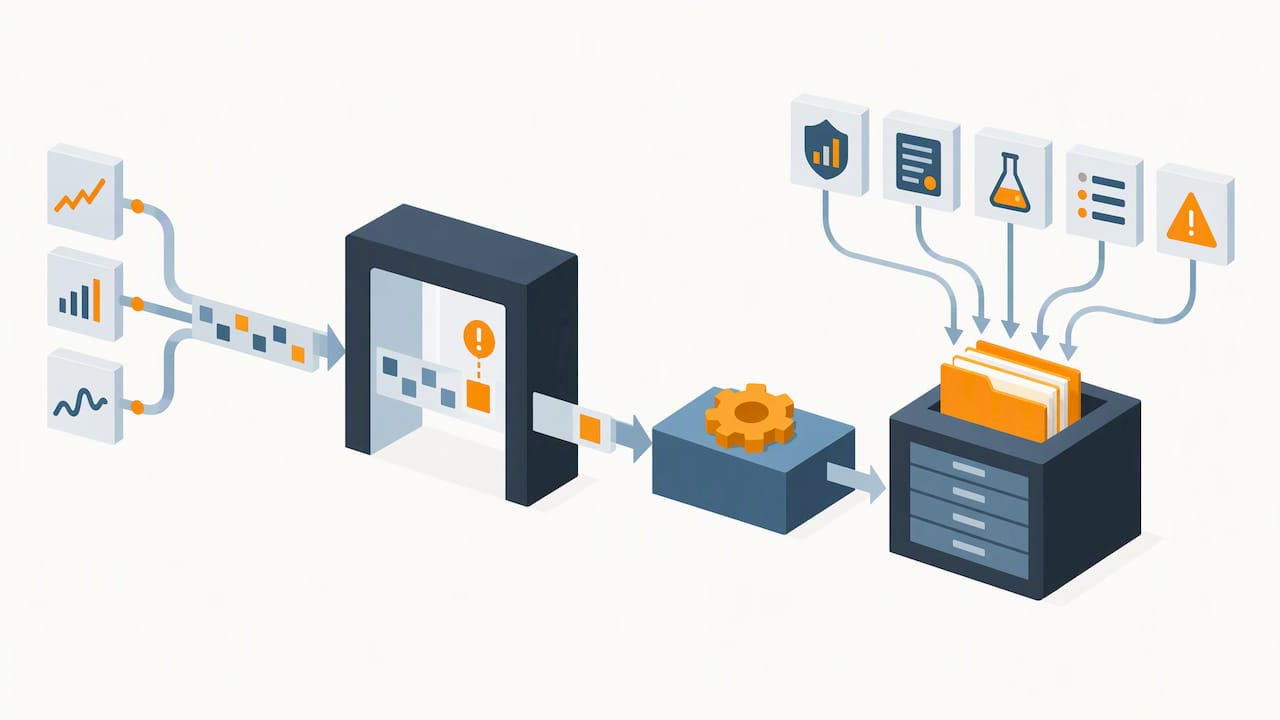
A risk analysis completed once a year does not hold up when a model’s behavior can shift between quarterly reviews. Continuous compliance means building evidence collection into daily operations, not scrambling for it before an audit.
Design patterns that work well in practice:
- Automated log aggregation that captures model inputs, outputs, and administrative actions in one searchable place
- Model cards and change logs updated every time a model is retrained or its training data changes
- Traceability records linking each AI decision back to the data and model version that produced it
Monitoring needs to cover three distinct layers: data drift (is the input data shifting away from what the model was trained on), model performance (is accuracy or bias creeping outside acceptable bounds), and security telemetry (are access patterns to the model itself normal). Our breakdown of AI-driven security monitoring covers how telemetry at the infrastructure layer catches anomalies that a purely model-level review would miss.
When monitoring flags a problem, the remediation workflow should route to a named owner, require documented root-cause analysis, and produce a remediation record that becomes part of the audit pack. That audit pack, built continuously rather than assembled under deadline pressure, should include the risk analysis, vendor BAAs, TEVV artifacts, change logs, and incident records organized by system. When an external auditor or OCR investigator asks for evidence, the difference between a same-day response and a two-week scramble is usually whether this pack already exists.
A Prioritized Checklist for Compliance Teams Adopting AI
Teams starting from scratch benefit from a clear order of operations rather than trying to tackle governance, contracts, and monitoring simultaneously.
- Inventory and classify. List every AI tool in use or under evaluation, and tag each by data sensitivity and regulatory touchpoint (HIPAA, FTC, or neither).
- Run an AI-aware risk analysis. Fold each tool into your existing HIPAA risk analysis, mapping specific mitigations to specific risks rather than a blanket statement that “AI risk is managed.”
- Lock down contracts. Require BAAs, audit access, and change control clauses before any new AI vendor touches ePHI.
- Operationalize monitoring and training. Stand up drift and performance monitoring, maintain TEVV documentation, and set a recurring staff training cadence.
| Step | Primary output | Owner typically responsible |
|---|---|---|
| Inventory and classify | AI asset register tagged by data sensitivity | Compliance / IT |
| AI-aware risk analysis | Updated HIPAA risk analysis with AI-specific mitigations | Privacy / Security officer |
| Contract controls | Signed BAAs and change control clauses | Legal / Procurement |
| Monitoring and training | Drift reports, TEVV logs, training records | Compliance / Clinical IT |
How We Support HIPAA-Ready AI Adoption
We built our HIPAA Compliance and FTC Safeguards Rule services around exactly this checklist: inventorying AI tools, running HIPAA-aware risk analyses, and documenting the controls OCR expects to see. Our Strategic AI Consulting work focuses on mapping AI use cases to regulatory obligations before deployment, not after an incident forces the question. Combined with our Cybersecurity Services, including risk assessments and incident response, and our Managed IT Services for ongoing monitoring, an engagement typically starts with an assessment, moves to a remediation roadmap, and settles into managed oversight so documentation stays current between audits.
Fitting AI Compliance Tools Into Your Existing Health IT Stack
An AI compliance tool that cannot talk to your EHR, your identity management system, or your existing logging infrastructure creates more manual work than it saves. Integration planning should start with a simple question: does this tool read from and write to systems you already use, or does it require a separate silo that someone has to reconcile by hand later.
Practical integration points to check before procurement include single sign-on compatibility with your existing identity provider, API access to pull logs into your centralized audit pack rather than a vendor-specific dashboard, and compatibility with your EHR’s audit trail format so investigators can trace an AI-assisted decision back to the clinical record without a manual lookup. Shadow AI, meaning tools adopted by individual departments without IT’s knowledge, is a common failure point here. Our piece on managing shadow AI covers how unsanctioned tools bypass exactly the integration checks that keep a compliance program coherent.
Vendors that cannot provide API access to their own logs, or that store data in a format incompatible with your existing retention schedule, should be treated as a red flag during procurement rather than a problem to solve after signing.
Clinical Decision Support: Where the Compliance Risk Gets Sharper
Clinical decision support systems carry a different weight than back-office AI tools because their output can influence a treatment decision directly. ONC’s DSI certification criterion exists specifically because predictive CDS tools need documented source attributes and intervention risk management practices, as outlined in the HTI-1 DSI fact sheet, so clinicians and compliance teams understand what a given recommendation is based on and where it might be wrong.
The practical risk is that a CDS tool’s output gets treated as authoritative without anyone checking whether the underlying model was validated on a population that resembles the patients it is now serving. A sepsis risk model trained primarily on one hospital system’s patient mix will not necessarily generalize cleanly to a different patient population.
Managing this risk means requiring the vendor’s validation population and performance metrics up front, building in a human-in-the-loop review for any high-stakes recommendation, and setting a performance baseline that triggers a formal review if real-world accuracy drifts below it. FDA’s TPLC guidance for AI-enabled devices reinforces the same point: a PCCP-style change control plan should specify exactly how and when a CDS model can be updated without quietly changing its risk profile underneath the clinicians relying on it.
Bias, Fairness, and the Ethics of Compliance Automation
An AI compliance or clinical tool that performs well on average can still fail specific patient groups, and that gap is where bias turns into a compliance problem rather than just a quality one. A model trained predominantly on one demographic’s data can underperform for patients outside that group, which raises both clinical safety and fair-treatment concerns.
Bias mitigation starts with knowing what your training and validation populations actually look like, not assuming they are representative. NIST’s AI RMF folds this directly into its “measure” function: testing a model’s performance across subgroups, not just in aggregate, before and after deployment. Where performance gaps show up, teams need a documented decision about whether the model is fit for use with that population, retrained, or retired for that use case.
Transparency plays a role too. ONC’s source-attribute requirements exist partly so clinicians and compliance teams can see what data trained a model and judge whether its blind spots matter for their patient population. Treating bias testing as a one-time checkbox rather than a recurring part of the TEVV cycle is one of the more common gaps we see in otherwise well-documented AI governance programs.
Getting Staff Ready for AI in a Compliance Context
Documentation and contracts only hold up if the people using AI tools day to day understand what they are allowed to do with them. A clinician who pastes patient notes into an ungoverned AI tool to draft a summary has created a HIPAA problem regardless of how strong your written risk analysis looks on paper.
Training programs that address AI specifically, rather than folding it into generic annual privacy training, tend to cover three things: which AI tools are approved for use with patient data and which are not, how to recognize when an AI-generated recommendation needs human verification before acting on it, and how to report a suspected AI-related incident, whether that is a privacy concern or a model producing an obviously wrong output.
Cadence matters as much as content. A single onboarding session will not keep pace with how quickly new AI tools get adopted informally across departments. Pairing a recurring training schedule with the same inventory process used for risk analysis, so new tools trigger a training update rather than waiting for the next annual cycle, keeps staff awareness aligned with what is actually in use.
Practical Perspective: Common Missteps and Quick Wins
The most common misstep we see is leaving AI out of the asset inventory entirely, treating it as “just software” rather than a system that touches ePHI. That single gap undermines an otherwise solid risk analysis.
Quick wins exist, though. Instrumenting logging on existing AI tools, locking down BAAs for vendors already in use, and running a small validation baseline on your highest-risk model will close most of the gap OCR tends to flag first. Scale governance in that order: inventory, contracts, then monitoring. Trying to build a full TEVV program before the inventory is complete wastes effort on systems nobody has fully mapped yet.
— Randy Bryan
Get Your AI Governance Program Audit-Ready
Every checklist in this guide points to the same conclusion: AI for healthcare compliance works when someone owns the inventory, the contracts, and the monitoring, and falls apart when those tasks sit scattered across departments. We handle that work directly, pairing Cybersecurity Services and risk assessments with Strategic AI Consulting built around HIPAA-aware governance. For organizations weighing broader AI strategy questions, Dr. Rashaan J. Green’s work on leadership and organizational readiness offers a useful outside perspective on building governance that scales. If your current AI inventory has gaps, request an AI readiness assessment through our HIPAA Compliance page and we will walk through what an audit-ready program looks like for your organization.
This article is general information, not a substitute for advice from a qualified doctor. Consult a qualified healthcare professional about your own circumstances before acting on anything here.
FAQ
Is there an AI tool that is HIPAA compliant?
No AI tool is inherently HIPAA compliant on its own; compliance depends on how it is configured, contracted, and governed. A tool becomes HIPAA-ready only when the vendor signs a business associate agreement, the organization completes an AI-aware risk analysis covering that tool, and ongoing monitoring and audit logging are in place, consistent with HHS guidance on risk analysis.
Which AI approach is best for regulatory compliance?
There is no single best AI tool for regulatory compliance; the right approach depends on lifecycle governance rather than any one product. Frameworks like the NIST AI Risk Management Framework favor organizations that document data flows, validate models before and after deployment, and keep audit trails current over any single feature set.
Does the United States have AI regulations?
The United States does not have one comprehensive federal AI law, but several agencies regulate AI through existing frameworks. The FDA applies total product life cycle guidance to AI-enabled medical devices, ONC requires source attributes for certified decision support tools under HTI-1, and the FTC enforces breach notification rules for health apps outside HIPAA’s reach.
What should healthcare organizations prioritize among AI applications in compliance?
Rather than ranking every possible AI application, healthcare organizations should prioritize the ones that touch protected health information most directly: clinical decision support, PHI analytics, and automated evidence collection for audits. These carry the clearest HIPAA and ONC obligations and should be inventoried and risk-assessed before lower-risk administrative AI tools.
Sources
- HHS OCR: HIPAA settlement and guidance emphasizing risk analysis
- FTC: Updated Health Breach Notification Rule
- HTI-1 DSI fact sheet
- NIST AI Risk Management Framework
- FDA: Artificial intelligence-enabled medical devices guidance
Recommended
Table of Contents