

SEO Pricing: What Small Businesses Get for $1,500 to $3,000 a Month
Most small businesses pay between $1,500 and $3,000 a month for legitimate SEO work, almost always billed as a monthly retainer rather than a one-time project. That range buys real traction, not instant rankings: expect the first measurable movement in 3 to 6 months, not three weeks. Below, we break down the tiers, the pricing models, and the exact steps to set a budget you can defend to a partner or a bank.
TL;DR:
- Startup budgets can begin at $500 to $1,500 monthly for technical fixes and page work; multiple locations or competitive niches may need $3,000 to $7,500.
- About 78.2% of providers use retainers; use hourly billing for defined tasks and fixed fees for bounded jobs, such as migrations or site relaunches.
- Prioritize crawl errors and existing pages with high traffic before new content; monitor crawl health, search impressions, and traffic from unbranded searches as early indicators.
- Google does not sell better local rankings; placement depends on relevance, distance, and prominence, so treat promises of paid local placement as a warning.
Table of Contents
Table of Contents
- Quick pricing snapshot and common tiers
- What SEO includes for the fee: deliverables and outputs
- Pricing models and trade-offs for small businesses
- Factors that push SEO prices up or down
- How to budget for SEO by business size and revenue
- ROI expectations and realistic timelines for seeing movement
- Ways to reduce or optimize SEO spend without sacrificing progress
- How tekRESCUE works with small businesses on SEO budgets
- Regional and local SEO pricing considerations
- SEO pricing versus other digital marketing options
- Choosing and defending your SEO budget
- How tekRESCUE can help with your SEO budget
- FAQ
- Sources
Quick pricing snapshot and common tiers
SEO pricing splits into four rough tiers, and knowing which one matches your situation saves you from both overpaying and underfunding the work. Industry data puts the overall average at $2,917 per month, with most businesses landing somewhere between $500 and $5,000.
- Low tier ($250 to $750/month): Usually a freelancer or a part-time specialist handling basic on-page fixes and light reporting, suited to a single-location business with minimal competition.
- Professional tier ($1,500 to $3,000/month): The range most small businesses actually invest in for effective, sustained results, typically delivered by a small or mid-size agency.
- Advanced tier ($3,000 to $7,500/month): A full-service agency managing technical SEO, content production, and link building simultaneously, often for a business in a competitive market or with multiple locations.
- Enterprise tier ($7,500+/month): An internal team or a specialized agency handling large catalogs, multi-market strategy, or heavily regulated content.

Billing format matters as much as the dollar figure. The vast majority of providers, 78.2% according to one survey, charge a monthly retainer rather than hourly or project fees, because SEO is a continuous process rather than a one-time fix. Hourly arrangements (averaging around $111 per hour) tend to show up for smaller, defined tasks like an audit or a migration review, while project pricing fits a bounded scope like a site relaunch.
What SEO includes for the fee: deliverables and outputs
A retainer fee is not a mystery box. For a small-business budget, the deliverables generally fall into five categories, and a vendor who cannot name concrete outputs in each one is worth questioning.
- Technical SEO: Crawlability fixes, site speed improvements, structured data, and mobile usability repairs.
- On-page optimization: Title tags, header structure, internal linking, and keyword mapping across priority pages.
- Content development: New pages or blog posts targeting specific search terms, typically a handful of assets per month at the professional tier.
- Link signals and local presence: Outreach for relevant backlinks and consistent, accurate business listings, including local link building tactics suited to service-area businesses.
- Reporting and account management: Monthly check-ins covering rankings, traffic, and next steps, not just a spreadsheet dump.
A one-time project (a technical audit, a content migration, a redesign-related SEO cleanup) delivers a fixed set of fixes and then ends. A retainer keeps producing new content and new links every month, which is why most small businesses that see lasting results choose the ongoing model over a single engagement.
Pricing models and trade-offs for small businesses
Each pricing model carries a different risk profile, and matching the model to your situation matters more than chasing the lowest number on a proposal.
- Monthly retainer: The default for continuous growth, because rankings and traffic compound over time and a vendor needs sustained access to build on prior work.
- Hourly: Sensible for narrow, well-defined tasks, but watch for scope creep. If hourly, ask up front how many hours cover a basic audit and get it in writing.
- Fixed-project: Works for one-time cleanups or migrations, though it rarely covers ongoing content or link work, so clarify what happens after launch.
- Performance-based: Attractive on paper (pay only for ranking gains), but practical limits apply: ranking tracking is imprecise, attribution gets murky, and many reputable providers avoid this model because it incentivizes shortcuts.
- In-house hire: A full-time SEO specialist’s salary, benefits, and tools typically run well above the professional-tier agency range once you account for the fact that one person rarely covers technical, content, and outreach work alone.

Pro Tip: Convert an in-house hire to a true monthly cost by adding salary, payroll taxes, benefits, and software subscriptions, then dividing by twelve. Compare that number, not just the base salary, against an agency retainer.
Factors that push SEO prices up or down
Two businesses in the same city can get wildly different quotes, and the gap usually comes down to a handful of measurable factors rather than a vendor padding the bill.
- Keyword competitiveness: Ranking for “plumber near me” in a dense metro costs far more effort than ranking in a smaller market with fewer competitors.
- Site health and technical debt: A site with years of unresolved crawl errors, duplicate content, or a slow host requires upfront cleanup before new content can even gain traction.
- Content volume and expertise required: Technical or regulated topics (legal, medical, financial) demand subject-matter review, which adds cost beyond standard blog writing.
- Regulated industries: Healthcare practices working under HIPAA or financial firms under compliance rules often need content and data handling reviewed for accuracy and privacy, which adds a layer most retailers never face.
- Multi-location or ecommerce scope: A business with five locations or a product catalog in the thousands multiplies the pages that need optimization, which multiplies the hours.
An initial audit commonly surfaces issues that add immediate cost: broken redirects, missing schema, duplicate pages, or a backlink profile that needs cleanup before new link building makes sense. Expect a credible proposal to flag these rather than bury them in a vague line item.
How to budget for SEO by business size and revenue
Budgeting for SEO works best as a staged decision, not a single number pulled from a competitor’s invoice.
- Startup or pre-revenue business: Start at the low end, $500 to $1,500 a month, focused on technical fixes and foundational on-page work rather than aggressive content output.
- Established small business: Budget $1,500 to $3,000 a month, the range where most small businesses see genuine, sustained results, covering technical maintenance, regular content, and local link building.
- Growth-stage SMB with multiple locations or a competitive niche: Plan for $3,000 to $7,500 a month to support the content volume and link velocity needed to outpace better-funded competitors.

In the first few months, prioritize fixing crawl errors and optimizing existing high-traffic pages before investing heavily in net-new content. Those existing pages often have the fastest path to improved rankings because they already carry some authority.
ROI expectations and realistic timelines for seeing movement
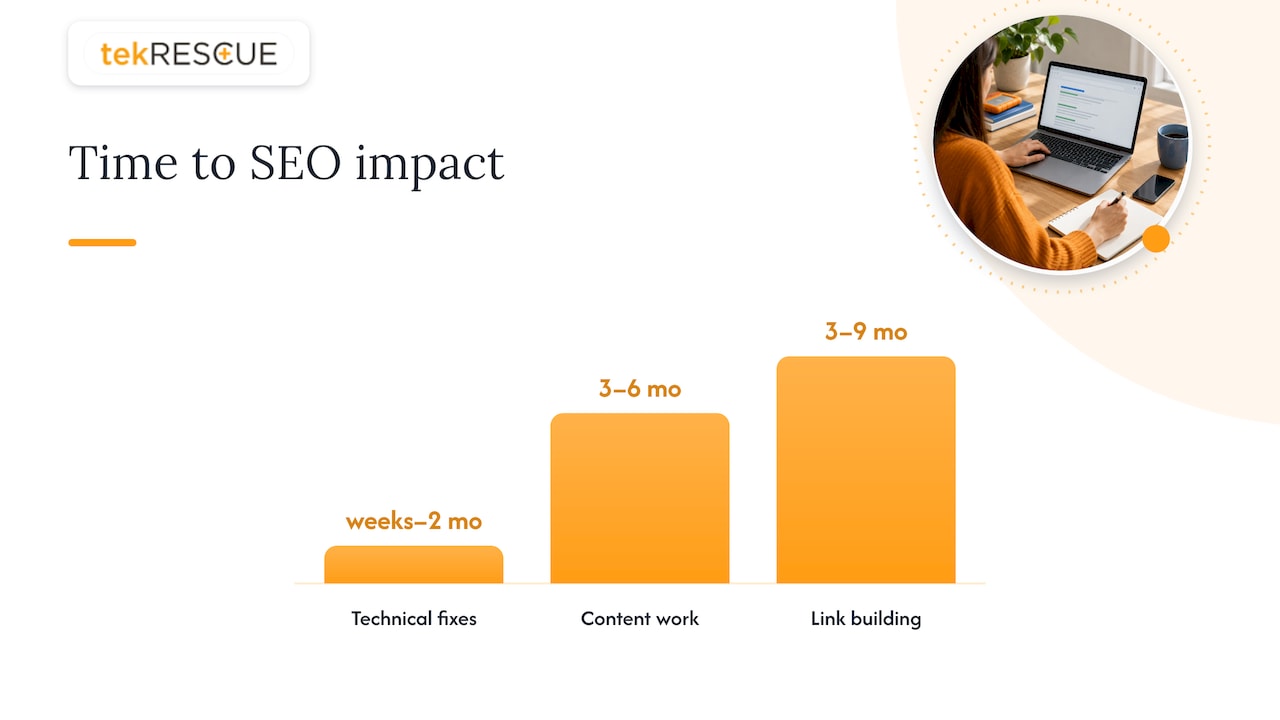
SEO moves on different clocks depending on the type of work. Technical fixes (speed, crawlability, structured data) can show up in search console data within weeks to a couple of months. Content work typically needs 3 to 6 months before new pages gain enough authority to rank meaningfully, and link-building campaigns often take 3 to 9 months to influence rankings for competitive terms.
Businesses that spend over $500 a month on SEO are 53.3% more likely to report being extremely satisfied with results compared to those spending less, which tracks with the reality that underfunded campaigns rarely get enough content or technical attention to move the needle.

Watch these early signals rather than waiting for a top ranking: improved crawl stats in Search Console, rising impressions for target terms, and growth in non-brand organic traffic. These metrics typically shift before rankings do, and they are the clearest early proof that the budget is working.
Ways to reduce or optimize SEO spend without sacrificing progress
A tighter budget does not have to mean slower results if the spend is sequenced well.
- Prioritize high-opportunity pages instead of spreading thin coverage across the entire site.
- Phase the engagement: fund an audit and quick technical wins first, then scale into content and link building once the foundation is solid.
- Repurpose existing assets like case studies, FAQs, or past blog posts into optimized pages rather than paying for everything from scratch.
- Define deliverables and reporting cadence in writing up front to avoid scope creep that inflates the bill mid-engagement.
Pro Tip: Ask any provider to show you which three pages they would fix first and why. A specific, prioritized answer signals a real strategy; a vague answer signals a template pitch.
How tekRESCUE works with small businesses on SEO budgets
We specialize in web design and development, SEO, cybersecurity, and managed IT services built specifically for small to medium-sized businesses, which means budget conversations start with your actual site and market, not a generic package. We bring expertise in compliance and security, including standards relevant to healthcare and financial data, so practices get content and data handling reviewed with that context built in from day one.
- We tailor SEO plans to your current site health, competition, and revenue goals rather than a one-size tier.
- Our phased approach starts with technical fixes and quick wins before scaling into content and link building.
- We align deliverables to the same budgeting logic covered above, so you know what each dollar is funding.

For businesses evaluating service-area SEO specifically, our guidance for property managers and service businesses walks through how visibility and lead generation connect to a realistic monthly spend.
Regional and local SEO pricing considerations
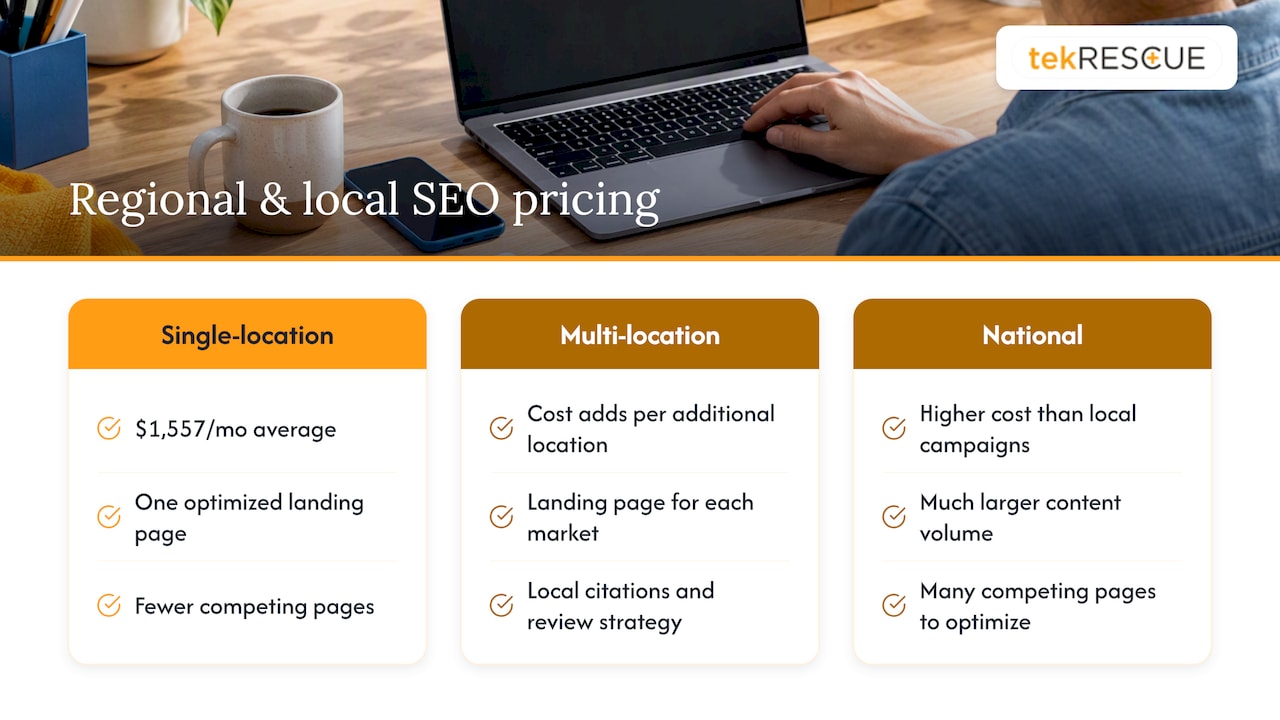
Local SEO pricing often runs lower than broad national campaigns, with industry benchmarks putting local SEO around $1,557 a month on average, reflecting a narrower geographic footprint and fewer competing pages to optimize. A single-location service business targeting one city or county needs far less content volume than a brand competing nationally, which is one reason local engagements tend to sit at the lower end of the professional tier.
Multi-location businesses change the math. Each additional location typically needs its own optimized landing page, its own local citations, and its own review strategy, which adds cost proportional to the number of markets served. A service-area business system built around multiple cities or counties should budget accordingly rather than assuming one flat fee covers every location equally.
One point worth stating plainly: Google has confirmed there is no way to pay for a better local ranking; placement depends on relevance, distance, and prominence, not ad spend or a premium package. Any proposal that implies paid placement on Google’s local results is describing something Google does not offer, and that claim should raise questions about the rest of the pitch.

SEO pricing versus other digital marketing options
Compared against paid search or paid social, SEO usually has a slower start but a different cost curve over time. A pay-per-click campaign stops producing traffic the moment spend stops, while SEO work (content, technical fixes, earned links) tends to keep generating visibility well after the initial investment, even as ongoing maintenance keeps it from decaying.
For a small business weighing $1,500 to $3,000 a month in SEO against a similar paid media budget, the practical difference shows up in durability: paid channels deliver faster, more controllable volume, while SEO builds an asset that compounds. Many small businesses that invest consistently in SEO end up spending less per lead over an 18 to 24 month window, though the comparison depends heavily on industry and competition. The most defensible approach for most small businesses is not choosing one over the other but sequencing them: paid channels for immediate demand while SEO builds toward a lower long-term cost per acquisition.
Choosing and defending your SEO budget
If you run a small business, here is the honest framing: the right SEO budget is not the biggest number you can afford, it is the smallest number that still funds consistent technical work, real content, and honest reporting every month. Underfunding SEO produces the worst outcome of all, a campaign that never gets enough attention to move anything.

Measure early KPIs (crawl health, impressions, non-brand traffic) against your revenue targets, and treat the first few months as proof of process, not proof of rankings. Education matters as much as execution: a vendor willing to explain what each dollar buys is one worth staying with.
— Randy Bryan
How tekRESCUE can help with your SEO budget
We build phased SEO packages for small and medium-sized businesses that map directly to the budgeting framework above: start with a technical audit and quick wins, then scale into content and local link building once the foundation holds. Our team’s background in compliance and security means regulated businesses, healthcare practices, CPA firms, and similar, get an SEO plan that respects data handling requirements from the start.
If you want a clear picture of where your site stands and what a realistic monthly investment looks like for your market, reach out for an initial consultation through our Search Engine Optimization page. We will walk through your current site health, your competition, and a staged budget built around your actual numbers rather than a generic package.
FAQ
How much does SEO optimization typically cost?
Most small businesses pay between $1,500 and $3,000 a month for legitimate, ongoing SEO work, usually billed as a monthly retainer. Pricing varies with competition, site health, and content needs, and the overall market average sits near $2,917 a month across all provider types.
What is the 80/20 rule in SEO?
The idea, borrowed from general business strategy, is that a small share of pages, keywords, or fixes typically drives most of the measurable results. In practice, that means prioritizing high-traffic pages and high-impact technical fixes before spreading effort across the entire site.
Is SEO still worth it in 2026?
SEO remains one of the more durable marketing investments for small businesses because organic visibility keeps producing traffic without ongoing ad spend. Clients who invest consistently, spending over $500 a month, report notably higher satisfaction than those who underfund the work.
Can I do SEO on my own?
A small business owner can handle basic fixes like updating title tags, claiming a Google Business Profile, and fixing obvious site errors without outside help. Competitive content strategy, technical troubleshooting, and sustained link building typically require more time and expertise than most owners can dedicate alongside running the business.
What should I prioritize if my SEO budget is limited?
Focus first on technical fixes and optimizing existing high-traffic pages rather than producing large volumes of new content. Accurate Google Business Profile information and consistent local listings also matter, since Google bases local ranking on relevance, distance, and prominence, not paid placement.
Sources
- SEO Pricing: How Much Does SEO Cost? 439 People Polled
- Clients who pay more for SEO services report higher satisfaction rates
- Tips to improve your local ranking on Google – Google Business Profile Help
- SEO pricing in USA 2026: What agencies, freelancers, charge?
Recommended
Table of Contents