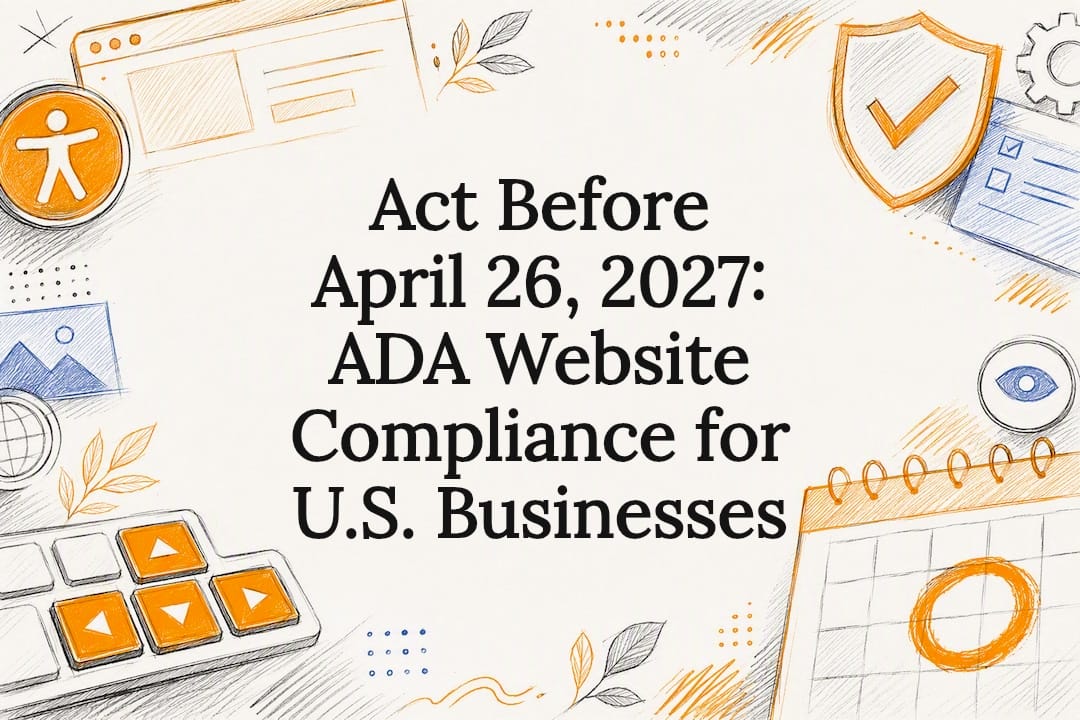

Act Before April 26, 2027: ADA Website Compliance for U.S. Businesses
WCAG 2.1 Level AA is the practical legal standard for ADA website compliance in the United States, whether you run a city government portal or a private business site. The DOJ’s Title II rule locks state and local governments into that standard on a fixed schedule, while Title III private businesses face the same benchmark through court precedent rather than a codified rule. Public entities with 50,000 or more residents must comply by a set compliance date in 2027; smaller entities and special districts have until a later compliance date in 2028.
TL;DR:
- Public entities with over 50,000 residents must meet WCAG 2.1 Level AA standards by April 2027, while smaller entities have until 2028.
- Most common accessibility failures include missing alt text, poor color contrast, unlabeled form fields, and navigation that cannot be keyboard operated.
- Private businesses are subject to court rulings that identify WCAG 2.1 Level AA as the benchmark, even without formal regulations.
- Ongoing governance and continuous monitoring are essential because conformance drifts without regular updates and training.
- Vendors and third-party tools must be explicitly contractually committed to WCAG 2.1 AA compliance, with clear remediation timelines.
Table of Contents
Table of Contents
- What the DOJ Rule and the ADA Require: Title II vs. Title III
- The Technical Standard: WCAG 2.1 Level AA Explained
- Deadlines, Timeline, and Who Follows Which Date
- Exceptions, Limited Circumstances, and “Equivalent Facilitation”
- Enforcement, Litigation Risk, and Likely Penalties
- Step-by-Step Compliance Checklist: Assess, Remediate, Verify, Maintain
- Testing and Monitoring: Tools, Manual Checks, and Real-User Testing
- Vendors, Contracts, and Procurement: Who’s Responsible for Third-Party Content?
- tekrescue Perspective: Treating Accessibility as Ongoing Digital Governance
- How tekrescue Helps U.S. Organizations Meet ADA Website Compliance
- Sources
- FAQ
What the DOJ Rule and the ADA Require: Title II vs. Title III
The Department of Justice finalized its Title II rule in April 2024, and it took effect on June 24, 2024. This rule requires state and local governments to make their websites and mobile apps meet WCAG 2.1 Level AA, closing a gap that had left web accessibility murky for decades under the original 1990 statute.
Title II applies broadly across the public sector. That includes:
- State agencies, city and county governments, and school districts
- Special purpose districts (water authorities, transit boards, library systems)
- Amtrak and commuter rail authorities
- Public colleges and universities

Private businesses fall under Title III instead, and Title III has never had a DOJ rule specifying a technical standard the way Title II now does. Courts have filled that vacuum themselves. Federal judges hearing website accessibility lawsuits against retailers, restaurants, and service businesses have overwhelmingly pointed to WCAG 2.1 Level AA as the working definition of an accessible site, even without Congress or DOJ writing it into a formal Title III regulation.
Here’s the part many business owners miss: your general ADA obligations don’t wait for a compliance deadline. Effective communication and reasonable modification requirements have applied to places of public accommodation for years. A business already has legal exposure today if a blind customer can’t complete a purchase or a deaf customer can’t access video content, deadline or no deadline.
The Technical Standard: WCAG 2.1 Level AA Explained
WCAG 2.1 organizes every requirement around four principles known as POUR: Perceivable, Operable, Understandable, and Robust. Each principle breaks into specific, testable success criteria, which is what makes WCAG useful as a legal benchmark rather than a vague aspiration.
Statistic to know: large-scale accessibility audits find that most detectable failures cluster around a handful of repeat offenders, not hundreds of scattered problems. Fix those categories first and you eliminate the bulk of your exposure.
The most common failures site owners face include:
- Missing or meaningless alt text on images, which blocks screen reader users from understanding visual content
- Insufficient color contrast between text and background, which affects users with low vision or color blindness
- Form fields with no programmatic label, leaving screen reader users guessing what information goes where
- Content or navigation that can’t be reached or operated using a keyboard alone
- Empty links and buttons with no accessible name
WCAG 2.2 has since been published as a newer version, adding criteria around focus visibility and target size for touch controls. DOJ’s Title II rule specifically names 2.1 as the standard, but building toward 2.2 now is smart. Standards move forward, not backward, and a site built to 2.2 already satisfies 2.1.
Concrete example: a “skip to main content” link sounds minor, but for a keyboard-only user tabbing through 40 navigation links before reaching the article body, it’s the difference between usable and unusable.
Deadlines, Timeline, and Who Follows Which Date
The compliance calendar depends entirely on your entity’s population, with distinct deadlines for larger state and local government entities and for smaller entities and special district governments.

These dates come from an Interim Final Rule that pushed the original 2024 deadlines back by one year, giving public entities more runway to inventory content and secure remediation budgets. If you manage a government website, check your jurisdiction’s most recent census population figure to confirm which tier applies. The tier determination isn’t optional or negotiable; it’s fixed by population count as of the rule’s effective date.
Private businesses have no equivalent statutory deadline, and that’s arguably riskier, not safer. Lawsuits under Title III can be filed at any time, so waiting for a “compliance date” that doesn’t exist for your business type is a mistake. Start remediation on the same rough timeline you’d use if you were a public entity anyway, because the legal standard courts apply is identical.
Exceptions, Limited Circumstances, and “Equivalent Facilitation”
The Title II rule carves out narrow exceptions, and none of them function as a blanket excuse to skip remediation.
- Archived web content: material posted before the rule’s compliance date, not maintained or updated, and clearly marked as archival can be exempt
- Content posted by a third party: if a public entity doesn’t control the third-party platform (a social media comment section, for instance) certain content may fall outside strict compliance
- Password-protected conventional documents and pre-existing conventional electronic documents have limited carve-outs
“Equivalent facilitation” allows an entity to meet accessibility goals through an alternate method rather than literal WCAG conformance, but the burden of proof sits entirely with the entity claiming it. You have to demonstrate the alternative provides genuinely equal access, not a lesser substitute dressed up as equivalent. None of these exceptions touch your underlying obligation to provide effective communication. Before leaning on any exception, ask whether a person with a disability actually gets the same functional outcome as everyone else. If the answer is no, the exception doesn’t apply.
Enforcement, Litigation Risk, and Likely Penalties

DOJ enforces Title II directly and can investigate complaints or file suit against noncompliant public entities. Title III carries a private right of action, which means any individual, not just DOJ, can sue a business directly, and that’s the mechanism driving most of the litigation volume businesses actually see.
Demand letters and website accessibility lawsuits have risen sharply in recent years, and a pattern has become depressingly familiar: a business installs an “accessibility overlay” widget, assumes the problem is solved, then gets sued anyway because the overlay didn’t fix the underlying code. Overlays have been ineffective at achieving real conformance and, in some cases, have become targets of lawsuits themselves for making false accessibility claims.
State laws add another layer of exposure. California’s Unruh Civil Rights Act, for example, allows plaintiffs to seek statutory damages on top of federal ADA claims, which raises the financial stakes of a lawsuit considerably beyond what federal law alone would produce.
Practical risk mitigation looks like this:
- Document every remediation step, scan result, and fix with dates and version records
- Prioritize fixes by user impact, not by whatever’s easiest to patch first
- Loop in legal counsel before publishing any public accessibility statement
- Never treat an overlay widget as a substitute for actual code and content remediation

Settlement outcomes vary widely based on jurisdiction, business size, and whether the defendant shows good-faith remediation efforts already underway. Courts and plaintiffs’ attorneys both look favorably on entities that can show a documented, active remediation plan rather than silence.
Step-by-Step Compliance Checklist: Assess, Remediate, Verify, Maintain
Getting to and staying at WCAG 2.1 AA conformance isn’t a single project with an end date. It’s a six-phase cycle that repeats every time you touch your site.
- Scope and inventory. Catalog every page, template, PDF, mobile app screen, and third-party widget your organization publishes or makes available to the public. You can’t fix what you haven’t listed.
- Automated scanning and prioritization. Run automated accessibility scanners across your full site to surface the common, machine-detectable failures like missing alt text and contrast violations. Rank issues by how many users they block and how many pages they touch.
- Manual testing and assistive-technology checks. Automated tools miss roughly half of real-world barriers because they can’t judge whether alt text is meaningful or whether a workflow makes sense to a screen reader user. Someone has to actually navigate the site with a keyboard only and with a screen reader.
- Build a remediation plan with prioritized fixes. Group fixes into quick wins (alt text, labels) versus structural work (navigation rebuilds, custom widget rewrites) and assign owners and dates to each.
- Verify and document. Retest every fixed page, keep dated records of what changed, and publish a public-facing accessibility statement describing your standard, your process, and how users can report barriers.
- Govern continuously. Train content editors and developers on accessible authoring, and add accessibility checks to your release checklist so new pages don’t reintroduce old problems.
Pro Tip: Treat phase 6 as the phase that actually protects you long term. A one-time remediation project that isn’t backed by ongoing governance drifts out of conformance within months, usually the first time someone on your team publishes a new page without training.
Development partners who understand this cycle end to end, from initial build through ongoing maintenance, tend to catch conformance drift before it becomes a legal problem rather than after.
Testing and Monitoring: Tools, Manual Checks, and Real-User Testing

No single testing method covers everything WCAG 2.1 AA requires, which is why a layered approach beats relying on any one tool.
Automated scanners are fast and cheap, and they reliably catch structural issues like missing form labels, missing alt attributes, and contrast ratio failures. Their limit is real: they cannot judge context, meaning, or whether a workflow actually makes sense to someone using assistive technology.
- Run automated scans on every page template, not just your homepage, since templates repeat errors across hundreds of pages at once
- Test keyboard navigation manually by unplugging your mouse and tabbing through every interactive element, checking that focus is always visible and the tab order makes sense
- Test with a screen reader (NVDA on Windows or VoiceOver on Mac are common, free starting points) to hear how your content actually sounds to a blind user
- Recruit a small group of actual assistive-technology users, even just three or four people, to complete real tasks on your site and flag friction points automated tools never catch
Pro Tip: Build accessibility checks into your continuous integration pipeline if your development team ships code regularly. A regression test that fails the build when contrast or labeling breaks is far cheaper than discovering the problem after a demand letter arrives.
Monitoring cadence matters as much as the initial audit. A quarterly automated rescan combined with manual spot checks after any major redesign catches drift before it compounds into a full-blown conformance gap.
Vendors, Contracts, and Procurement: Who’s Responsible for Third-Party Content?

Your organization stays legally responsible for accessibility even when a vendor, plugin, or third-party widget provides the content or functionality on your site. That includes embedded booking tools, chat widgets, payment forms, and content management plugins you didn’t build yourself.
Protect yourself at the contract stage:
- Require explicit WCAG 2.1 AA conformance language in every vendor contract, not a vague “accessibility friendly” promise
- Build in remediation service level agreements that specify how fast a vendor must fix a reported accessibility defect
- Run acceptance testing on vendor deliverables before launch, using the same manual and automated checks you’d apply to your own code
- Ask vendors directly for their own conformance testing documentation before signing, not after
Legacy vendor tools already deployed on your site need the same audit treatment as your own pages. If a vendor won’t commit to a remediation timeline, that’s a signal to budget for replacing the tool rather than hoping it improves.
tekrescue Perspective: Treating Accessibility as Ongoing Digital Governance
Most businesses still treat ADA website compliance as a one-time fix instead of what it actually is: ongoing governance. That mindset gap is where lawsuits happen. An accessible site also tends to rank better and convert better, since clean semantic structure and fast, keyboard-navigable pages satisfy both screen readers and search engine crawlers at the same time.
tekrescue approaches accessibility the way we approach HIPAA compliance work for healthcare clients: audit first, remediate by priority, then build monitoring into the maintenance cycle so conformance doesn’t quietly erode. Compliance isn’t a certificate you earn once. It’s a standard you defend every time you publish.
— Randy Bryan
How tekrescue Helps U.S. Organizations Meet ADA Website Compliance
tekrescue is the practical alternative to hiring a generic freelancer or relying on an overlay widget for ADA website compliance: full-code remediation backed by the same compliance discipline we apply to HIPAA and FTC engagements, not a script bolted onto your homepage. Our team runs accessibility audits against WCAG 2.1 AA, prioritizes fixes by real user impact, remediates the underlying code and content, and builds ongoing monitoring into your maintenance plan so new pages don’t drift out of conformance.
Because tekrescue also handles cybersecurity and managed IT for small and mid-sized businesses across Texas, accessibility work gets folded into the same governance rhythm as your security patching and uptime monitoring, not treated as a separate fire drill. If your site needs a real remediation plan instead of a quick patch, start with tekrescue’s website development services and get a concrete assessment of where your current site stands against WCAG 2.1 AA.
Sources
Skip the secondary summaries when the stakes involve a legal deadline. Read the primary text directly:
- Ada
- Extension of compliance dates for nondiscrimination on the basis of disability; accessibility of web information and services of State
- Web Content Accessibility Guidelines (WCAG) 2.1 — W3C
- ADA Compliance for Websites — WCAGsafe
FAQ
Does ADA website compliance apply to private businesses too?
Yes. Title III of the ADA covers businesses open to the public, and courts consistently use WCAG 2.1 Level AA to judge whether a business website meets that standard, even without a codified DOJ rule for Title III.
What is the ADA website compliance deadline for 2027?
Public entities serving populations of 50,000 or more must reach WCAG 2.1 AA conformance by April 26, 2027, under the DOJ’s Interim Final Rule extension.
Is WCAG 2.1 or WCAG 2.2 the required standard?
The DOJ’s Title II rule specifically names WCAG 2.1 Level AA as the technical standard, though building toward the newer WCAG 2.2 criteria now protects you as standards continue to advance.
Can an accessibility overlay widget make my site ADA compliant?
No single widget guarantees conformance, and overlays have repeatedly failed to fix underlying code problems, sometimes drawing lawsuits themselves for making inaccurate accessibility claims.
How much does it cost to fix ADA website compliance issues?
Costs vary widely depending on site size, platform, and how many structural issues exist, which is why a professional audit and prioritized remediation plan, the approach tekrescue uses with clients, matters more than guessing at a flat number.
Recommended
Table of Contents