
Local SEO Checklist: 8 Tasks Small Businesses Should Tackle First
Eight tasks separate the local businesses that show up in map results from the ones that stay invisible: claiming and verifying your Google Business Profile, optimizing on-page local content, locking down consistent NAP data, earning and managing reviews, building local links, fixing technical site issues, and monitoring your results. Start with your Google Business Profile today. Without verification, you are not eligible to appear in local map results at all.
TL;DR:
- After verification, choose the narrowest accurate primary category, list actual services, define the real service area, and keep hours, photos, and attributes current.
- Audit your name, address, and phone number across major directories and social profiles; correct aggregators first, since their records feed smaller listings.
- Request reviews after service through a direct link, respond within a few days, and never offer discounts or gifts, which violate platform policy.
- Create a separate landing page for each service area, with location specific titles, visible contact details, and LocalBusiness structured data that matches your profile.
- Check mobile rendering, page speed, sitemap submission, and indexing settings; Google indexes the mobile version, so broken phone layouts can undermine otherwise strong pages.
Table of Contents
Table of Contents
- The at-a-glance local SEO checklist
- Google Business Profile: claim, verify, and optimize every field
- On-page local SEO: local landing pages, metadata, and structured data
- Citations and directories: audit, fix, and prioritize listings
- Reviews and reputation: generate legitimate reviews and manage negative feedback
- Local link building: practical outreach and partnership tactics
- Technical site health: speed, indexing, and verification tools
- Monitoring and reporting: metrics, cadence, and simple dashboards
- Ensuring NAP consistency across social media profiles
- Optimizing for voice search and mobile-local queries
- Leveraging localized content marketing and blogging
- Using local events and sponsorships for SEO benefit
- Monitoring competitors’ local SEO strategies
- Integrating local SEO with paid local advertising campaigns
- What we actually prioritize first for small businesses
- How tekRESCUE helps you work through this checklist
- FAQ
- Sources
The at-a-glance local SEO checklist
Local SEO rewards sequence. Do these out of order and you waste effort on pages nobody can find because the profile that would surface them is not even verified yet. Here is the task order we recommend, with the time commitment and priority level for each.
- Claim and verify Google Business Profile (30-60 minutes, high priority): eligibility for map results depends on it, so nothing else matters until this is done.
- Complete every GBP field (1-2 hours, high priority): category, hours, services, photos, and attributes all factor into ranking.
- Audit and fix NAP consistency (2-4 hours, high priority): inconsistent business data across the web confuses search engines and buyers alike.
- Build local landing pages with schema (3-6 hours, medium priority): signals relevance for each location or service area you serve.
- Launch a review generation workflow (ongoing, high priority): reviews feed directly into the prominence factor Google uses to rank businesses.
- Fix technical issues (2-4 hours, medium priority): mobile rendering and page speed problems block even well-optimized pages.
- Start local link outreach (ongoing, medium priority): sponsorships and partnerships build the prominence signal over time.
- Set up monitoring (1 hour, low priority but non-negotiable): you cannot improve what you do not track.

Each task gets its own walkthrough below, starting with the profile that unlocks everything else.
Google Business Profile: claim, verify, and optimize every field
Your Google Business Profile is the single highest-leverage asset in local search, and it costs nothing but time. Claiming it starts the process; verifying it is what actually makes you eligible to appear in map results and the local pack. Google offers verification by phone, email, video, or postcard depending on your business category and history, and video or live verification can confirm you on the spot in many cases rather than requiring a multi-day wait.
Once verified, prioritize these fields in this order:
- Primary category: this single field carries more ranking weight than almost any other, so choose the most specific match available rather than a broad catch-all.
- Services and products: list what you actually offer, since local ranking guidance from Google ties relevance directly to how well your listing matches what a searcher is looking for.
- Address or service area: brick-and-mortar businesses need an accurate address; service-area businesses should define their coverage zone precisely rather than overstating it.
- Hours, phone, and website: keep these current, since stale hours are a common source of lost trust and lost calls.
- Photos and attributes: profiles with recent photos and completed attributes (wheelchair accessible, women-led, appointment-only) tend to perform better on both ranking and click-through.
Reviews live on this profile too, and managing them well matters as much as collecting them. When a review violates Google’s policies, such as fake content, spam, or off-topic abuse, you can report it directly through the platform. According to Google’s guidance on reporting reviews, flagged content that violates policy gets removed, and appeals for denied removal requests typically take several days to resolve, with one additional appeal available if the first request is denied.
Accuracy matters beyond ranking. Google’s guidelines for representing your business require a truthful name, address, and category, and recommend one profile per physical location: duplicate or misleading listings risk moderation.
For a deeper field-by-field walkthrough, see our guide to mapping every Google Business Profile field to Google’s three local ranking pillars.
Pro Tip: Log into your profile weekly, even for five minutes. Stale listings lose ground to competitors who update theirs constantly.
On-page local SEO: local landing pages, metadata, and structured data
Your website has to back up what your Google Business Profile claims. That means building pages that speak directly to the services and locations you serve, not a single generic homepage trying to rank for everything.

For each distinct service or service area, build a focused landing page with its own title tag, meta description, and body content that names the service and the location together in natural language. A plumbing company serving three towns needs three pages, not one page stuffed with three city names.
Structure matters for both crawlability and clarity:
- URL structure: use a clean, descriptive pattern like
/plumbing-austinrather than deep nested folders that bury the page. - Title tags and meta descriptions: lead with the service and location, and keep the value proposition specific rather than generic.
- NAP on the page: display your name, address, and phone number in the footer or a dedicated contact section on every page, not just the contact page.
- Image optimization: compress images, use descriptive file names and alt text, and avoid stock photos when you can show your actual location or team.
Structured data is where many small-business sites fall short. Adding Schema gives search engines a machine-readable version of your name, address, hours, and category, which supplements what they can infer from visible content. Google also pulls business information from multiple sources beyond your site, including crawled content and user contributions, so the more consistent your signals, the cleaner the picture Google assembles.
We put together three copy-ready LocalBusiness schema patterns small businesses can drop into their pages without hiring a developer. For the full on-page sequence, our 10-step on-page SEO checklist covers the technical details this section only summarizes.
Pro Tip: Test your structured data after publishing. A single typo in a schema field can make the whole markup invalid.
Citations and directories: audit, fix, and prioritize listings
A citation is any place online that lists your business name, address, and phone number, and inconsistent versions of that data across the web actively work against you. An old suite number, a dropped area code, or a misspelled street name on even one major directory can create doubt that Google resolves by trusting a different, possibly outdated, source.
- Run a manual spot check first. Search your business name plus city in Google and scan the first two pages of results for directory listings with outdated details.
- Use a citation tool for scale. A citation crawler surfaces inconsistencies across dozens of directories faster than manual searching, especially useful if you have moved or rebranded.
- Prioritize the aggregators. Data aggregators feed information to many smaller directories downstream, so fixing a listing at the source often cascades to correct secondary listings automatically.
- Fix major directories next. Focus on the handful of general directories with the highest traffic and authority before moving to niche sites.
- Claim industry-specific directories. A contractor, dentist, or restaurant each has trade-specific directories worth claiming for both citation value and referral traffic.
- Remove true duplicates. A duplicate listing at the same address splits your review count and confuses searchers, so request removal through the directory rather than leaving both live.
Consistency beats volume here. A handful of accurate, prominent citations outperforms dozens of sloppy ones.
Reviews and reputation: generate legitimate reviews and manage negative feedback
Reviews are a ranking input and a trust signal, which means the process for collecting them matters as much as the count. Build a simple, repeatable ask into your existing customer touchpoints rather than treating review generation as a separate campaign.
- Ask right after service delivery, when satisfaction is freshest, either in person or through a follow-up text or email.
- Include a direct link on receipts, invoices, or confirmation emails so customers do not have to search for your listing.
- Respond to every review, positive or negative, within a few days. A short, specific thank-you for good reviews and a calm, solution-focused reply to bad ones both signal an active, accountable business.
- Never incentivize reviews. Offering discounts or gifts for reviews violates platform policy and risks the whole profile, not just the offending review.

When a review crosses from critical into policy-violating territory (fake, off-topic, or abusive content), report it through Google’s review-flagging tool rather than arguing with the reviewer publicly. Gather screenshots, transaction records, or any evidence that the review does not reflect a real interaction before filing. Per Google’s reporting process, appeals on denied removal requests generally take several days to process, and you get one additional appeal if the first is rejected. Google’s Maps content policies also note that automated spam detection removes some fake or incentivized reviews without a manual report, which is one more reason to keep your own solicitation practices clean.
Pro Tip: Reply to reviews within 48 hours when possible. Fast, thoughtful responses show up in screenshots that future customers actually read.
Local link building: practical outreach and partnership tactics
Links from other local sites tell Google your business has real standing in your community, and they tend to come from relationships you are already building anyway.
- Sponsor a local event, team, or fundraiser in exchange for a link on the organizer’s site, which is a legitimate and common source of local backlinks.
- Partner with complementary businesses for cross-links, such as a caterer linking to the venue it regularly works with.
- Pitch local media and bloggers on a genuinely newsworthy angle, like a grand opening, a milestone, or a community contribution.
- Get listed on community calendars and chamber of commerce sites, which are often overlooked but carry solid local relevance.
Prioritize targets by relevance and reach: a mention from your local chamber of commerce or a regional news outlet outweighs a dozen low-traffic directory links. Keep outreach messages short and specific, naming the exact page or event you are referencing rather than sending a generic pitch.
Avoid paid link networks and any scheme that pairs links with incentivized reviews. Both violate search engine guidelines and put your entire profile at risk for a short-term gain. For outreach templates and a fuller tactic list, see our guide to local link building for small businesses.
Technical site health: speed, indexing, and verification tools
A technically broken site undermines every other task on this list, no matter how well-optimized the content is.
- Check mobile rendering first. Google indexes the mobile version of your site, so any element that breaks or disappears on a phone screen directly hurts your ranking.
- Test page speed. Slow-loading pages lose visitors and rank worse; compress images and minimize unnecessary scripts on your highest-traffic pages.
- Submit an XML sitemap so search engines can find every page, especially new local landing pages that have no other inbound links yet.
- Review your robots.txt file to confirm you are not accidentally blocking pages you want indexed.
- Set canonical tags correctly on any page with a near-duplicate, such as printer-friendly versions or location pages with overlapping content.
- Verify Google Search Console and Analytics on every local page so you can see indexing status, search queries, and traffic in one place.
Common errors we see on small-business sites include unverified Search Console properties, missing sitemaps after a redesign, and duplicate content across near-identical location pages. Each is a quick fix once identified, but invisible until someone checks.
Monitoring and reporting: metrics, cadence, and simple dashboards
Tracking the right numbers tells you which tasks are working and which need another pass.
- Map impressions and clicks show how often your profile appears and how often people engage with it.
- Calls and direction requests from your Google Business Profile indicate real buying intent, not just visibility.
- Website visits and conversions from local pages reveal whether your on-page content is doing its job.
- Review count and average rating track your reputation trend over time.

Check task-level progress weekly, such as whether new citations went live or reviews were answered. Reserve a monthly review for the bigger picture: ranking movement, traffic trends, and conversion rates. When a metric stalls, revisit the checklist section tied to it rather than guessing at a fix.
Ensuring NAP consistency across social media profiles
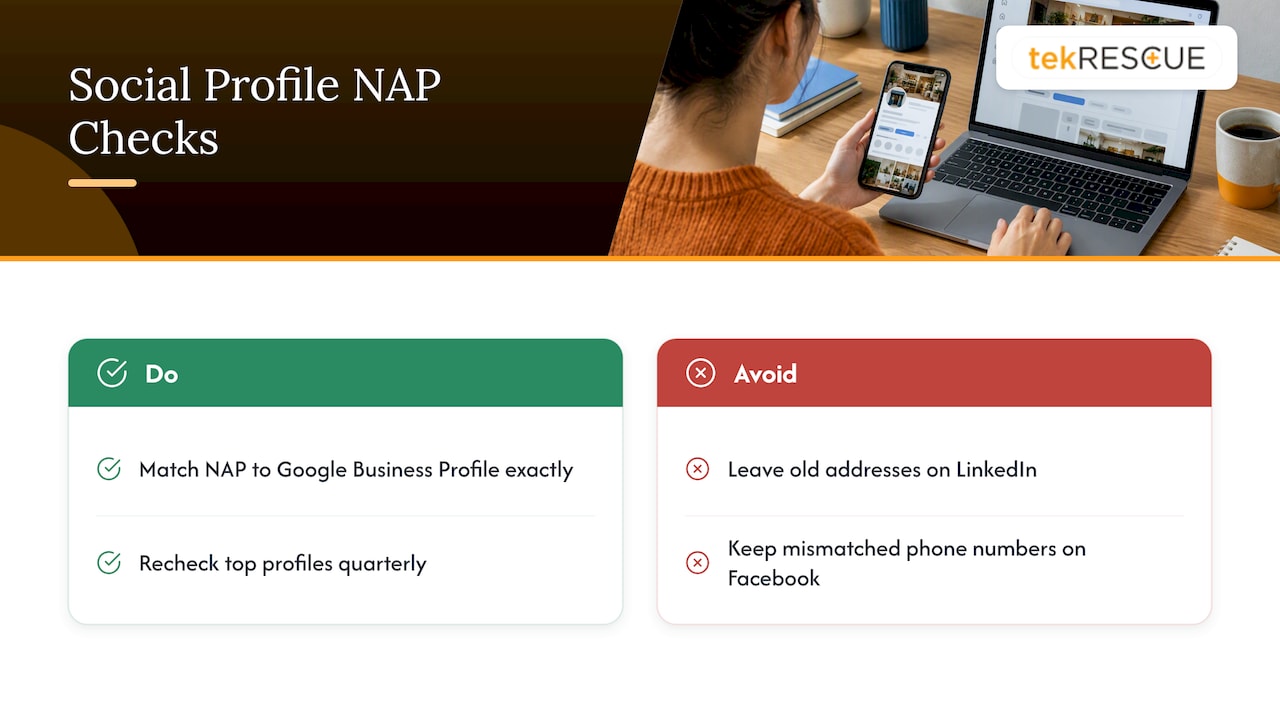
Your Facebook, Instagram, LinkedIn, and other social profiles are citations too, even though they rarely get treated that way. A mismatched phone number on Facebook or an old address still listed on LinkedIn sends the same confusing signal to search engines as an inconsistent directory listing.
Audit every social platform where your business has a presence and confirm the name, address, and phone number match your Google Business Profile exactly, down to abbreviations like “St.” versus “Street.” Update your bio or “About” section on each platform if you have moved, rebranded, or changed phone systems.
This matters more than it seems because social profiles often rank well in their own right for branded searches, meaning a customer searching your business name may land on your Facebook page before your website. If that page shows outdated contact information, you lose the customer before they ever reach your actual site.
Set a recurring reminder, quarterly is reasonable, to re-check your top three or four social profiles against your current business information. This takes a few minutes and closes a gap that otherwise sits unnoticed for years. Treat it as part of the same citation consistency work you do for directories, not a separate task, since the underlying goal, a single accurate version of your business identity everywhere it appears online, is identical.
Optimizing for voice search and mobile-local queries
Voice assistants and mobile search both favor the same thing: direct, conversational answers to specific local questions. Someone asking a smart speaker “where’s the nearest coffee shop open now” or typing “plumber near me” into their phone expects an immediate, accurate answer, and your content needs to be structured to supply one.
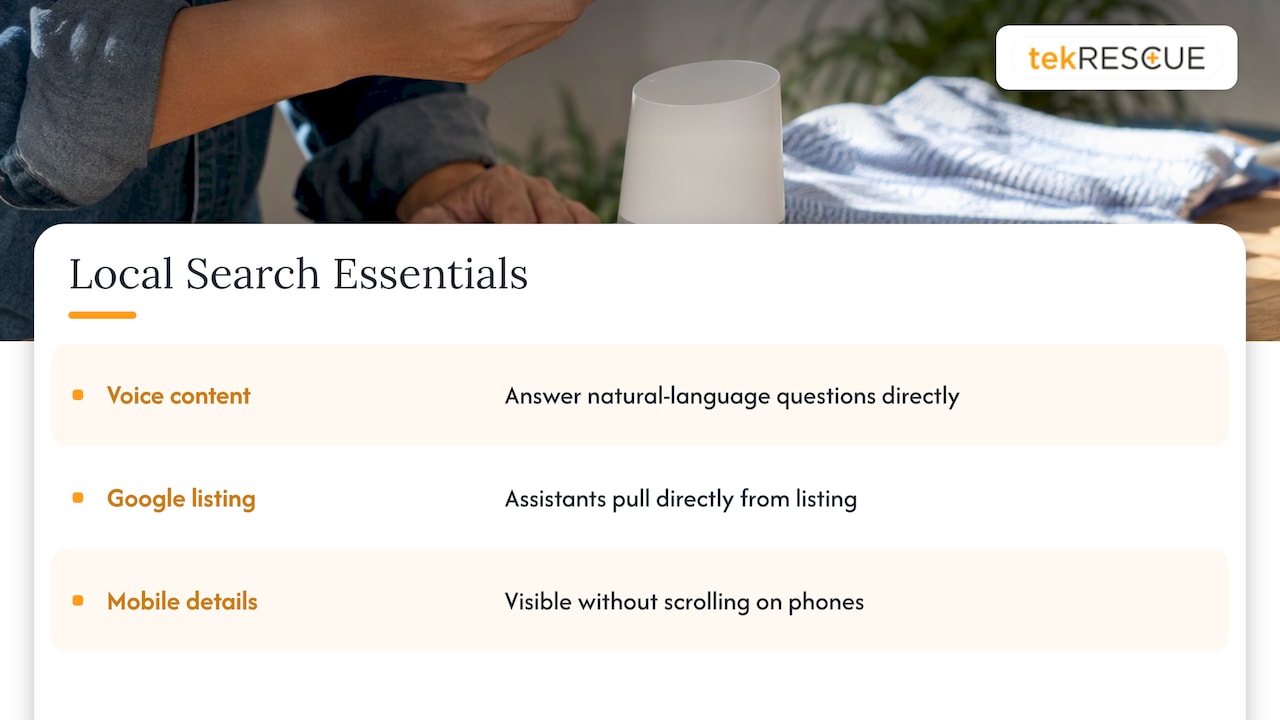
Write page content that answers natural-language questions directly, since voice queries tend to be longer and more conversational than typed searches. A heading like “What are your hours on Sunday?” followed by a direct answer serves both a voice assistant and a mobile searcher skimming quickly.
Accurate hours, address, and phone number on your Google Business Profile matter even more for voice search, since assistants typically pull directly from that listing rather than crawling your website. A single wrong digit in your phone number sends every voice-initiated call to a dead end.
Mobile page speed is non-negotiable here too. A mobile searcher looking for an open business right now will not wait for a slow page to load, and Google’s mobile-first indexing means a poor mobile experience hurts your ranking for everyone, not just mobile users. Keep your most important local information (hours, phone, address) visible without scrolling on a phone screen, since that is often the only thing a voice-triggered or mobile-local searcher actually needs.
Leveraging localized content marketing and blogging
A blog built around your actual service area gives you a steady supply of pages that target specific local questions your landing pages cannot cover on their own. A local landing page states what you do and where; a blog post can answer “how much does X cost in [your area]” or “what to expect during [a local seasonal issue]” in detail.
Write about topics your customers actually ask about: seasonal maintenance tied to your region’s climate, local regulations that affect your industry, or roundups of community events relevant to your business. A roofing company might cover how a region’s hail season affects shingle lifespan; a CPA firm might cover state-specific filing deadlines.
Mention your service area naturally throughout rather than forcing a city name into every sentence. Link blog posts back to the relevant local landing page, which both helps readers find your service pages and distributes relevance signals across your site.
Consistency matters more than volume. A monthly post addressing a real customer question outperforms a rushed weekly post with no clear audience. Each post is also a natural candidate for sharing on social media and in your review-request follow-ups, extending its reach beyond organic search alone.
Using local events and sponsorships for SEO benefit
Sponsoring a youth sports league, a charity run, or a town festival does more than build goodwill. It often earns a link from the event organizer’s website, a mention in local event listings, and sometimes local news coverage, all of which reinforce the prominence factor that Google’s local ranking guidance identifies as a core input alongside relevance and distance.
Look for events that already align with your customer base rather than sponsoring anything available. A pet grooming business sponsoring a dog adoption event reaches a more relevant audience than the same business sponsoring an unrelated golf tournament, and relevance affects how naturally the resulting coverage reads.
Request a link back to your site as part of any sponsorship agreement, since many organizers will include one on a sponsors page without being asked twice. Attend or host a booth when possible, since in-person presence often leads to photos, social media tags, and local press mentions that a check alone would not generate.
Track which sponsorships produce measurable links, mentions, or referral traffic so next year’s budget goes toward the events that actually move the needle rather than the ones that only felt good to support.
Monitoring competitors’ local SEO strategies
Watching what nearby competitors do well, and poorly, gives you a shortcut to opportunities you might otherwise miss. Search your core service terms plus your city and note which businesses consistently appear in the local map pack.
Check their Google Business Profile for category choices, the services they list, and how recently their photos were updated. A gap in their profile, such as missing services you offer or stale photos, is a gap you can fill better on your own listing.
Review their citation footprint on major directories to spot listings you have not claimed yet. If a competitor appears on an industry-specific directory you have overlooked, that is a quick addition to your own citation list.
Pay attention to their review volume and response pattern too. A competitor who ignores negative reviews or has a thin review count is vulnerable to a business that handles both better. This is not about copying a competitor’s content, which offers no real advantage, but about spotting structural gaps in their local presence that a more complete checklist on your end can close.
Integrating local SEO with paid local advertising campaigns
Organic local SEO and paid local ads work best as complements, not substitutes. Local Services Ads and geographically targeted search campaigns can fill the gap while your organic rankings build, especially for a newly verified profile or a recently launched local landing page.
Align your paid campaigns with the same local landing pages you built for organic traffic rather than sending paid clicks to a generic homepage. A searcher who clicks a geographically targeted ad expects the same specific, local relevance your organic page already delivers, and a mismatched landing experience wastes the click.
Use paid campaign data as a research shortcut for organic priorities. Search terms that convert well in paid campaigns are strong candidates for dedicated organic landing pages or blog content, since you already have performance data proving customer intent around them.
Keep your Google Business Profile and paid ads consistent on hours, service area, and offers. A paid ad promising same-day service that contradicts your profile’s listed hours creates the same kind of trust gap as inconsistent NAP data, just in a channel you are actively paying for.
What we actually prioritize first for small businesses
If you have a weekend and nothing else, do three things: verify your Google Business Profile, fix any NAP mismatch on your three most-visited directory listings, and send review requests to your last ten customers. None of these require a developer or a budget, and together they touch the three factors, relevance, distance, and prominence, that Google’s own ranking guidance names as the core of local search.
Healthcare practices, financial services, and other compliance-sensitive categories should treat profile claims and website content with extra care. Inaccurate service descriptions or improperly handled patient data can create liability well beyond a ranking problem, and that is a conversation worth having with a qualified provider before you publish.
— Randy Bryan
How tekRESCUE helps you work through this checklist
Most of this checklist is doable in-house, but the tasks compound fast once you are managing multiple locations, a service area spanning several towns, or a website that needs structured data and performance fixes a content team alone cannot handle. That is where we come in.
Our search engine optimization services cover Google Business Profile optimization, citation cleanup, and local landing page strategy end to end, so the sequence in this checklist becomes a managed project instead of a backlog. When your site itself needs rebuilding to support local landing pages, structured data, or faster load times, our website design and development team builds those foundations correctly the first time.
For healthcare practices, CPA firms, and other businesses handling sensitive client data, our cybersecurity and risk assessment services address the compliance side that a local SEO checklist alone cannot cover, including HIPAA-aware website and data handling practices.
If you would rather hand off the checklist than work through it line by line, request a local SEO audit and we will tell you exactly where your profile, site, and citations stand today.
FAQ
What is the most important task on a local SEO checklist?
Claiming and verifying your Google Business Profile comes first, since it determines whether you are even eligible to appear in local map results at all. Every other task, from on-page content to reviews, builds on that foundation.
How long does it take to see results from local SEO?
Results vary by competition and starting point, but profile verification and NAP fixes can affect visibility within weeks, while review growth and link building tend to compound over several months. Consistent monthly effort across the checklist produces steadier gains than a single burst of activity.
What is NAP consistency and why does it matter?
NAP stands for name, address, and phone number, and consistency means that information matches exactly across your website, Google Business Profile, directories, and social media. Mismatched NAP data can confuse search engines about which version is accurate, which Google’s local ranking guidance ties directly to how well a business matches a searcher’s query.
How do I report a fake or inappropriate Google review?
Use the flagging option on the specific review within your Google Business Profile and select the policy violation that applies. According to Google’s reporting process, reviewed removals that get denied can be appealed once more, and that appeal typically takes several days to resolve.
Does tekRESCUE offer local SEO services for small businesses?
Yes, our SEO services include Google Business Profile optimization, citation cleanup, and local landing page development for small and medium-sized businesses. Pricing is available on request based on the scope of work.
Sources
Recommended
Table of Contents