
90 Day AI Data Governance for SMBs: Audit Ready, Mapped to NIST ISO EU
AI data governance is the set of controls that determine what data feeds your AI systems, who can touch it, and how you prove that to a regulator or client later. It matters now because the EU AI Act, state privacy laws, and enterprise procurement teams are all asking the same question at once: show your evidence. The first move, before you write a single policy, is building a live inventory of every AI system and every data flow touching it, and producing two artifacts immediately: a model card and a system inventory.
TL;DR:
- Building a live inventory of all AI systems and data flows is essential before implementing policies, with model cards and system inventories as immediate outputs.
- Key controls include discovery and classification, access management, in-flight data protection, audit logging, and vendor lifecycle management, each critical for operational security.
- Frameworks like NIST, ISO/IEC 42001, and the EU AI Act should be mapped together to create a comprehensive, auditable evidence base tailored to specific regulatory requirements.
- A staged rollout of AI data governance over 90 days—starting with inventory, then classification and controls, followed by monitoring and vendor review—improves compliance and reduces risks.
- Continuous evidence generation through automation and employee training on policy changes ensures ongoing compliance and promotes adoption of governance best practices.
Table of Contents
Table of Contents
- Key Takeaways on AI Data Governance
- What Is AI Data Governance, and How Is It Different From AI Governance?
- The Core Operational Pillars Every Program Needs
- How Do NIST, ISO, and the EU AI Act Map to Your Controls?
- What Does a 90-Day AI Data Governance Rollout Look Like?
- Which Tools and Architecture Patterns Actually Work?
- Who Owns What: Building the RACI for AI Data Governance
- How Do You Prove Ongoing Compliance, Not Just a Point-in-Time Audit?
- How Do You Get Employees to Actually Follow the New Rules?
- How Does AI Data Governance Fit Into Your Existing Governance Structure?
- Publisher Perspective: A Practical Approach for Growing Businesses
- How tekrescue Helps You Build an AI Data Governance Program
- Sources
- FAQ
Key Takeaways on AI Data Governance
Before the deep dive, here is the operational shape of a working program:
- Five pillars carry the weight: discovery and classification, access and identity, in-flight protection, audit logging, and vendor/model lifecycle management.
- Three frameworks matter most: the NIST AI Risk Management Framework, ISO/IEC 42001, and the EU AI Act’s Article 10 data governance requirements.
- The biggest operational risk isn’t malicious misuse. It’s shadow AI: employees feeding sensitive data into unapproved tools with no logging and no owner.
- Auditors ask for the same three things first: model cards, training data provenance, and continuous monitoring logs, not a static compliance binder.
- Timing is not optional. Gartner has found that only 22% of organizations have successfully scaled AI across multiple business units, and governance gaps are a leading reason projects stall before they scale.
What Is AI Data Governance, and How Is It Different From AI Governance?

Data governance answers one question: what data goes in, what comes out, and who is allowed to touch it at each step. AI governance answers a different question: how does the model behave, and who is accountable when it behaves badly. They overlap, but they are not the same discipline, and conflating them is why so many governance programs stall in committee.
For most organizations that consume AI models rather than build them, data governance is the bigger lever. You don’t control how GPT-4 or Claude was trained. You do control whether your employees pasted a client’s protected health information into a public chatbot last Tuesday. That distinction should drive where you spend your first budget dollar.
Ownership typically splits three ways, with access controls and monitoring firmly rooted in security. Data governance and classification usually sit with a data or information governance team. Access controls and monitoring sit with security. Model selection, prompt engineering, and output validation sit with whatever function has emerged to own MLOps, sometimes IT, sometimes a dedicated AI team. If nobody in your organization can name who owns each of those three lanes, that gap is your actual starting risk, ahead of anything a vendor contract discloses.
The Core Operational Pillars Every Program Needs
Every credible AI data governance program rests on five pillars. Skip one, and you have a policy document, not a control system.
- Discovery and classification. You cannot govern data you cannot find. Classification has to work at two levels: file-level (is this document PII, PHI, or trade secret) and prompt-level (is a user about to paste regulated data into a chat window). Most legacy data loss prevention tools only catch the first. A minimal viable control here is tagging your three highest-risk data categories and deploying prompt-level scanning on whatever generative AI tools your teams actually use, sanctioned or not. Shadow AI use is a common gap seen in the field, and it’s usually invisible until someone runs a discovery scan.
- Access and identity. Every model connection, API key, and OAuth token needs an owner and an expiration. Least privilege applies to machines the same way it applies to people: a retrieval-augmented generation system should only query the document sets relevant to its function, not your entire file share.
- In-flight protection. This is redaction and masking applied at the moment data moves, not after the fact. Query-time redaction of Social Security numbers, account numbers, and health identifiers before they reach a model’s context window is the difference between a near-miss and a reportable incident.
- Audit and logging. Logs need to capture who queried what, which model responded, what data was retrieved, and what output was returned, retained long enough to satisfy your industry’s record-keeping rules. HIPAA-covered entities typically need years, not weeks.
- Vendor and model lifecycle management. Every model you use, whether licensed or open-source, needs a documented version, an update cadence, and a deprecation plan. Model swaps happen quietly. Your governance program can’t.
Pro Tip: Start your discovery phase by auditing browser extensions and approved SaaS tools for AI features quietly turned on by default. Most shadow AI exposure comes from features nobody remembers enabling, not from someone deliberately breaking policy.
How Do NIST, ISO, and the EU AI Act Map to Your Controls?
You don’t need to pick one framework and ignore the rest. The practical move is building evidence categories once, then mapping them to whichever framework a given customer, regulator, or auditor asks about.
The NIST AI Risk Management Framework organizes everything around four functions: Govern, Map, Measure, and Manage. That vocabulary has become something close to a lingua franca among US auditors and examiners, which makes it the natural backbone for your internal control matrix even if you never seek formal certification against it.
ISO/IEC 42001 takes a different path: it’s a certifiable management-system standard, and unlike NIST’s voluntary framework, an external body can audit you against it. The standard places the data lifecycle at the center of its requirements, with clauses covering documentation and lifecycle controls that closely track the AI RMF’s own knowledge base guidance. If you sell into procurement-driven enterprise markets, expect ISO 42001 certification to show up as a vendor questionnaire requirement sooner than you’d like.
The EU AI Act’s Article 10 imposes specific data governance obligations on high-risk AI systems: training, validation, and testing datasets must be relevant, representative, and examined for bias. The extraterritorial trigger matters here. If your AI system’s output is used in the EU, the Act can reach you regardless of where your servers sit.
For US organizations, the regulatory picture is still shifting at the federal level. Federal statute already directs the development of dataset documentation standards and privacy and security guidance for trustworthy AI systems, and a December 2025 executive order established a federal effort to evaluate state AI laws through a new AI Litigation Task Force, aiming at more uniform national policy. Until that settles, build to the evidence categories NIST and ISO already define, then map state-by-state as specific rules solidify.
What Does a 90-Day AI Data Governance Rollout Look Like?
A staged rollout beats a big-bang deployment every time, because you cannot classify what you have not found, and you cannot control what you have not classified. Here is a sequence that works across mid-market and enterprise organizations alike.
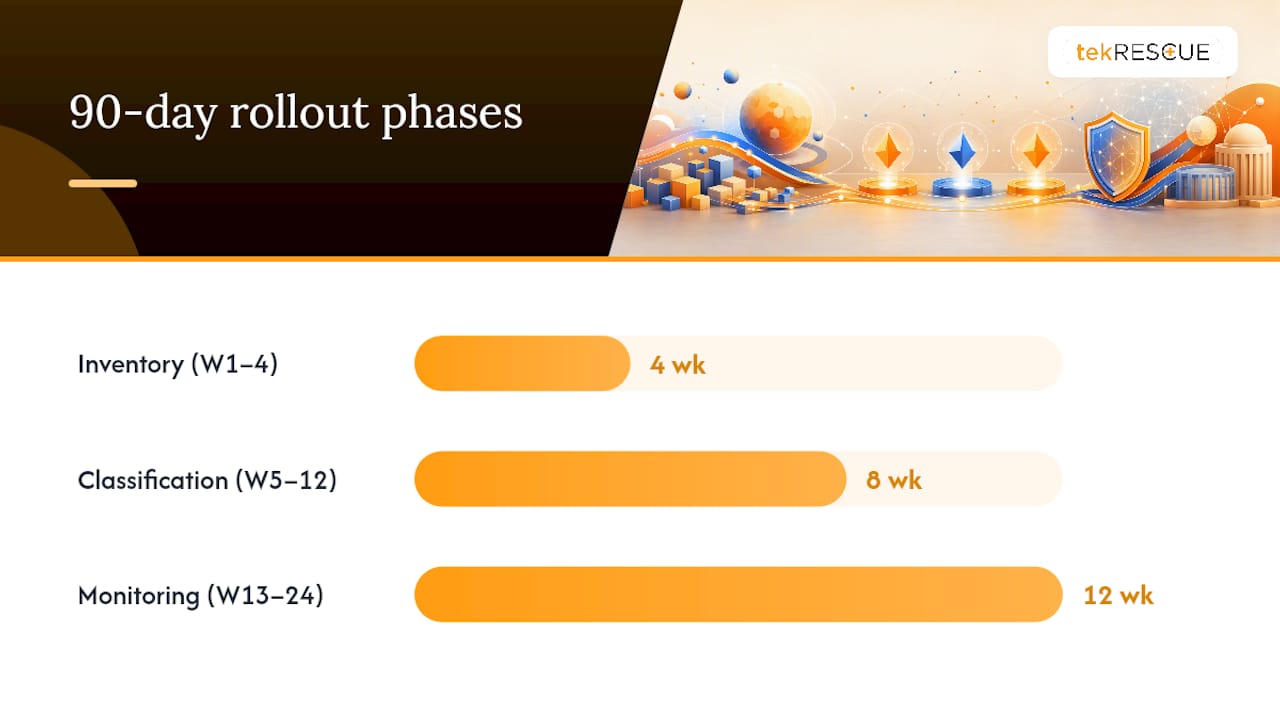
- Weeks 1 to 4: Inventory. Catalog every AI system in use, sanctioned and unsanctioned, every data source feeding it, and every vendor contract governing it. Output: a living system inventory and a first-pass shadow AI report.
- Weeks 5 to 12: Classification and controls. Tag your data by sensitivity tier, deploy prompt-level and file-level classification, and stand up baseline access controls and in-flight redaction on your top two or three risk categories. Output: a control matrix mapped to NIST’s four functions, plus your first model cards for production systems.
- Weeks 13 to 24: Monitoring and vendor governance. Turn on continuous logging, establish drift and bias monitoring cadences, and formalize vendor review cycles tied to contract renewal dates. Output: a unified AI audit log and a vendor lifecycle registry.
Risk tiering should drive how much rigor each system gets. A low-risk internal tool summarizing meeting notes needs a lightweight model card and basic logging. A high-risk system touching health records or credit decisions needs a full artifact set: model card, training data description, bias testing results, a documented human review step, and audit-grade logs retained per your industry’s record rules.

Pro Tip: Treat your model card as a living document, not a one-time deliverable. Auditors increasingly ask when it was last updated, not just whether one exists.
Practitioner analysis of enterprise rollouts consistently points to the same lesson: auditors want continuous, system-generated evidence, not a manually assembled dossier built the week before a review. Build your logging and documentation to generate that evidence automatically from day one, and the audit stops being an event and becomes a report you already have.
Which Tools and Architecture Patterns Actually Work?
The architecture debate usually comes down to one choice: a centralized data catalog with AI-aware controls layered on top, or federated query-time enforcement where each system checks permissions at the moment of the request.
Centralized cataloging works well when your data estate is consolidated and your AI use cases are moderate in number. It gives you one place to see classification, lineage, and access rules. Federated query-time enforcement fits organizations with sprawling, decentralized data sources, where forcing everything through a central catalog first would slow deployment to a crawl.
- Prompt redaction strips sensitive fields before a query reaches a model’s context window.
- Retrieval-scope limits confine a retrieval-augmented generation system to only the document sets it needs, never your full repository.
- Output scanning catches sensitive data that slipped through on the way back out, a second checkpoint most programs skip until after an incident.
Vendor platforms increasingly bundle these capabilities together. Microsoft’s approach to modern data governance unifies cataloging, protection, and AI-enabled enforcement into a single layer rather than three disconnected tools, which is the direction most enterprise platforms are heading.
Whatever architecture you choose, your logs need to feed somewhere useful. Integration with SIEM and GRC platforms turns raw access logs into evidence a compliance officer can actually query during a review, rather than a folder of files someone has to parse by hand. If your organization already runs a security operations function, extending its threat detection scope to cover AI query patterns is usually faster than building a parallel monitoring stack from scratch.
Who Owns What: Building the RACI for AI Data Governance
Governance fails quietly when everyone assumes someone else owns the decision. A basic RACI structure closes that gap fast.
- Data stewards own classification accuracy and data quality for the sets feeding AI systems.
- Model owners are accountable for a specific system’s behavior, performance, and update cadence.
- Security owns access controls, in-flight protection, and incident response for AI-related events.
- An AI governance committee, usually cross-functional, approves production releases and reviews incidents.
No system should reach production without three things signed off: a completed model card, a documented risk tier, and evidence that classification and access controls are active. When an incident occurs, whether it’s a redaction failure or a biased output, that finding routes back into the same GRC workflow your security incidents already use. Treating AI incidents as a separate reporting track is how they get lost.
How Do You Prove Ongoing Compliance, Not Just a Point-in-Time Audit?
Bias testing needs a cadence, not a one-time check before launch. Quarterly testing against your highest-risk models is a reasonable baseline, with more frequent checks for systems making decisions about people, like hiring or credit. Drift detection watches for shifts in input data patterns or output distributions that signal a model is behaving differently than it did at validation, and it should trigger an alert, not wait for someone to notice a complaint.

Metrics that hold up under audit scrutiny include classification coverage rate, number of redactions triggered per period, and time-to-remediation on flagged incidents. Practitioner guidance on scaled AI adoption reinforces this pattern: organizations that fail to move past pilot stage almost always lack the automated evidence generation that turns these metrics into a standing report instead of a quarterly scramble.
How Do You Get Employees to Actually Follow the New Rules?
Policy without training is theater. Most AI data governance programs fail at adoption, not design, because employees keep using the tools that got the job done yesterday, sanctioned or not.
Start with a short, mandatory training module explaining what’s now classified, what’s now logged, and why. Skip the lecture on AI ethics in the abstract. Show people the specific prompt that would have triggered a redaction last month and explain what happened instead. Concrete near-misses land better than hypothetical risk.
Change management works best staged alongside your rollout, not bolted on afterward. During the inventory phase, communicate that a discovery scan is underway and why, so it doesn’t read as surveillance. During classification and controls, train teams on the specific tools now flagged or restricted, and give them an approved alternative in the same breath you take one away. Nobody adopts a new rule that just removes their fastest option without replacing it.
Assign champions inside high-usage departments, marketing, legal, customer support, wherever generative AI adoption has run ahead of policy. These champions catch friction points before they become workarounds. Track adoption the same way you track any other control: what percentage of flagged tools have an approved alternative in place, how many employees completed training, how many policy violations dropped quarter over quarter. A governance program that can’t show adoption metrics alongside technical metrics will struggle to justify its budget at renewal time.
How Does AI Data Governance Fit Into Your Existing Governance Structure?
AI data governance is not a parallel universe. It should extend your existing enterprise data governance program, not duplicate it with a separate committee, separate policies, and separate tooling that nobody reconciles.
If you already have a data governance council, add AI-specific data flows to its existing charter rather than spinning one up. The classification taxonomy you use for AI training data should be the same taxonomy your broader data governance program already applies to structured and unstructured data elsewhere in the business. Divergent taxonomies are how organizations end up with two conflicting answers to “is this dataset sensitive.”
At the corporate governance level, AI data risk belongs on the same risk register your board or audit committee already reviews, not in a standalone AI appendix nobody reads until something breaks. Tie AI incident reporting into whatever enterprise risk management process already escalates security and compliance incidents. The organizations that handle this well treat AI as a new risk category inside an existing structure. The ones that struggle build a separate AI governance silo that competes with data governance and security for the same budget and the same people.
Publisher Perspective: A Practical Approach for Growing Businesses
Full enterprise replatforming is out of reach for most small and mid-sized organizations, and honestly, it’s overkill. A risk-tiered approach, inventory your highest-exposure systems first, gets you real protection faster than a comprehensive program that takes eighteen months to design. Certain cybersecurity and managed IT teams support exactly these stages: discovery, classification, in-flight protection, and the logging infrastructure that turns compliance into an ongoing report rather than a fire drill.
— Randy Bryan
How tekrescue Helps You Build an AI Data Governance Program
Most SMB leaders don’t need a 40-person governance office. They need a partner who can run the inventory, stand up the controls, and keep the logs auditable without adding headcount. tekrescue’s Strategic AI Consulting service is built for exactly that gap: an assessment engagement that maps your current AI and data footprint against NIST and ISO expectations, then hands you a prioritized roadmap instead of a generic checklist.
From there, the pieces connect. Cybersecurity Services cover the access controls, in-flight protection, and incident response your governance program depends on, while Managed IT Services can host and operationalize the continuous monitoring and logging that turns an audit into a report you already have on file. tekrescue’s background in HIPAA and FTC Safeguards Rule compliance means the same rigor already applied to healthcare and financial clients extends naturally to AI data handling. If your organization is still trying to figure out what AI tools your teams are actually using, start with an assessment conversation rather than a policy document nobody will read.
Sources
For deeper reference: the NIST AI Risk Management Framework, ISO/IEC 42001, and 15 U.S. Code § 278h-1 on AI standards development.
- 15 U.S. Code § 278h-1 — Standards for artificial intelligence
- Executive Order on Eliminating State-Law Obstruction of National Artificial Intelligence Policy (Dec 2025)
- NIST AI Risk Management Framework
- Introducing modern data governance for the era of AI – Microsoft Azure
FAQ
What Is AI Data Governance?
AI data governance is the set of policies and controls determining what data feeds AI systems, who can access it, and how that activity gets logged and proven to auditors. It differs from AI governance, which focuses on model behavior and output accountability rather than data flow.
How Is AI Data Governance Different From Traditional Data Governance?
Traditional data governance manages data quality and access across an organization broadly. AI data governance adds AI-specific concerns: prompt-level classification, in-flight redaction before data reaches a model, and audit logs covering what a model retrieved and returned.
What Documents Do Auditors Ask for First?
Auditors most commonly request model cards, training data descriptions, and continuous monitoring logs before anything else, according to practitioner analysis of AI audits. A static compliance binder assembled after the fact rarely satisfies that request.
Does tekrescue Offer AI Data Governance Consulting?
Yes. tekrescue’s Strategic AI Consulting service maps your existing AI and data footprint against NIST and ISO frameworks and builds a prioritized implementation roadmap. Pricing is available on request through the service page.
Which Regulatory Framework Should a US Company Follow First?
Start by building evidence categories against the NIST AI Risk Management Framework, since its Govern, Map, Measure, Manage vocabulary is widely recognized by US auditors. Then map those same evidence categories to state laws or the EU AI Act’s Article 10 requirements as they apply to your specific operations.
Recommended
Table of Contents